
The Cell Cycle
Every time you scrape your knee, your body launches a construction project. Cells around the wound start duplicating themselves to patch the gap. But a cell cannot just split in half whenever it feels like it. It has to copy all 6 billion base pairs of DNA, duplicate its organelles, stockpile enough energy and raw materials, and verify everything is correct - all before it divides. That preparation process is the cell cycle.
The Big Picture
The cell cycle has two main parts:
- Interphase - the long “preparation” period (G1 + S + G2). The cell spends about 90% of its life here.
- M phase (Mitotic phase) - the actual division. This is the shortest part.
Most students make the mistake of thinking “cell division” is the whole cycle. It is not. Division is the grand finale. The bulk of the work happens in interphase.
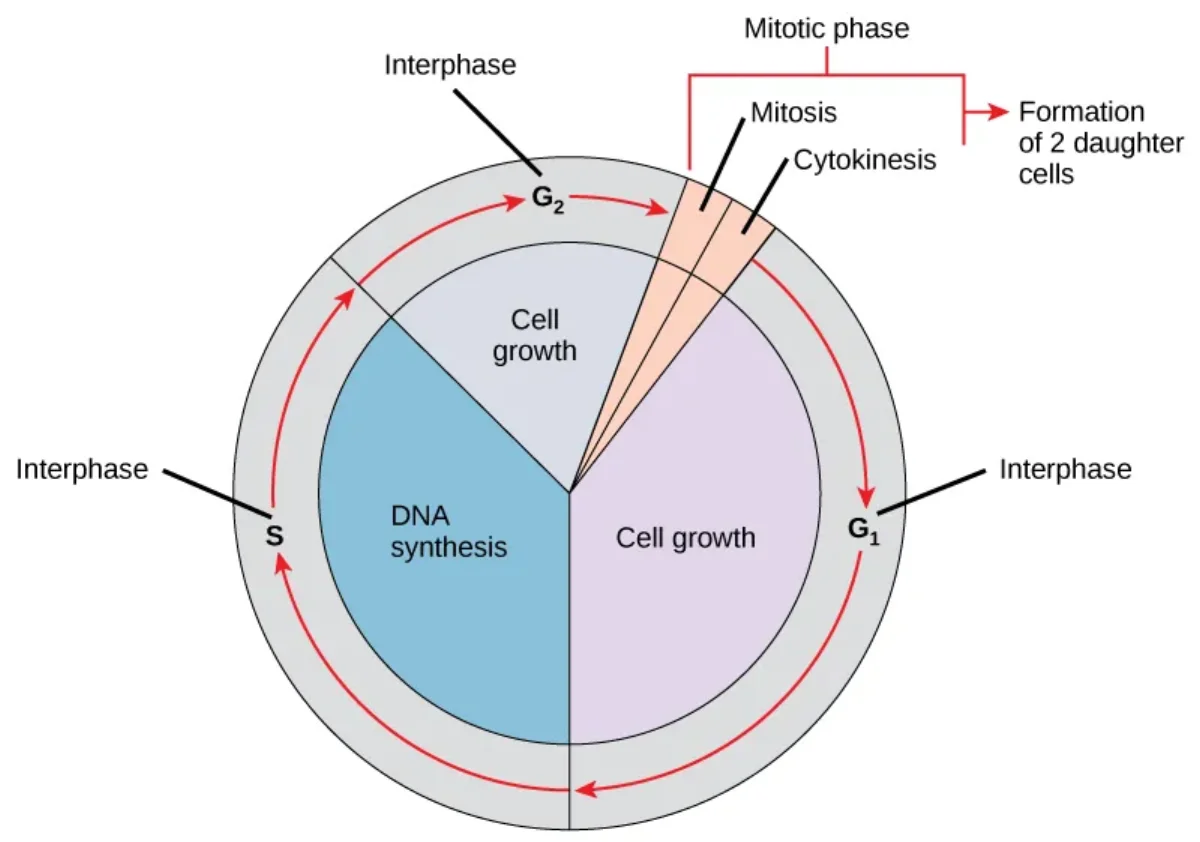
G1 Phase (First Gap) - “Get Ready”
G1 is the cell’s growth phase. The cell:
- Increases in size
- Synthesizes proteins and ribosomes
- Produces the building blocks (nucleotides) it will need to copy its DNA
- Accumulates energy reserves (ATP)
This is also when the cell receives external signals (growth factors) telling it whether to proceed with division or stop. If the cell does not receive the right signals, or if conditions are unfavorable, it can exit the cycle and enter G0.
G1 is the longest and most variable phase. Fast-dividing cells (like gut epithelium) blow through G1 quickly. Slow-dividing cells (like liver cells) linger in G1 for a long time.
S Phase (Synthesis) - “Copy the Blueprint”
This is when DNA replication occurs. Every chromosome in the nucleus is duplicated, producing two identical copies called sister chromatids, joined at a structure called the centromere.
Before S phase: 46 chromosomes, each made of 1 chromatid.
After S phase: still 46 chromosomes, but each now made of 2 sister chromatids (92 chromatids total).
The centrosome (the cell’s microtubule organizing center) also duplicates during S phase.
G2 Phase (Second Gap) - “Final Check”
G2 is the final preparation before division. The cell:
- Continues to grow and produce proteins
- Synthesizes proteins specifically needed for mitosis (like tubulin for the mitotic spindle)
- Checks that DNA replication in S phase was completed accurately
- Verifies there is no DNA damage
If errors are detected, the cell pauses here to repair them before committing to division.
M Phase (Mitosis) - “Divide”
The cell physically splits into two daughter cells. This involves:
- Mitosis - division of the nucleus (covered in detail in Section 2.2)
- Cytokinesis - division of the cytoplasm
G0 Phase - “Off the Clock”
Not every cell is constantly dividing. Cells that have exited the cell cycle enter G0, a quiescent (resting) state. G0 cells are alive and metabolically active - they are just not preparing to divide.
Some cells enter G0 temporarily and can be called back into the cycle by the right signals:
- Liver cells (hepatocytes) - normally in G0, but re-enter the cycle if the liver is damaged
- Lymphocytes - re-enter the cycle when activated by an antigen
Other cells enter G0 permanently and never divide again:
- Neurons - once mature, they do not divide (this is why brain damage is often irreversible)
- Cardiac muscle cells (cardiomyocytes) - heart cells cannot regenerate after a heart attack, which is why damaged heart tissue is replaced by scar tissue
Chromosome Counting Across the Cell Cycle
This table is critical for the MCAT. Know these numbers cold:
| Phase | Chromosomes | Chromatids | DNA Content | Ploidy |
|---|---|---|---|---|
| G1 | 46 | 46 | 2n | Diploid |
| After S phase | 46 | 92 | 4n | Diploid |
| After G2 | 46 | 92 | 4n | Diploid |
| After Mitosis | 46 | 46 | 2n | Diploid |
| After Meiosis I | 23 | 46 | 2n | Haploid |
| After Meiosis II | 23 | 23 | n | Haploid |