
Hormonal Control
The reproductive system runs on a chain of command that starts in the brain and ends in the gonads. If you understand this hierarchy - who gives the orders, who carries them out, and who reports back - you can answer almost any MCAT question about reproductive hormones.
The HPG Axis
The hypothalamic-pituitary-gonadal (HPG) axis is the master control system for reproduction in both males and females:
- Hypothalamus releases GnRH (gonadotropin-releasing hormone) in pulsatile bursts.
- Anterior pituitary responds to GnRH by releasing FSH (follicle-stimulating hormone) and LH (luteinizing hormone).
- Gonads respond to FSH and LH by producing sex hormones and gametes.
- Sex hormones feed back to the hypothalamus and pituitary to regulate the system.
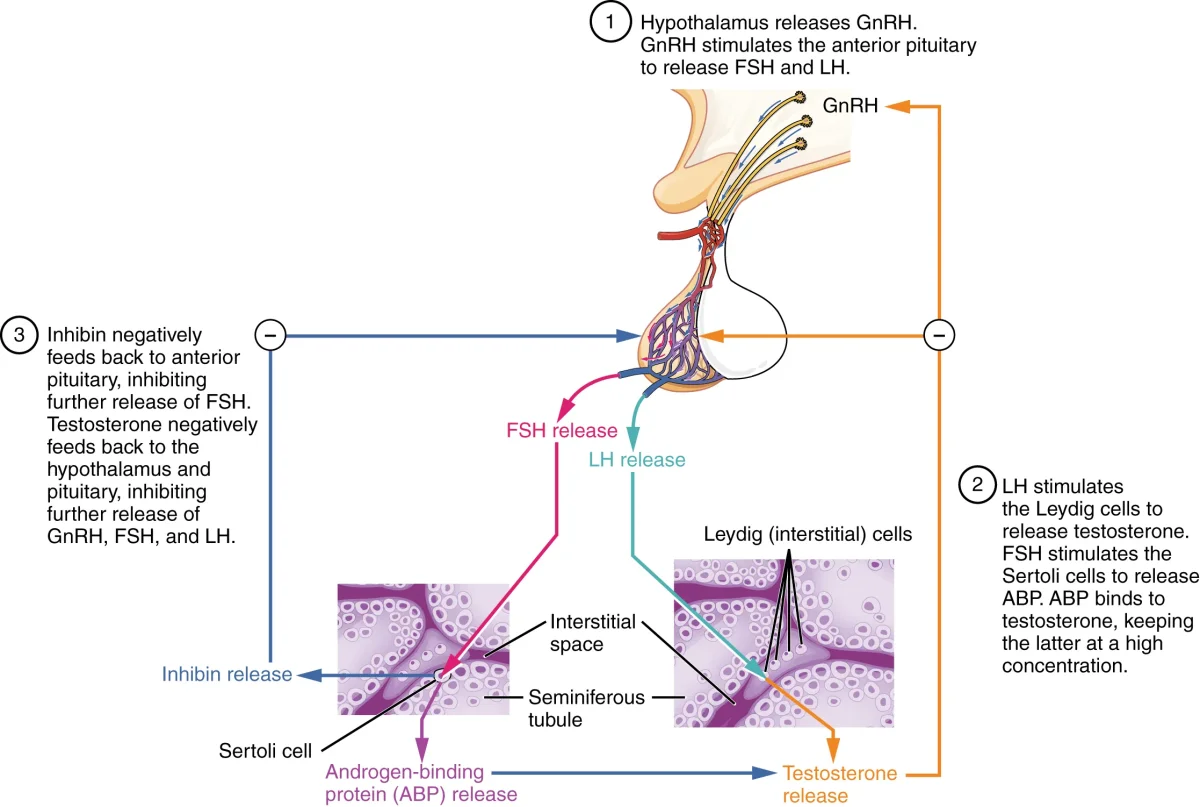
HPG Axis in Males
| Hormone | Source | Target | Action |
|---|---|---|---|
| GnRH | Hypothalamus | Anterior pituitary | Stimulates FSH and LH release |
| FSH | Anterior pituitary | Sertoli cells | Supports spermatogenesis, stimulates ABP production |
| LH | Anterior pituitary | Leydig cells | Stimulates testosterone production |
| Testosterone | Leydig cells | Whole body + hypothalamus/pituitary | Male development, secondary sex characteristics; negative feedback on GnRH and LH |
| Inhibin | Sertoli cells | Anterior pituitary | Negative feedback specifically on FSH |
| DHT | Target tissues (from testosterone) | External genitalia, prostate, hair follicles | More potent androgen for specific targets |
The male system is relatively straightforward: it is a simple negative feedback loop. Testosterone and inhibin keep GnRH, LH, and FSH in check. There is no positive feedback in the male system.
HPG Axis in Females
The female system is more complex because it involves cycling hormone levels and a switch between negative and positive feedback.
| Hormone | Source | Target | Action |
|---|---|---|---|
| GnRH | Hypothalamus | Anterior pituitary | Stimulates FSH and LH release |
| FSH | Anterior pituitary | Granulosa cells | Stimulates follicle growth and estrogen production |
| LH | Anterior pituitary | Theca cells, corpus luteum | Stimulates androgen production (theca), triggers ovulation, maintains corpus luteum |
| Estrogen | Granulosa cells | Whole body + hypothalamus/pituitary | Female development, endometrial growth; negative feedback at low levels, POSITIVE feedback at high levels (triggers LH surge) |
| Progesterone | Corpus luteum (then placenta) | Uterus + hypothalamus/pituitary | Maintains endometrium, negative feedback on GnRH/LH/FSH |
| Inhibin | Granulosa cells | Anterior pituitary | Negative feedback on FSH |
| hCG | Embryonic trophoblast/placenta | Corpus luteum | Maintains corpus luteum during early pregnancy |
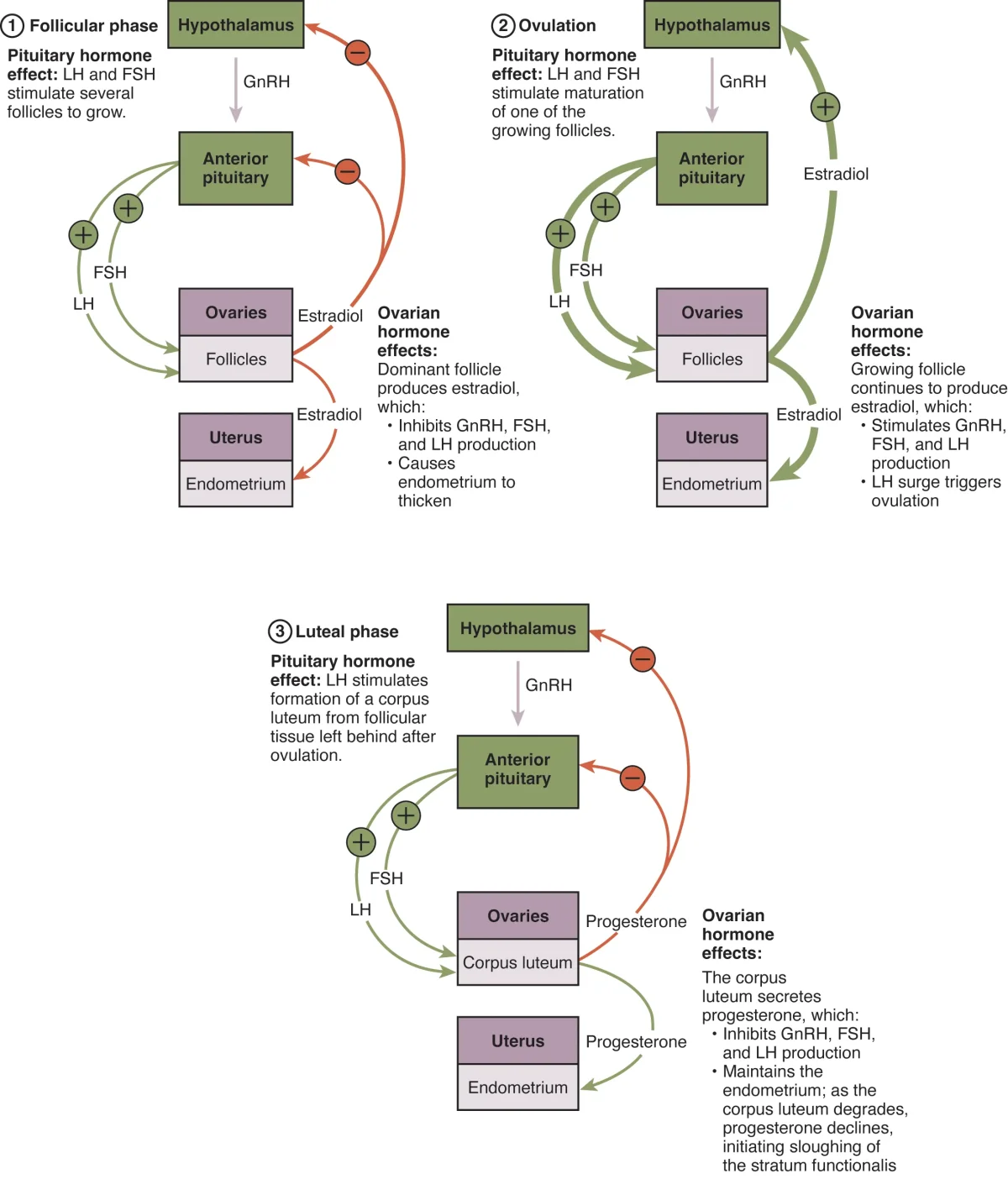
The Estrogen Feedback Switch
This is the single most important concept in reproductive endocrinology:
- Low to moderate estrogen → negative feedback → suppresses GnRH, FSH, and LH
- Sustained high estrogen (from the dominant follicle in late follicular phase) → positive feedback → stimulates a surge of GnRH and LH → triggers ovulation
After ovulation, the corpus luteum produces progesterone, which exerts strong negative feedback, preventing another LH surge and another ovulation for the rest of the cycle.
Estrogen Cooperation: Theca and Granulosa Cells
Estrogen production in the ovary requires teamwork between two cell types:
- Theca cells (outer layer of the follicle) - stimulated by LH to produce androgens (androstenedione)
- Granulosa cells (inner layer) - stimulated by FSH, they express the enzyme aromatase, which converts the androgens into estrogen
This is called the two-cell, two-gonadotropin model. Neither cell type can make estrogen alone - theca cells make the precursor, granulosa cells convert it.
Puberty
Puberty is triggered by activation of the HPG axis - the hypothalamus begins pulsatile GnRH secretion that was suppressed during childhood. Rising sex hormones then drive secondary sex characteristics.
- Males (testosterone): testis/penis growth, spermatogenesis, deeper voice, facial and body hair, muscle mass, growth spurt.
- Females (estrogen): breast development (thelarche, usually first), widened hips, body fat redistribution, menarche, growth spurt.
Both testosterone and estrogen ultimately cause fusion of the epiphyseal (growth) plates, ending height growth. Children who enter puberty early tend to be shorter as adults because their plates close sooner.
Hormonal Contraception as a Feedback Demonstration
The main MCAT point about contraception is that it exploits negative feedback. Combined oral contraceptives (synthetic estrogen + progestin) hold estrogen and progesterone steadily high, which suppresses GnRH, FSH, and LH. Without the FSH rise and LH surge, follicle development and ovulation cannot occur.
The body essentially “thinks” it is already in the luteal phase or pregnant. This is the same mechanism the corpus luteum uses to prevent a second ovulation within one cycle.
Menopause
As a woman ages, her ovaries run out of viable follicles and stop responding to FSH and LH. Estrogen and progesterone fall, and follicle development ceases. Menopause typically occurs between ages 45 and 55.
The MCAT-testable signature is a paired hormone shift:
- Estrogen and progesterone drop because the ovaries no longer produce functional follicles or corpora lutea.
- FSH and LH rise sharply because their negative feedback has been removed. The pituitary keeps shouting at ovaries that cannot answer.
Elevated FSH is the clinical marker used to confirm menopause. Secondary effects include endometrial atrophy, loss of bone density (estrogen normally supports bone), and vasomotor symptoms like hot flashes.
hCG - The LH Mimic
hCG (human chorionic gonadotropin) is secreted by the trophoblast once the blastocyst implants. Structurally it looks like LH, so it binds the LH receptor on the corpus luteum and keeps it producing progesterone past its normal 12-day lifespan. That sustained progesterone prevents menstruation and protects the embryo.
After ~10-12 weeks, the placenta takes over progesterone production and hCG declines. hCG in urine or blood is the molecule detected by pregnancy tests.
Key Hormone Summary
| Hormone | Primary Source | Key Functions |
|---|---|---|
| GnRH | Hypothalamus | Stimulates FSH and LH release; pulsatile secretion |
| FSH | Anterior pituitary | Follicle growth (females), spermatogenesis support (males) |
| LH | Anterior pituitary | Ovulation trigger, corpus luteum formation (females); testosterone production (males) |
| Estrogen | Granulosa cells, corpus luteum, placenta | Female development, endometrial growth, positive/negative feedback |
| Progesterone | Corpus luteum, placenta | Endometrial maintenance, negative feedback, pregnancy support |
| Testosterone | Leydig cells, adrenal cortex | Male development, spermatogenesis, secondary sex characteristics |
| Inhibin | Sertoli cells (males), granulosa cells (females) | Negative feedback specifically on FSH |
| hCG | Trophoblast/placenta | Maintains corpus luteum in early pregnancy |