
Eukaryotic vs. Prokaryotic
All living organisms (viruses excluded, since they are not alive) fall into one of two cell types: eukaryotic or prokaryotic. The names tell you the key difference if you know a bit of Greek.
- Eu- means “true.” Karyon means “kernel” (nucleus). Eukaryotic cells have a true nucleus - their DNA is enclosed in a membrane-bound compartment.
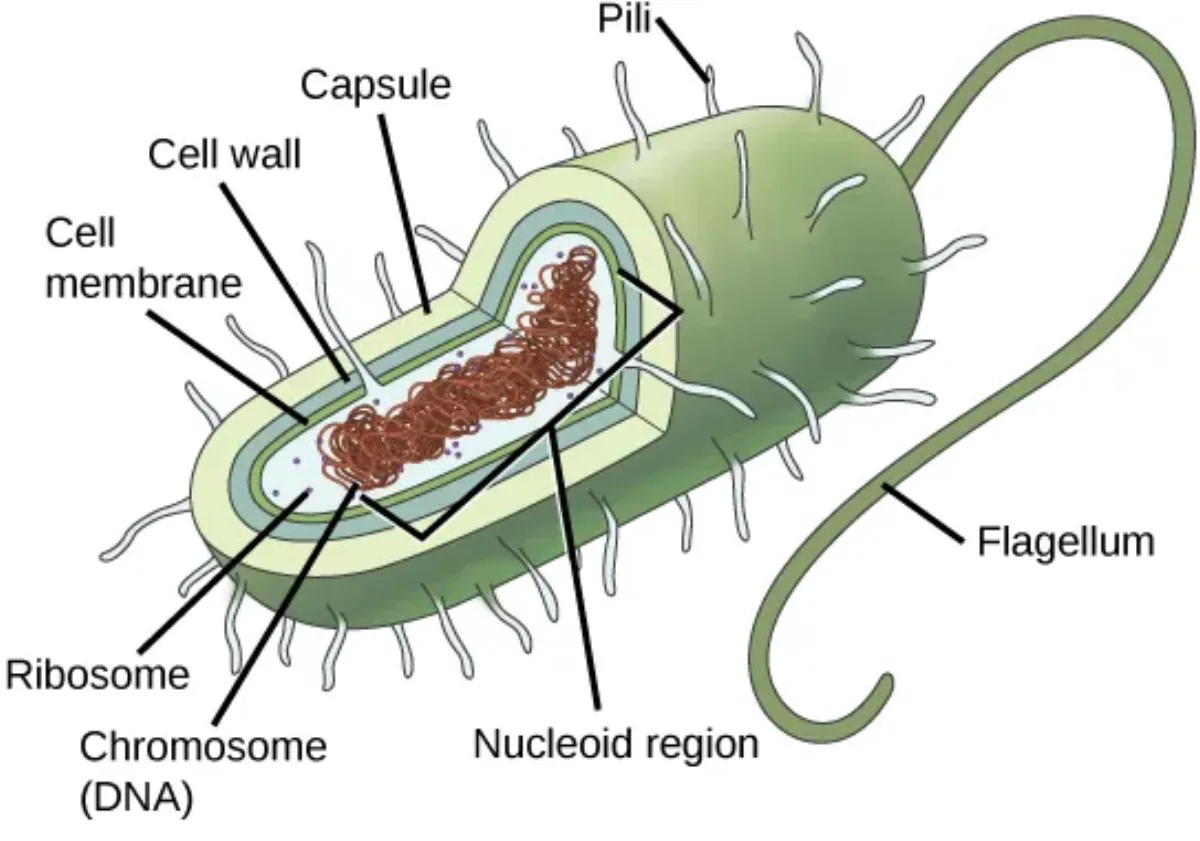
- Pro- means “before.” Prokaryotic cells came before eukaryotes in evolutionary history. They are simpler - no true nucleus, no membrane-bound organelles. Their DNA floats freely in a region called the nucleoid.
The Three Domains of Life
When we classify living organisms, they are grouped into three domains: Archaea, Bacteria, and Eukarya. Two of these domains (Archaea and Bacteria) are prokaryotic; one (Eukarya) is eukaryotic.
| Feature | Bacteria | Archaea | Eukarya |
|---|---|---|---|
| Cell type | Prokaryotic | Prokaryotic | Eukaryotic |
| Nucleus / membrane-bound organelles | No | No | Yes |
| DNA shape | Circular | Circular | Linear chromosomes |
| Ribosomes | 70S | 70S | 80S |
| Cell wall | Peptidoglycan | No peptidoglycan | Cellulose (plants), chitin (fungi), none (animals) |
| Histones | No | Yes | Yes |
| Initiation amino acid | Formylmethionine (fMet) | Methionine | Methionine |
| Reproduction | Binary fission | Binary fission | Mitosis / meiosis |
Why Eukaryotic Cells Have Organelles: Endosymbiotic Theory
Eukaryotic cells are not just “prokaryotes plus a nucleus.” They are prokaryotes that ate other prokaryotes and kept them as internal tenants. The endosymbiotic theory proposes that mitochondria (and, in plants, chloroplasts) are the descendants of free-living prokaryotes that were engulfed by a larger host cell billions of years ago.
Evidence: mitochondria have their own circular DNA, their own 70S ribosomes, a double membrane, and they divide by binary fission. We cover this in depth in Mitochondria.
Archaea in One Minute
Archaea look like bacteria (unicellular, no nucleus, circular DNA) but their molecular machinery resembles eukaryotes. The three features the MCAT wants you to know:
- Histones package Archaeal DNA (bacteria lack histones).
- Methionine starts translation (bacteria use formylmethionine).
- Archaeal RNA polymerases resemble the eukaryotic enzymes.
Many Archaea are extremophiles (hot springs, salt lakes, deep-sea vents) and most are chemosynthetic, pulling energy from inorganic reactions rather than sunlight.