
Viruses
Remember the city analogy? A virus is like a carjacker who does not know how to build a car. It has a set of instructions (its genetic material) and maybe a disguise (envelope), but it has absolutely no engine, no factory, no workers.
To reproduce, it must break into your car (cell), hijack the steering wheel (ribosomes and enzymes), and use your gas (ATP and nucleotides) to build copies of itself. When the car is full of copies, it either explodes (lytic cycle) or the virus hides its instructions in your glove compartment and waits (lysogenic cycle).
Viral Structure
Viruses are tiny - ranging from 20 nm to 300 nm, far smaller than even the smallest bacterium (1-10 micrometers). Despite their simplicity, they are incredibly effective at what they do.
Core components:
- Genetic material - either DNA or RNA (never both). Can be single-stranded or double-stranded, linear or circular.
- Capsid - a protein shell made of subunits called capsomeres that surrounds and protects the genetic material. Capsids can be helical (spiral), icosahedral (20-sided polyhedron), or complex (like bacteriophages with heads, tails, and tail fibers).
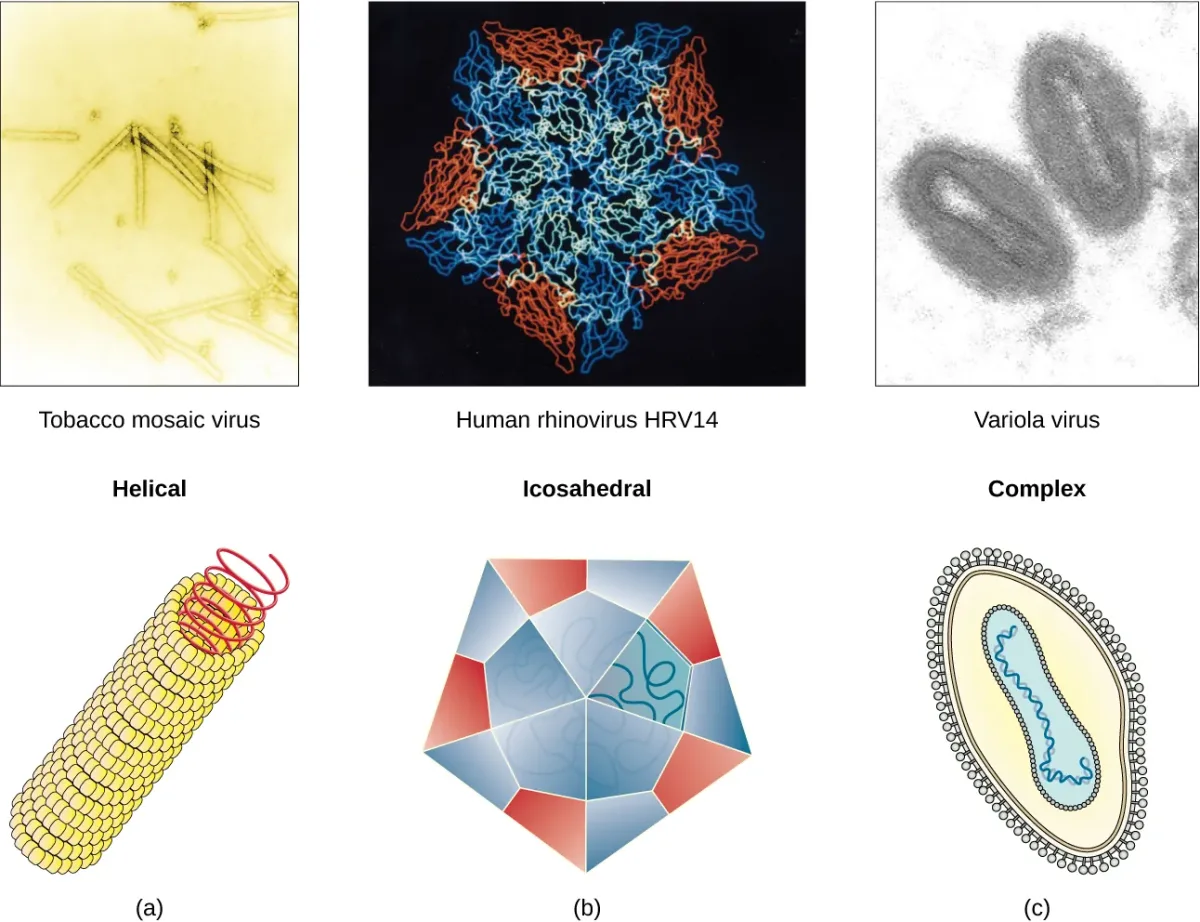
- Envelope (some viruses) - a lipid bilayer membrane stolen from the host cell during budding. Contains viral glycoproteins used for attachment to host cells.
- Naked viruses - lack an envelope. They are generally more resistant to environmental conditions (heat, detergents, desiccation) than enveloped viruses because they do not have a fragile lipid membrane.
Bacteriophage structure (viruses that infect bacteria):
- Head (icosahedral capsid containing DNA)
- Tail sheath - a contractile tube that injects DNA into the host bacterium, like a molecular syringe
- Base plate and tail fibers - structures that recognize and attach to specific receptors on the bacterial surface
Viral Classification by Genome
| Type | Genome | Example | Key Feature |
|---|---|---|---|
| dsDNA virus | Double-stranded DNA | Herpes simplex virus (HSV), Adenovirus | Most stable; replicates in the nucleus using host machinery |
| ssDNA virus | Single-stranded DNA | Parvovirus | Must convert to dsDNA before replication |
| dsRNA virus | Double-stranded RNA | Rotavirus | Carries its own RNA-dependent RNA polymerase |
| (+) ssRNA virus | Positive-sense single-stranded RNA | Hepatitis C, Coronavirus | RNA can be directly translated by host ribosomes (acts like mRNA) |
| (-) ssRNA virus | Negative-sense single-stranded RNA | Ebola, Influenza | Must first be converted to (+) sense RNA before translation; carries RNA replicase |
| Retrovirus | Single-stranded RNA | HIV | Uses reverse transcriptase to convert RNA to DNA, which integrates into host genome |
Enveloped vs. Naked Viruses
- Enveloped viruses - have a lipid bilayer envelope stolen from the host cell during budding. They are easier to kill outside the body because the envelope is fragile and susceptible to detergents, heat, and drying. They typically enter cells by fusing with the host membrane or by endocytosis.
- Naked (non-enveloped) viruses - have only a protein capsid. They are more resistant to environmental stressors and can persist on surfaces longer. They enter cells by endocytosis or by injecting their genome through the cell membrane.
The Viral Life Cycle
All viruses follow a general replication strategy:
- Attachment - the virus binds to specific receptors on the host cell surface. This specificity determines which cells and species a virus can infect (tropism).
- Entry/Penetration - the viral genome (and sometimes associated enzymes) enters the host cell. Methods vary: membrane fusion (enveloped viruses), endocytosis, or injection (bacteriophages).
- Replication and gene expression - the viral genome hijacks the host’s ribosomes, tRNA, amino acids, and enzymes to make viral proteins and copies of the viral genome.
- Assembly - new viral capsids are assembled and loaded with copies of the viral genome.
- Release - new virions exit the cell. This can happen by lysis (the cell bursts open and dies) or by budding (virions push through the membrane, acquiring an envelope in the process - the cell may survive and continue producing viruses).
Lytic vs. Lysogenic Cycles (Bacteriophages)
Bacteriophages (viruses that infect bacteria) can follow two distinct pathways:
Lytic cycle - the aggressive path. The phage immediately hijacks the bacterial cell, replicates massively, and lyses (bursts) the cell to release hundreds of new phage particles. The host cell is destroyed.
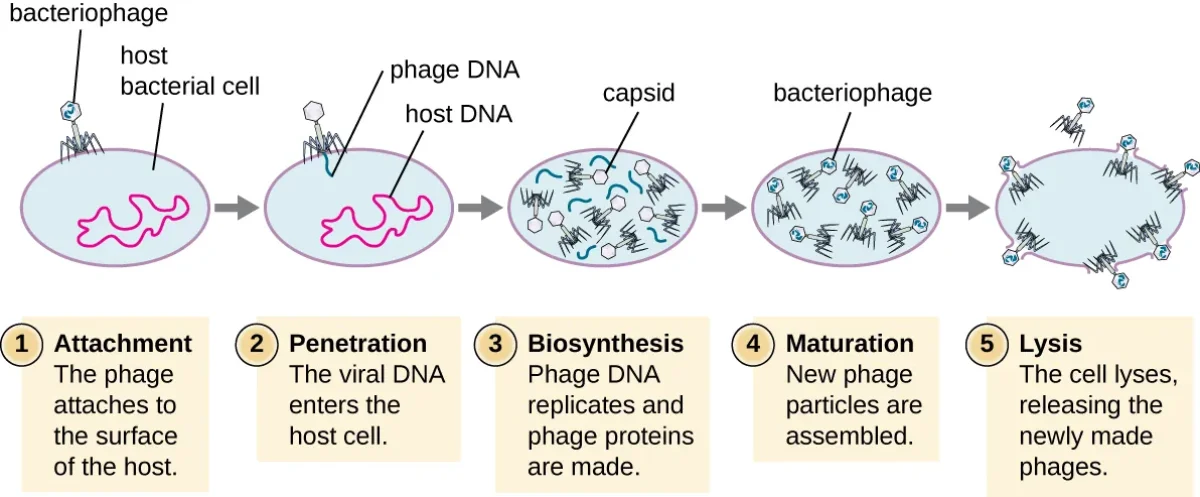
Lysogenic cycle - the stealth path. Instead of immediately replicating, the phage integrates its DNA into the host bacterium’s chromosome. The integrated viral DNA is called a prophage (or provirus). Every time the bacterium divides, it copies the prophage along with its own DNA, unknowingly passing the viral genes to all its descendants.
The prophage can remain dormant for many generations. But when the bacterium encounters stress (UV radiation, chemical damage, nutrient depletion), the prophage can excise itself from the host chromosome and enter the lytic cycle, producing new phage particles and destroying the host.
Retroviruses
Retroviruses (like HIV) deserve special attention because they violate the “normal” flow of genetic information. Instead of DNA -> RNA -> Protein, retroviruses go RNA -> DNA -> RNA -> Protein.
They carry the enzyme reverse transcriptase, which converts their single-stranded RNA genome into double-stranded DNA. This DNA is then integrated into the host cell’s genome. Once integrated, the viral DNA (called a provirus) is transcribed by the host’s own RNA polymerase, producing new viral RNA and mRNA for viral protein synthesis.
Prions and Viroids - Even Simpler Than Viruses
The MCAT explicitly lists these two subviral agents, so know them:
Prions are infectious misfolded proteins with no nucleic acid at all. The normal prion protein has an alpha-helix-rich fold. The misfolded prion has a beta-pleated sheet-rich fold, and when it contacts a normal copy it templates that normal copy into the misfolded shape. The misfolded proteins clump in neural tissue, producing fatal neurodegenerative disease. Prions challenge the idea that genetic material is required to propagate an infection.
Viroids are short, circular, single-stranded RNA molecules with no protein coat. They infect plants and cause disease by interfering with host gene expression. Hepatitis D virus is a viroid-like human pathogen that can only replicate when Hepatitis B is also present.