
Enzymes of the Small Intestine
The small intestine is where the heavy enzymatic machinery lives. Two sources supply the enzymes: the pancreas (secreted into the lumen) and the brush border of the intestinal epithelium itself. Together, they finish the digestion of every macromolecule into its absorbable building blocks.
Pancreatic Enzymes: The Heavy Artillery
The exocrine pancreas produces a cocktail of digestive enzymes delivered to the duodenum through the pancreatic duct. These enzymes work at a slightly alkaline pH (~7-8), which is maintained by pancreatic bicarbonate that neutralizes the acidic chyme from the stomach.
The Trypsin Activation Cascade
This is one of the most important enzyme cascades for the MCAT. All pancreatic proteases are secreted as inactive zymogens to prevent the pancreas from digesting itself.
The cascade works like a row of dominoes:
- Enteropeptidase (also called enterokinase) - an enzyme embedded in the duodenal brush border - cleaves trypsinogen into active trypsin
- Trypsin then activates everything else:
- Chymotrypsinogen → chymotrypsin
- Procarboxypeptidase → carboxypeptidase
- Proelastase → elastase
- More trypsinogen → trypsin (autocatalysis)
Complete Pancreatic Enzyme Table
| Enzyme | Zymogen Form | Substrate | Products |
|---|---|---|---|
| Trypsin | Trypsinogen | Proteins/peptides | Shorter peptides (cleaves after Arg, Lys) |
| Chymotrypsin | Chymotrypsinogen | Proteins/peptides | Shorter peptides (cleaves after Phe, Trp, Tyr) |
| Carboxypeptidase A & B | Procarboxypeptidase | Peptides | Removes C-terminal amino acids |
| Elastase | Proelastase | Elastin, proteins | Shorter peptides |
| Pancreatic amylase | (secreted active) | Starch, glycogen | Maltose, maltotriose, limit dextrins |
| Pancreatic lipase | (active form secreted) | Triglycerides | 2 fatty acids + 1 monoglyceride |
| Nucleases | (secreted active) | DNA, RNA | Nucleotides |
Note that amylase, lipase, and nucleases are secreted in their active forms - they are not zymogens. Only the proteases need to be secreted as zymogens because only proteases pose a self-digestion risk.
Brush-Border Enzymes: The Finishing Touches
Brush-border enzymes are embedded in the microvilli membrane of enterocytes throughout the small intestine. They perform the final digestion steps, breaking dimers and short chains into individual monomers ready for absorption.
Disaccharidases
| Enzyme | Substrate | Products |
|---|---|---|
| Maltase | Maltose | Glucose + glucose |
| Isomaltase | Isomaltose (alpha-1,6 branch points) | Glucose |
| Sucrase | Sucrose | Glucose + fructose |
| Lactase | Lactose | Glucose + galactose |
Peptidases
| Enzyme | Substrate | Products |
|---|---|---|
| Aminopeptidase | Peptides | Removes N-terminal amino acid |
| Dipeptidase | Dipeptides | Two free amino acids |
Other Brush-Border Enzymes
- Enteropeptidase - converts trypsinogen to trypsin (the cascade starter)
- Nucleotidases and nucleosidases - break nucleotides into bases, sugars, and phosphate groups
The Complete Digestion Summary
| Macromolecule | Mouth | Stomach | Small Intestine | Final Products |
|---|---|---|---|---|
| Starch | Salivary amylase | (paused - too acidic) | Pancreatic amylase, then maltase/sucrase/lactase | Monosaccharides |
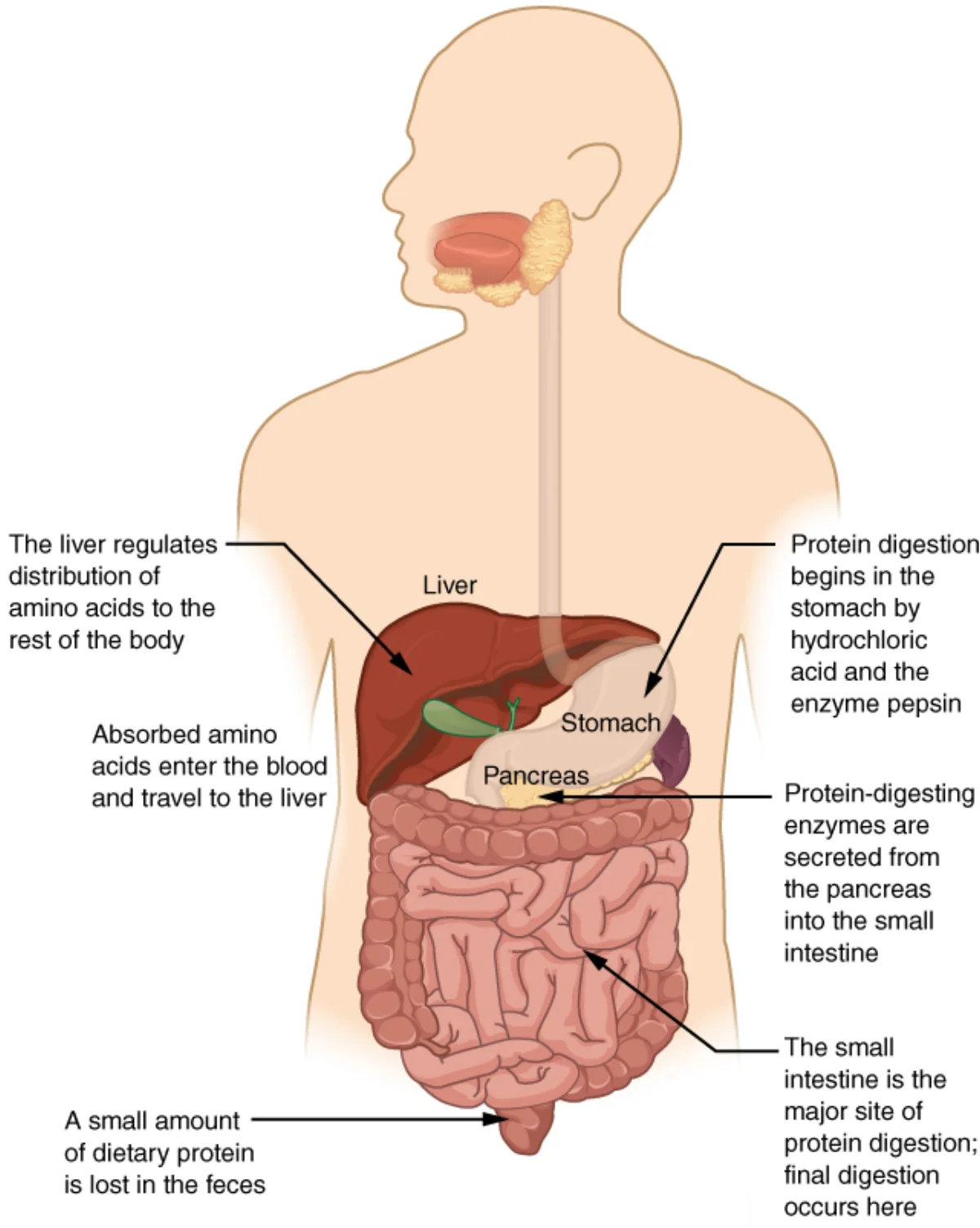
| Protein | None | Pepsin | Trypsin, chymotrypsin, carboxypeptidase, aminopeptidase, dipeptidase | Amino acids |
| Fat | Lingual lipase | Gastric lipase | Bile + pancreatic lipase | Fatty acids + monoglycerides |
| Nucleic acids | None | None | Nucleases, nucleotidases, nucleosidases | Bases + sugars + phosphate |