
The Stomach
The stomach is a muscular sac that serves as a holding tank and processing plant. It stores food, mixes it with acid and enzymes, and slowly releases the resulting slurry (chyme) into the small intestine. The stomach’s acid is so strong it could dissolve a nail - yet the stomach lining survives because of a constantly renewed mucus shield.
Stomach Anatomy
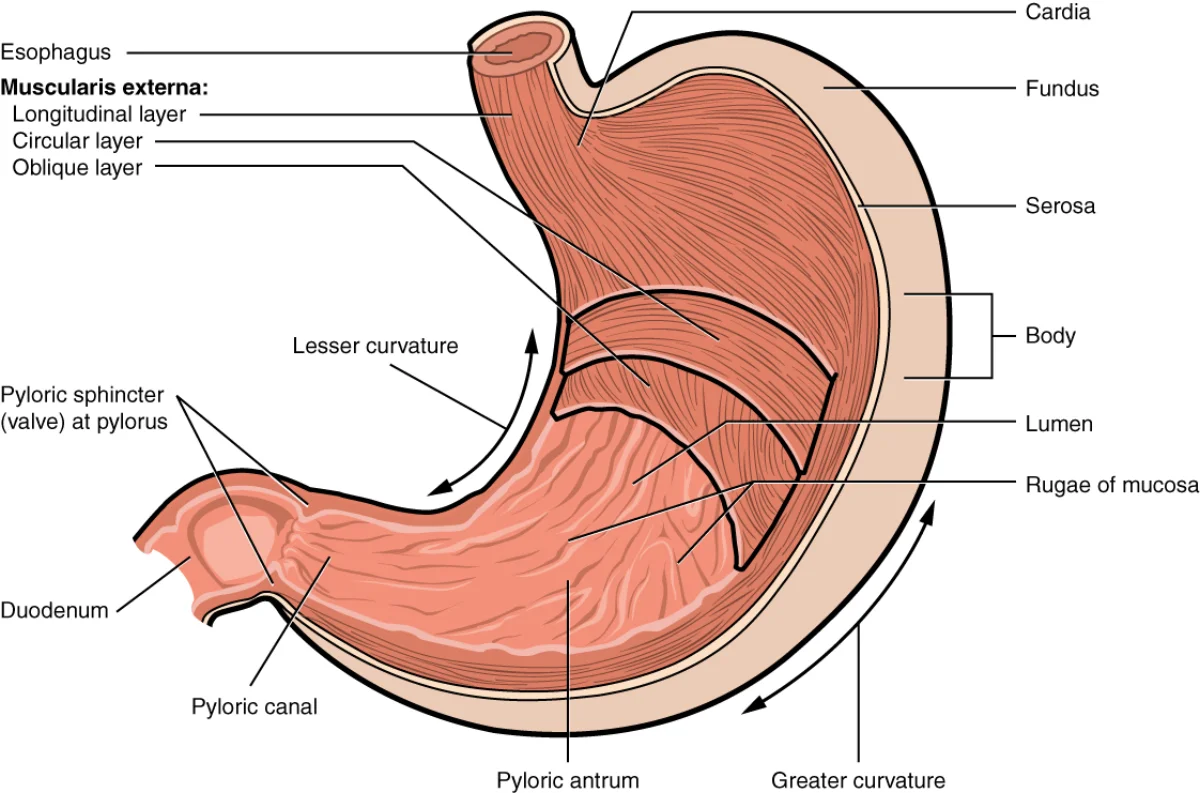
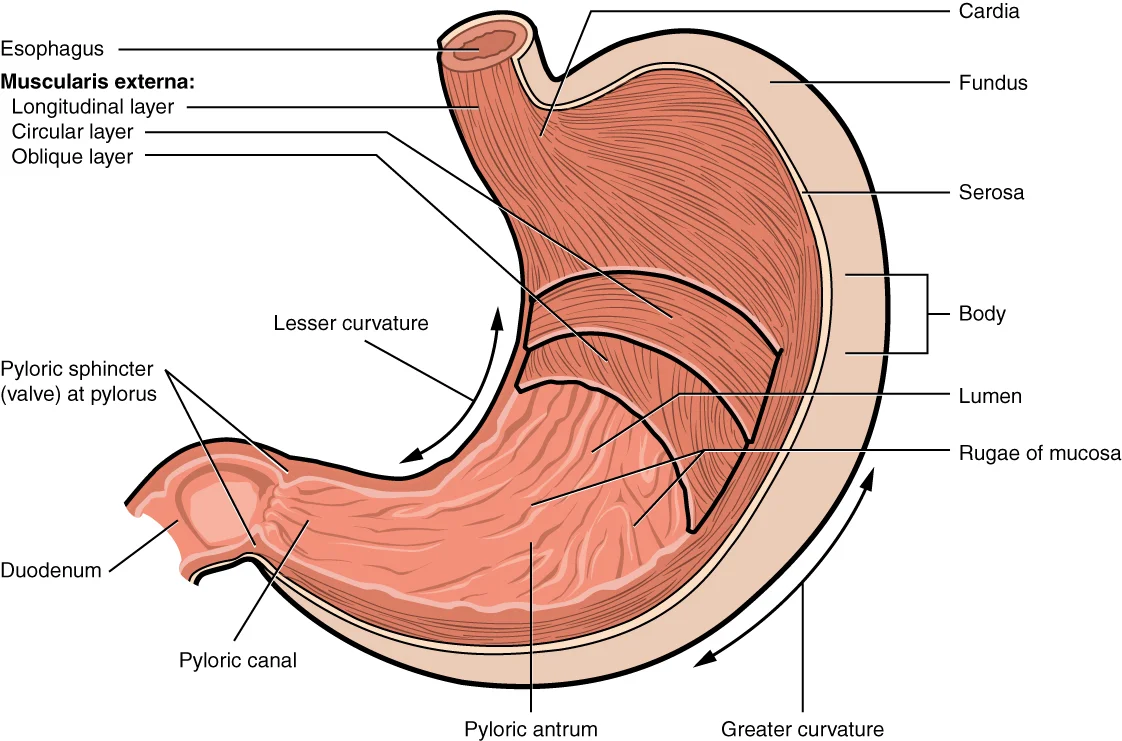
The stomach has four main regions:
- Cardia - where the esophagus connects; just below the lower esophageal sphincter
- Fundus - the upper dome that often collects swallowed air
- Body - the largest region; main site of mixing and digestion
- Pylorus - the lower region that connects to the duodenum via the pyloric sphincter
The inner surface is thrown into folds called rugae, which flatten as the stomach expands (like an accordion). This allows the stomach to stretch from ~50 mL (empty) to ~1-1.5 L (after a large meal).
Gastric Glands: The Acid Factory
Scattered across the stomach lining are millions of gastric pits - small depressions that lead down to gastric glands. These glands contain four specialized cell types:
| Cell Type | Secretion | Function |
|---|---|---|
| Parietal cells | HCl, intrinsic factor | HCl activates pepsinogen, kills bacteria; intrinsic factor needed for B12 absorption in ileum |
| Chief cells | Pepsinogen, gastric lipase | Pepsinogen is the inactive zymogen of pepsin; gastric lipase digests some fat |
| Mucous neck cells | Alkaline mucus | Coats the stomach lining with a bicarbonate-rich barrier, protecting it from acid |
| G cells | Gastrin (hormone) | Stimulates parietal cells to produce more HCl; stimulates stomach motility |
HCl: The Chemical Weapon
Parietal cells secrete HCl into the stomach lumen using the H+/K+ ATPase (proton pump). This pump exchanges H+ ions (into the lumen) for K+ ions (into the cell), using ATP. The result is a lumen pH of about 1.5-2 - acidic enough to kill most bacteria and denature proteins.
The HCl does three things:
- Activates pepsinogen into pepsin (the active protease)
- Denatures proteins - unfolds them, exposing peptide bonds to enzymatic attack
- Kills pathogens - acts as a first line of defense against ingested bacteria
Pepsinogen to Pepsin: The Zymogen Cascade Begins
Chief cells secrete pepsinogen, the inactive form of the protease pepsin. This is a critical safety mechanism - if chief cells secreted active pepsin, the enzyme would digest the cells that made it.
Once pepsinogen contacts HCl in the lumen, the acid cleaves off a small peptide fragment, converting pepsinogen into active pepsin. Pepsin then:
- Digests proteins into shorter peptide fragments
- Works optimally at pH ~2 (and is inactive above pH ~6)
- Can activate more pepsinogen (positive feedback loop)
Intrinsic Factor: The B12 Key
Parietal cells also secrete intrinsic factor, a glycoprotein that binds vitamin B12 in the stomach. The intrinsic factor-B12 complex is absorbed later in the ileum (the last segment of the small intestine). Without intrinsic factor, B12 cannot be absorbed, which leads to a form of anemia caused by B12 deficiency.
Gastric Motility and Chyme Formation
The stomach’s three smooth muscle layers (an extra oblique layer compared to the rest of the GI tract) churn and mix food with gastric juice. After 2-6 hours of mechanical and chemical digestion, food is converted into a thick, acidic paste called chyme.
Chyme is released into the duodenum in small squirts through the pyloric sphincter. The rate of gastric emptying is regulated by:
- Duodenal feedback - fat and acid in the duodenum slow gastric emptying (via CCK and secretin)
- Gastrin - speeds up gastric emptying
- Volume and composition - liquids empty faster than solids; carbohydrates faster than proteins; fats are the slowest