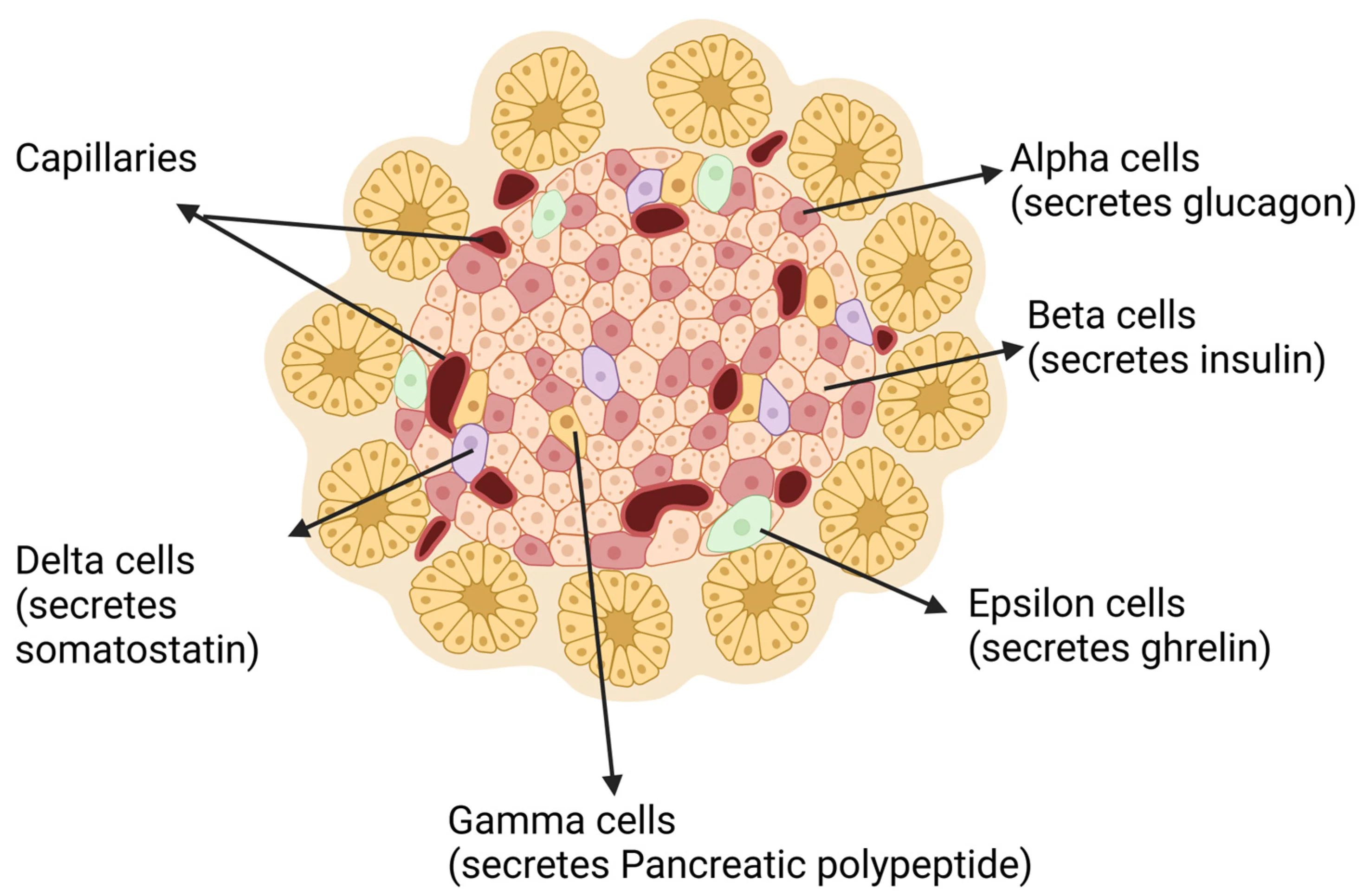
The pancreas is a dual-function organ - part digestive gland, part hormone factory. Its exocrine portion (about 99% of the organ) produces digestive enzymes and bicarbonate. Its endocrine portion (tiny clusters called the Islets of Langerhans) produces hormones that regulate blood glucose. The MCAT expects you to know both sides.
Exocrine Pancreas: Enzymes and Bicarbonate
The exocrine pancreas consists of acinar cells organized into grape-like clusters. These cells produce pancreatic juice containing:
Digestive enzymes - proteases (as zymogens), lipase, amylase, nucleases (covered in detail in the enzyme section)
Bicarbonate (HCO3-) - produced by duct cells, neutralizes acidic chyme entering the duodenum, raising the pH from ~2 to ~7-8 where pancreatic enzymes work optimally
Pancreatic juice is delivered to the duodenum through the pancreatic duct, which merges with the common bile duct at the ampulla of Vater.
What Triggers Pancreatic Secretion?
Two duodenal hormones control the exocrine pancreas:
Hormone
Trigger
Pancreatic Response
Secretin
Acid in the duodenum
Duct cells release bicarbonate (neutralize acid)
CCK
Fat and protein in the duodenum
Acinar cells release digestive enzymes
Endocrine Pancreas: The Islets of Langerhans
Scattered among the acinar cells are about 1-2 million tiny cell clusters called the Islets of Langerhans. They make up only ~1-2% of the pancreas by mass but are critical for metabolic regulation.
An Islet of Langerhans with its cell types labeled. Beta cells (insulin) are the most abundant, alpha cells produce glucagon, and delta cells produce somatostatin. The islets make up only 1-2% of pancreatic mass. Credit: Wikimedia Commons, CC BY 4.0
Inhibits both insulin and glucagon release; slows GI motility and secretion
Blood Glucose Regulation: Insulin vs. Glucagon
After a carbohydrate-rich meal (fed state):
Blood glucose rises
Beta cells release insulin
Insulin promotes: glucose uptake by cells (via GLUT4 in muscle/fat), glycogenesis in liver and muscle, lipogenesis, protein synthesis
Blood glucose falls back to normal (~70-100 mg/dL)
During fasting or exercise:
Blood glucose drops
Alpha cells release glucagon
Glucagon promotes: glycogenolysis (glycogen to glucose) in the liver, gluconeogenesis (making glucose from non-carbohydrate precursors like lactate, glycerol, amino acids)
Blood glucose rises back to normal
A patient has a tumor that destroys only the Islets of Langerhans. Will they have problems digesting food?
Click to reveal answer
No - digestion will be normal. The Islets of Langerhans are the endocrine pancreas (insulin, glucagon). Digestive enzyme production is handled by the exocrine pancreas (acinar cells), which remains intact. The patient will have blood glucose regulation problems (diabetes) but normal digestion.
Secretin and CCK both act on the pancreas. How do their effects differ?
Click to reveal answer
Secretin stimulates bicarbonate release (from duct cells); CCK stimulates enzyme release (from acinar cells). Secretin responds to acid in the duodenum and triggers alkaline bicarbonate to neutralize it. CCK responds to fats and proteins in the duodenum and triggers digestive enzyme secretion. Different triggers, different targets within the pancreas, complementary functions.