
The Large Intestine
By the time chyme reaches the large intestine, digestion is essentially complete. The large intestine’s job is not to digest, but to reclaim water and electrolytes, house trillions of bacteria, and compact the leftovers into feces. It is shorter than the small intestine (~1.5 meters) but wider in diameter - hence the name.
Anatomy: Three Main Regions
1. The Cecum
The cecum is a pouch-like structure at the junction of the small and large intestines. Material enters from the ileum through the ileocecal valve, which prevents backflow. Attached to the cecum is the appendix.
The appendix was long considered a vestigial organ, but current evidence suggests it serves as a reservoir for beneficial gut bacteria. After a bout of diarrhea that flushes the colon, the appendix may help repopulate it with normal flora. It also contains lymphoid tissue for immune surveillance.
Inflammation of the appendix (appendicitis) is a common clinical condition that may appear as passage context on the MCAT.
2. The Colon
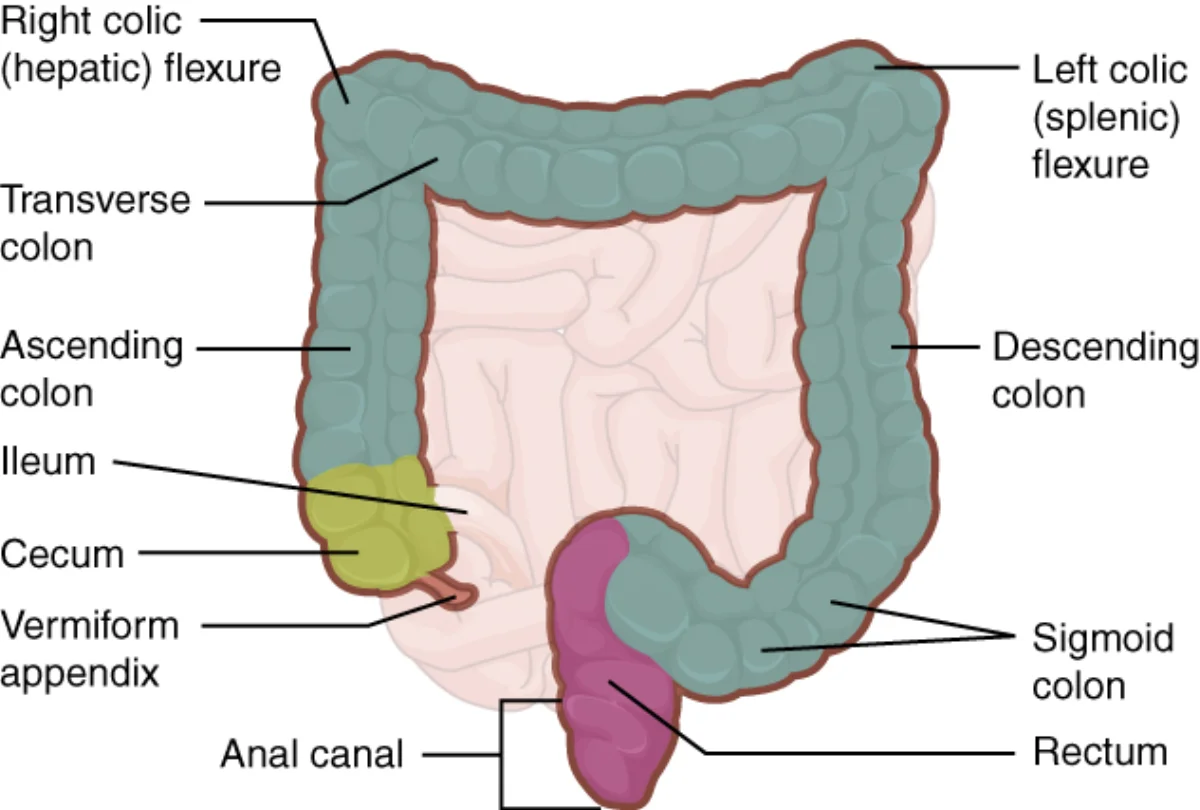
The colon has four segments that form an inverted U-shape:
- Ascending colon - runs up the right side
- Transverse colon - crosses horizontally
- Descending colon - runs down the left side
- Sigmoid colon - S-shaped curve connecting to the rectum
3. The Rectum and Anus
The rectum stores feces until defecation. Two sphincters control the exit:
| Sphincter | Muscle Type | Control |
|---|---|---|
| Internal anal sphincter | Smooth muscle | Involuntary (autonomic) |
| External anal sphincter | Skeletal muscle | Voluntary (somatic) |
The defecation reflex is initiated when the rectum is stretched by feces. The internal sphincter relaxes automatically (parasympathetic), but the external sphincter remains under voluntary control - allowing you to choose when to defecate.
Water Absorption: Turning Liquid to Solid
Chyme entering the large intestine is mostly liquid. The colon absorbs about 1.4 liters of water per day along with sodium, chloride, and other ions. This converts the liquid chyme into semi-solid feces.
- Sodium is absorbed via Na+ channels (regulated by aldosterone) and Na+/H+ exchangers
- Water follows sodium by osmosis
- Too much absorption = constipation (hard, dry stools)
- Too little absorption (or excess secretion) = diarrhea
Goblet Cells: Mucus Protection
The large intestine is lined with goblet cells that secrete mucus. This mucus:
- Lubricates the fecal mass for easier passage
- Protects the epithelium from mechanical abrasion
- Shields the lining from bacterial products and toxins
The mucus does not aid in digestion - its role is purely protective and lubricating.
Gut Microbiota: Your 100 Trillion Roommates
The large intestine hosts a vast community of bacteria (the gut microbiota). These organisms:
- Ferment undigested carbohydrates (fiber), producing short-chain fatty acids (acetate, propionate, butyrate) that provide ~10% of daily caloric intake
- Synthesize vitamin K and certain B vitamins (biotin, folate) - a key source since dietary vitamin K alone is often insufficient
- Compete with pathogenic bacteria for nutrients and space (colonization resistance)
- Train the immune system - gut flora stimulate development of GALT (Peyer’s patches, isolated lymphoid follicles) and teach the immune system to distinguish harmless microbes from pathogens
Bacteria and their byproducts make up a significant fraction of fecal mass.
What’s in Feces?
Normal feces contain:
- Water (~75%)
- Bacteria (living and dead)
- Undigested fiber and food residue
- Bile pigments (stercobilin - gives brown color)
- Sloughed epithelial cells
- Small amounts of fat, protein, and inorganic matter