
The Oral Cavity
Digestion begins the instant you take a bite. Your teeth grind the food into smaller pieces (mechanical digestion), and enzymes in saliva immediately start breaking chemical bonds (chemical digestion). By the time you swallow, starch digestion is already underway.
Mastication: The First Station
Chewing (mastication) is the only voluntary step of mechanical digestion. Your teeth cut, tear, and grind food into a soft mass called a bolus. This increases the surface area available for enzymes - a whole cracker has far less exposed surface than a chewed-up cracker.
Saliva: More Than Just Water
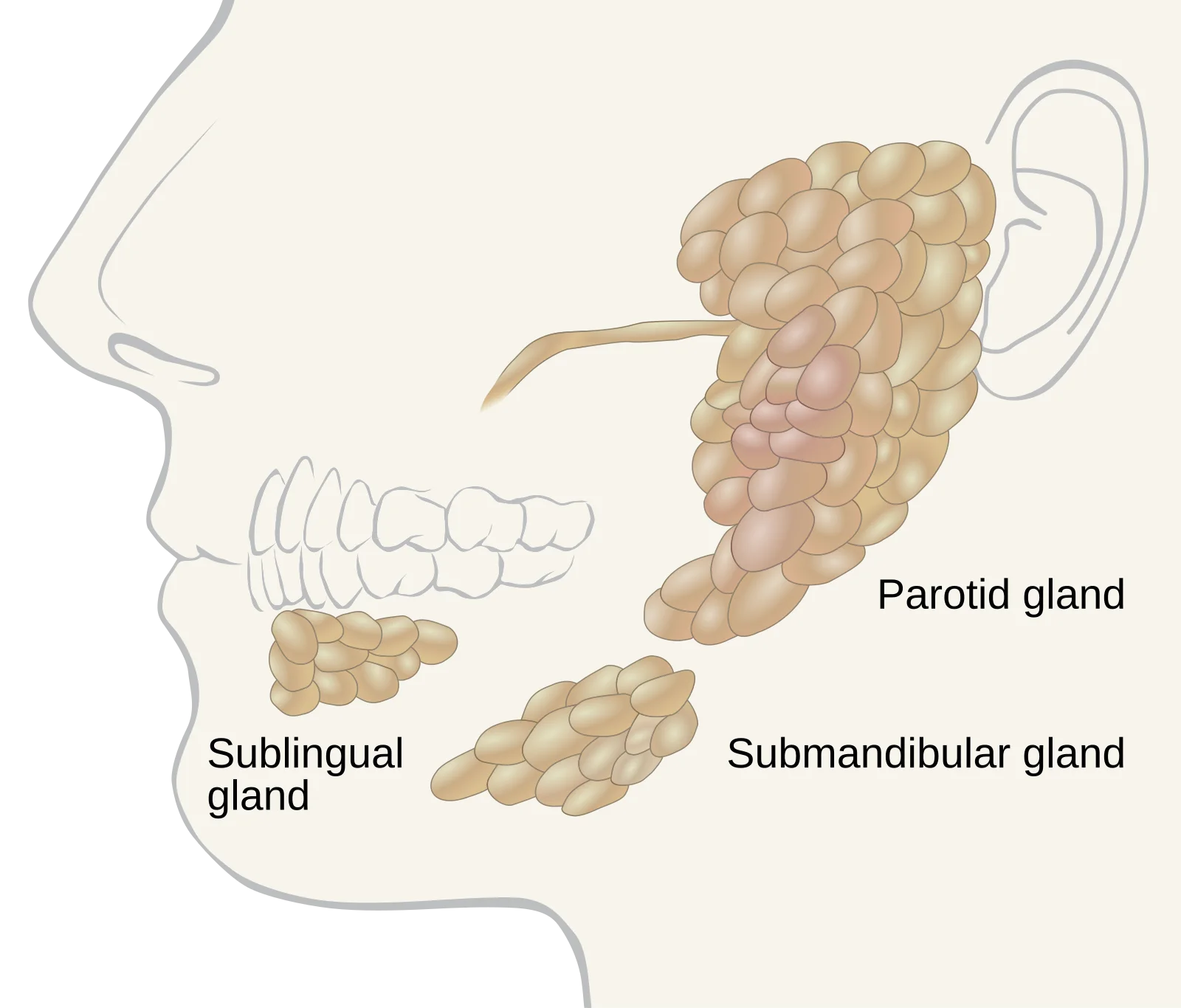
Saliva is produced by three pairs of salivary glands:
| Gland | Location | Main Contribution |
|---|---|---|
| Parotid | In front of each ear | Serous (watery) fluid rich in salivary amylase |
| Submandibular | Below the jaw | Mixed serous and mucous secretion |
| Sublingual | Under the tongue | Primarily mucous secretion |
Saliva contains:
- Water and mucus - moisten food and lubricate the bolus for swallowing
- Salivary amylase - begins starch digestion
- Lingual lipase - begins fat digestion (secreted by glands at the back of the tongue)
- Lysozyme and IgA - antimicrobial defense
- Bicarbonate - buffers acids to protect tooth enamel
Saliva production is controlled by the autonomic nervous system. Parasympathetic stimulation (rest and digest) increases saliva flow. Sympathetic stimulation (fight or flight) decreases it - that is why your mouth goes dry when you are nervous.
Salivary Amylase: Starch Digestion Starts Here
Salivary amylase hydrolyzes the alpha-1,4-glycosidic bonds in starch, breaking it into maltose and maltotriose (shorter chains). This enzyme works best at a neutral pH (~6.8) and is inactivated once it reaches the acidic stomach.
Try this: hold a plain cracker in your mouth for 30 seconds without swallowing. It starts to taste sweet. That sweetness is maltose being released as salivary amylase breaks down the starch in real time.
Lingual Lipase: Fat Digestion Also Starts Here
Lingual lipase is secreted by glands at the back of the tongue. It begins triglyceride digestion in the mouth, although its activity continues in the stomach because lingual lipase is acid-stable (it works at low pH). It is most important for digesting milk fat in infants.
What Does NOT Get Digested in the Mouth?
Protein digestion does not begin until the stomach (pepsin requires acidic pH). If you mix saliva with protein in a test tube, nothing happens to the protein - there are no proteases in saliva.