
The Small Intestine
The small intestine is the MVP of digestion. Despite its name (“small” refers to diameter, not length), it stretches about 6-7 meters and is where 90% of digestion and absorption occur. Its secret weapon is surface area - an internal architecture of folds, fingers, and micro-fingers that gives it the absorptive area of a tennis court packed into a tube you could coil inside your abdomen.
The Three Segments
The Duodenum: Where Chemistry Happens
The duodenum is the first and shortest segment (~25 cm). It receives:
- Acidic chyme from the stomach through the pyloric sphincter
- Bile from the liver/gallbladder via the common bile duct
- Pancreatic juice from the pancreas via the pancreatic duct
Both the common bile duct and pancreatic duct empty into the duodenum at the ampulla of Vater (hepatopancreatic ampulla), controlled by the sphincter of Oddi.
The duodenum is the principal site for chemical digestion. It neutralizes stomach acid with pancreatic bicarbonate, emulsifies fats with bile, and unleashes a battery of pancreatic and brush-border enzymes.
The duodenum also has an endocrine role: it secretes secretin (in response to acid) and cholecystokinin (CCK) (in response to fats and proteins).
The Jejunum: Absorption Powerhouse
The jejunum is the middle segment and the primary site of nutrient absorption. Its walls are densely packed with villi, giving it a velvety appearance. Most amino acids, monosaccharides, fatty acids, and water-soluble vitamins are absorbed here.
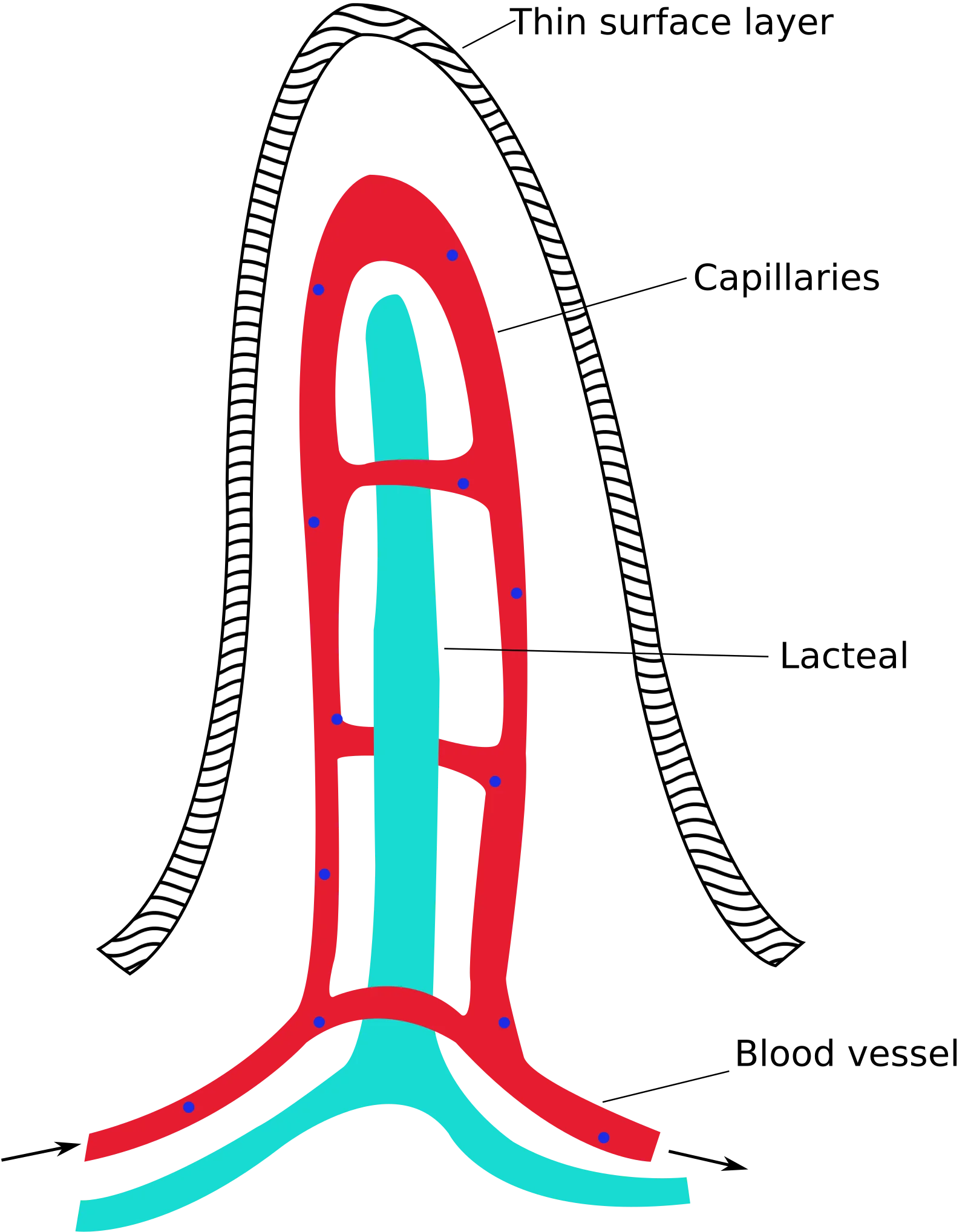
Water-soluble nutrients (amino acids, monosaccharides) are absorbed into capillaries within each villus and travel via the hepatic portal vein to the liver for processing.
Fats take a different route - they enter lacteals (lymphatic vessels within each villus) and travel through the lymphatic system before entering the bloodstream.
The Ileum: The Final Stretch
The ileum is the longest segment and connects to the large intestine at the ileocecal valve. It has two specialized absorption jobs:
- Vitamin B12 - the intrinsic factor-B12 complex formed in the stomach is absorbed exclusively in the ileum by receptor-mediated endocytosis
- Bile salts - recycled back to the liver via the hepatic portal vein in a process called enterohepatic circulation (bile salts are reused 6-8 times per day)
The ileum also contains Peyer’s patches - clusters of lymphoid tissue that monitor intestinal bacteria and mount immune responses against pathogens. They are part of the gut-associated lymphoid tissue (GALT).
The Surface Area Amplification System
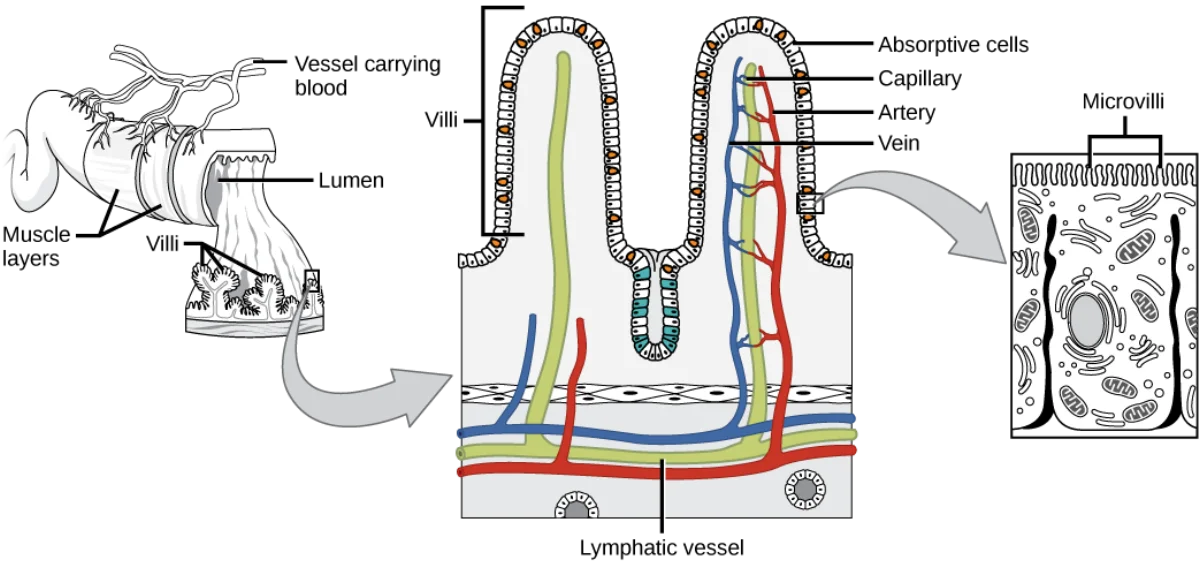
The small intestine achieves its enormous surface area through three levels of folding:
| Level | Structure | Surface Area Increase |
|---|---|---|
| 1 | Plicae circulares (circular folds) | ~3x the flat surface |
| 2 | Villi (finger-like projections, ~1 mm tall) | ~10x more |
| 3 | Microvilli (brush border on each enterocyte) | ~20x more |
Each villus contains:
- A capillary network for absorbing water-soluble nutrients
- A lacteal (lymphatic vessel) for absorbing fats
- Smooth muscle that contracts to “pump” absorbed nutrients into vessels
Intestinal Crypts: The Cell Factory
At the base of each villus are crypts of Lieberkuhn (intestinal crypts). These contain stem cells that constantly produce new enterocytes. The intestinal epithelium renews itself every 3-5 days - one of the fastest cell turnover rates in the body.