
Absorption
Digestion breaks food into tiny building blocks. Absorption is the process of moving those building blocks across the intestinal epithelium into the blood or lymph. Each type of nutrient uses a specific transport mechanism, and the MCAT expects you to know them.
Carbohydrate Absorption
After digestion, carbohydrates exist as monosaccharides: glucose, galactose, and fructose. They are absorbed primarily in the jejunum.
| Monosaccharide | Apical Membrane (Lumen → Cell) | Basolateral Membrane (Cell → Blood) |
|---|---|---|
| Glucose | SGLT1 (Na+-dependent secondary active transport) | GLUT2 (facilitated diffusion) |
| Galactose | SGLT1 (same transporter as glucose) | GLUT2 (facilitated diffusion) |
| Fructose | GLUT5 (facilitated diffusion - no Na+ needed) | GLUT2 (facilitated diffusion) |
Note that glucose and galactose absorption is Na+-dependent (secondary active transport), while fructose absorption is Na+-independent (facilitated diffusion through GLUT5).
Protein Absorption
Proteins are digested into amino acids, dipeptides, and tripeptides. All three forms can be absorbed:
- Amino acids - absorbed by Na+-dependent secondary active transport (similar to glucose) through specific amino acid transporters
- Dipeptides and tripeptides - absorbed by H+-dependent cotransport, then hydrolyzed into amino acids inside the enterocyte
- Once inside the cell, amino acids exit via facilitated diffusion into capillaries
All absorbed amino acids enter the hepatic portal vein and travel to the liver.
Lipid Absorption: The Special Route
Fat absorption is the most complex and the most frequently tested on the MCAT.
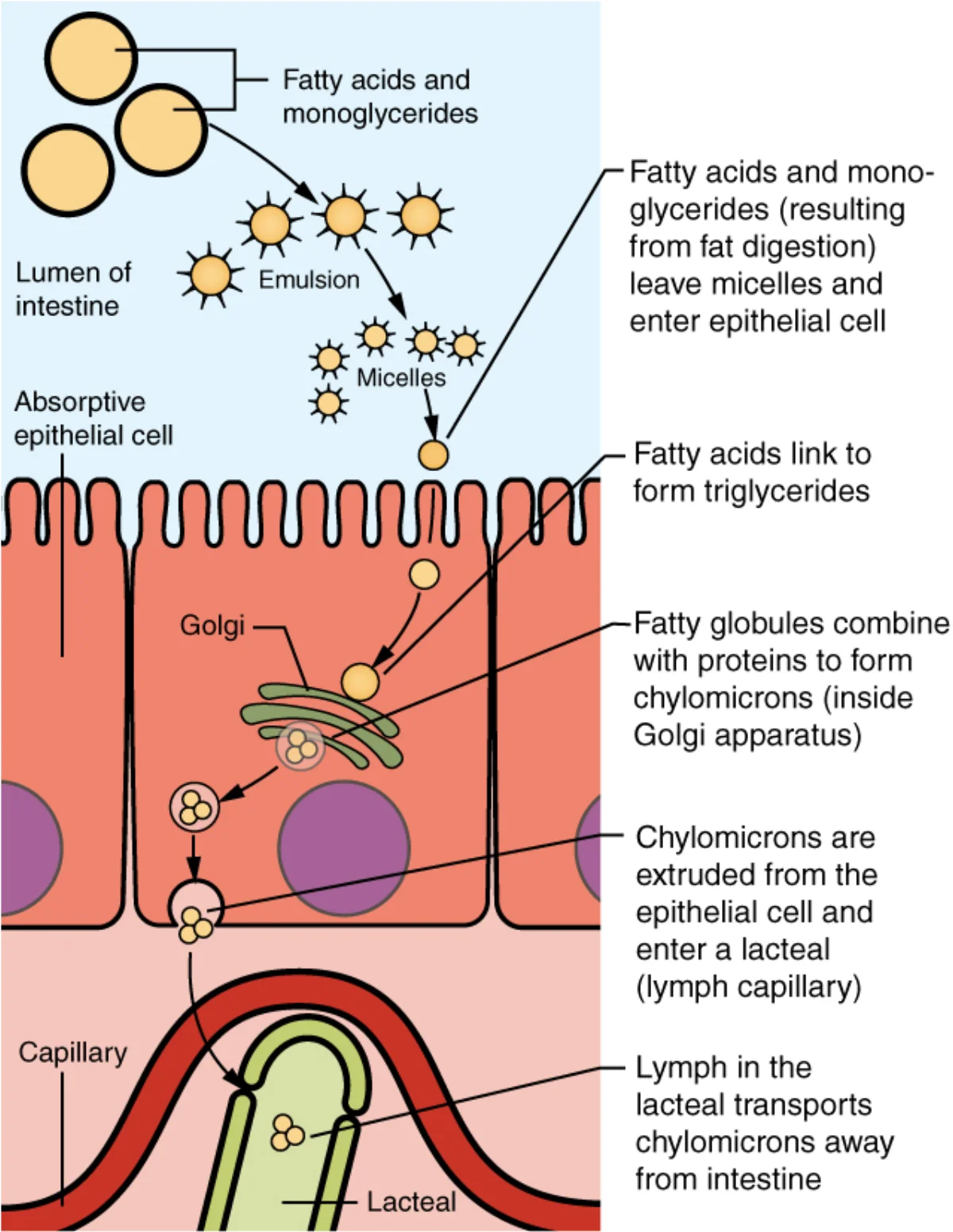
The full pathway:
- Bile salts emulsify large fat globules into tiny micelles in the duodenal lumen
- Pancreatic lipase digests triglycerides into 2 fatty acids + 1 monoglyceride
- These products are carried to the enterocyte surface by micelles
- Fatty acids and monoglycerides diffuse across the enterocyte membrane (they are hydrophobic - no transporter needed for long-chain fatty acids)
- Inside the enterocyte’s smooth ER, fatty acids and monoglycerides are re-esterified back into triglycerides
- Triglycerides are packaged with cholesterol and phospholipids in the Golgi to form chylomicrons
- Chylomicrons are exocytosed from the basolateral membrane into lacteals (lymphatic vessels)
- Lacteals drain into the lymphatic system, which empties into the thoracic duct and then the left subclavian vein
Vitamin Absorption
| Vitamin Type | Examples | Absorption Mechanism | Transport |
|---|---|---|---|
| Fat-soluble (A, D, E, K) | Retinol, calciferol, tocopherol, phylloquinone | Absorbed with dietary fat in micelles | Packaged into chylomicrons; require bile |
| Water-soluble (B vitamins, C) | Thiamine, riboflavin, ascorbic acid | Various transporters; mostly in jejunum | Enter capillaries, travel via hepatic portal vein |
| Vitamin B12 | Cobalamin | Binds intrinsic factor in stomach; complex absorbed in terminal ileum by receptor-mediated endocytosis | Portal circulation to liver |
Water and Ion Absorption
The GI tract processes about 9 liters of fluid per day (2 L ingested + 7 L secreted). About 98% is reabsorbed:
- Small intestine absorbs most water and ions (~7.5 L) by osmosis following solute absorption
- Large intestine absorbs the remaining ~1.4 L
- Only ~100-200 mL is lost in feces
Sodium absorption drives water absorption. Na+ enters enterocytes via:
- SGLT1 (co-transported with glucose)
- Na+/amino acid cotransporters
- Na+/H+ exchangers
- Na+ channels in the colon (regulated by aldosterone)
Water follows Na+ by osmosis through tight junctions and aquaporins.