
Endocrine Disorders
The MCAT does not ask you to diagnose patients, but it regularly presents endocrine disorders in passage-based questions to test whether you understand the underlying physiology. The strategy is always the same: identify which hormone is too high or too low, then reason through the feedback loop to predict the consequences.
Every disorder in this section can be understood by asking three questions:
- Which hormone is abnormal?
- Is it too much (hyper) or too little (hypo)?
- Where in the axis is the problem - gland, pituitary, or hypothalamus?
Growth Hormone Disorders
Gigantism - GH excess before epiphyseal plate closure (in children). Excess GH/IGF-1 drives excessive linear growth.
Acromegaly - GH excess after plate closure (in adults). Long bones can no longer lengthen, so bones thicken instead (hands, feet, face).
Dwarfism - GH deficiency (or GH-receptor insensitivity) in childhood. Produces proportional short stature, unlike the disproportionate short stature of achondroplasia.
Adrenal Disorders
Cushing Syndrome - cortisol excess. Predictable from cortisol’s actions: hyperglycemia (gluconeogenesis), central fat deposition, muscle wasting (protein catabolism), hypertension, and immunosuppression. Causes include a pituitary adenoma (high ACTH), an autonomous adrenal tumor (low ACTH), or exogenous steroids.
Addison Disease - primary adrenal insufficiency. The adrenal cortex is destroyed, so both cortisol and aldosterone drop. Loss of cortisol feedback drives ACTH very high, which also drives hyperpigmentation (ACTH and MSH share a precursor). Expect low Na⁺, high K⁺ (no aldosterone), low glucose, and low blood pressure.
Thyroid Disorders (Detailed)
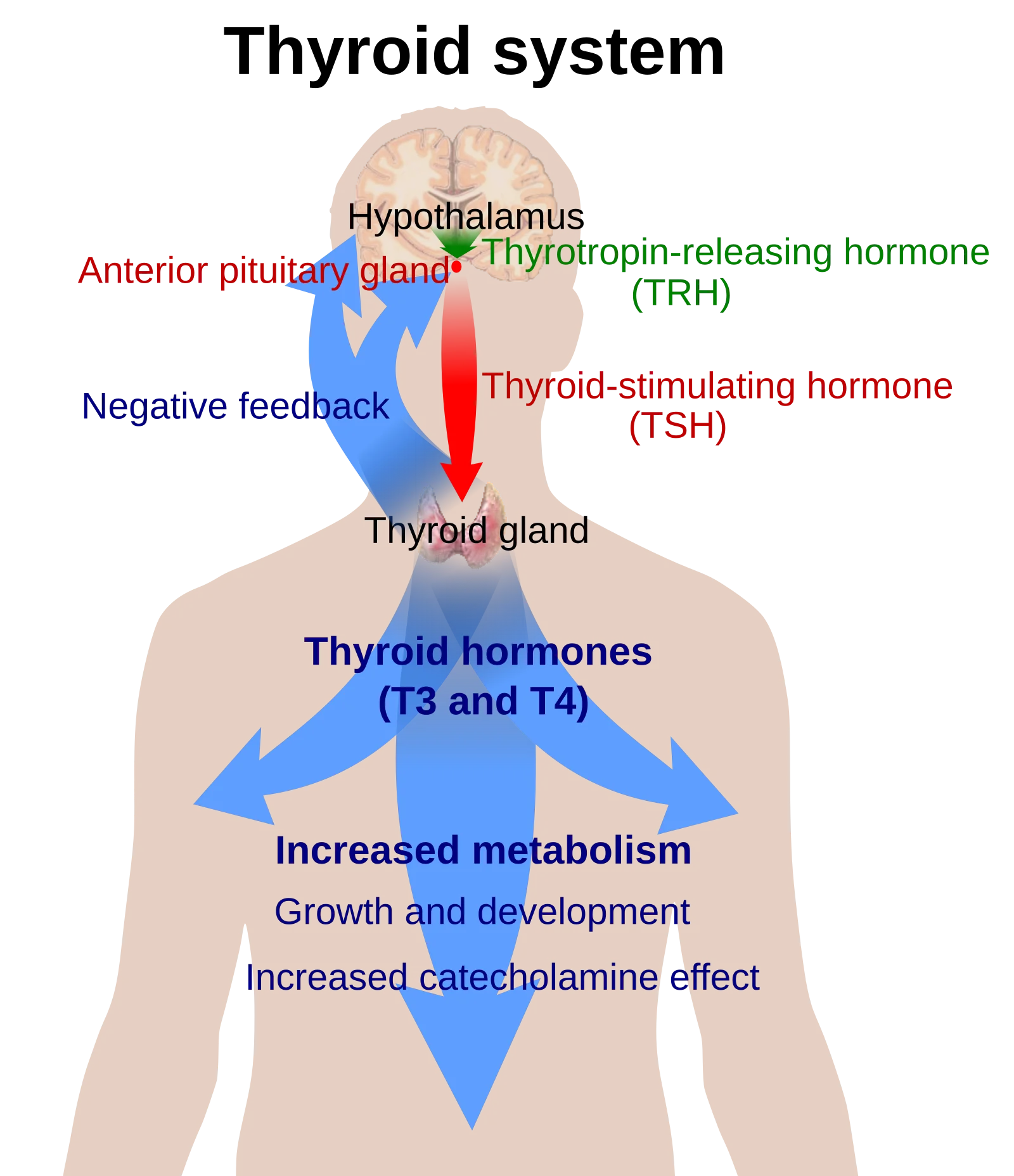
Graves Disease - autoimmune hyperthyroidism. Antibodies mimic TSH and continuously stimulate the thyroid. Labs: high T3/T4, LOW TSH (suppressed by feedback, but the antibodies bypass that control).
Hashimoto Thyroiditis - autoimmune destruction of the thyroid. Labs: low T3/T4, HIGH TSH (pituitary trying to rescue a damaged gland).
Iodine Deficiency Goiter - no iodine means no T3/T4. TSH stays elevated, chronically stimulating the thyroid, which enlarges into a visible goiter.
Water Balance Disorders
SIADH (Syndrome of Inappropriate ADH Secretion) - too much ADH. The kidneys reabsorb too much water, diluting the blood. Result: hyponatremia (dangerously low sodium from dilution), concentrated urine, water retention. Can be caused by certain tumors, drugs, or CNS disorders.
Diabetes Insipidus - too little ADH effect. Two types:
- Central DI: hypothalamus/posterior pituitary does not produce enough ADH
- Nephrogenic DI: kidneys do not respond to ADH (receptor or aquaporin defect)
Both produce the same symptoms: enormous volumes of very dilute urine (the patient “insipidly” wastes water), extreme thirst, and risk of dehydration. Note: “diabetes” here means “excessive urination” (from Greek “to pass through”) - this has nothing to do with blood sugar or insulin.
Aldosterone Disorders
Hypoaldosteronism - aldosterone deficiency. Causes sodium loss, potassium retention (hyperkalemia), low blood volume, and hypotension. Often seen as part of Addison disease.
Catecholamine Disorder
Master Disorder Table
| Disorder | Hormone Problem | Key Lab Findings | Key Symptoms |
|---|---|---|---|
| Cushing Syndrome | Cortisol excess | High cortisol, variable ACTH | Moon face, central obesity, hyperglycemia |
| Addison Disease | Cortisol + aldosterone deficiency | Low cortisol, HIGH ACTH | Hypotension, hyperpigmentation, fatigue |
| Graves Disease | T3/T4 excess | High T3/T4, LOW TSH | Weight loss, tachycardia, exophthalmos |
| Hashimoto Thyroiditis | T3/T4 deficiency | Low T3/T4, HIGH TSH | Weight gain, fatigue, cold intolerance |
| Acromegaly/Gigantism | GH excess | High GH, high IGF-1 | Enlarged extremities (acromegaly) or tall stature (gigantism) |
| Type 1 Diabetes | Insulin deficiency | High glucose, low insulin, low C-peptide | Polyuria, polydipsia, weight loss |
| Type 2 Diabetes | Insulin resistance | High glucose, high insulin (early) | Polyuria, polydipsia, obesity |
| SIADH | ADH excess | Low serum Na+, concentrated urine | Water retention, hyponatremia |
| Diabetes Insipidus | ADH deficiency/resistance | High serum Na+, dilute urine | Massive urine output, extreme thirst |
| Conn Syndrome | Aldosterone excess | Low K+, high Na+ | Hypertension, hypokalemia |
| Pheochromocytoma | Catecholamine excess | High catecholamines/metabolites | Episodic hypertension, tachycardia |