
The Gonads
The gonads - testes in males and ovaries in females - are the body’s reproductive endocrine organs. They produce gametes (sperm and eggs) and secrete sex hormones that drive puberty, maintain reproductive function, and influence everything from bone density to mood. The MCAT frequently tests the hypothalamic-pituitary-gonadal (HPG) axis and the feedback loops that regulate these hormones.
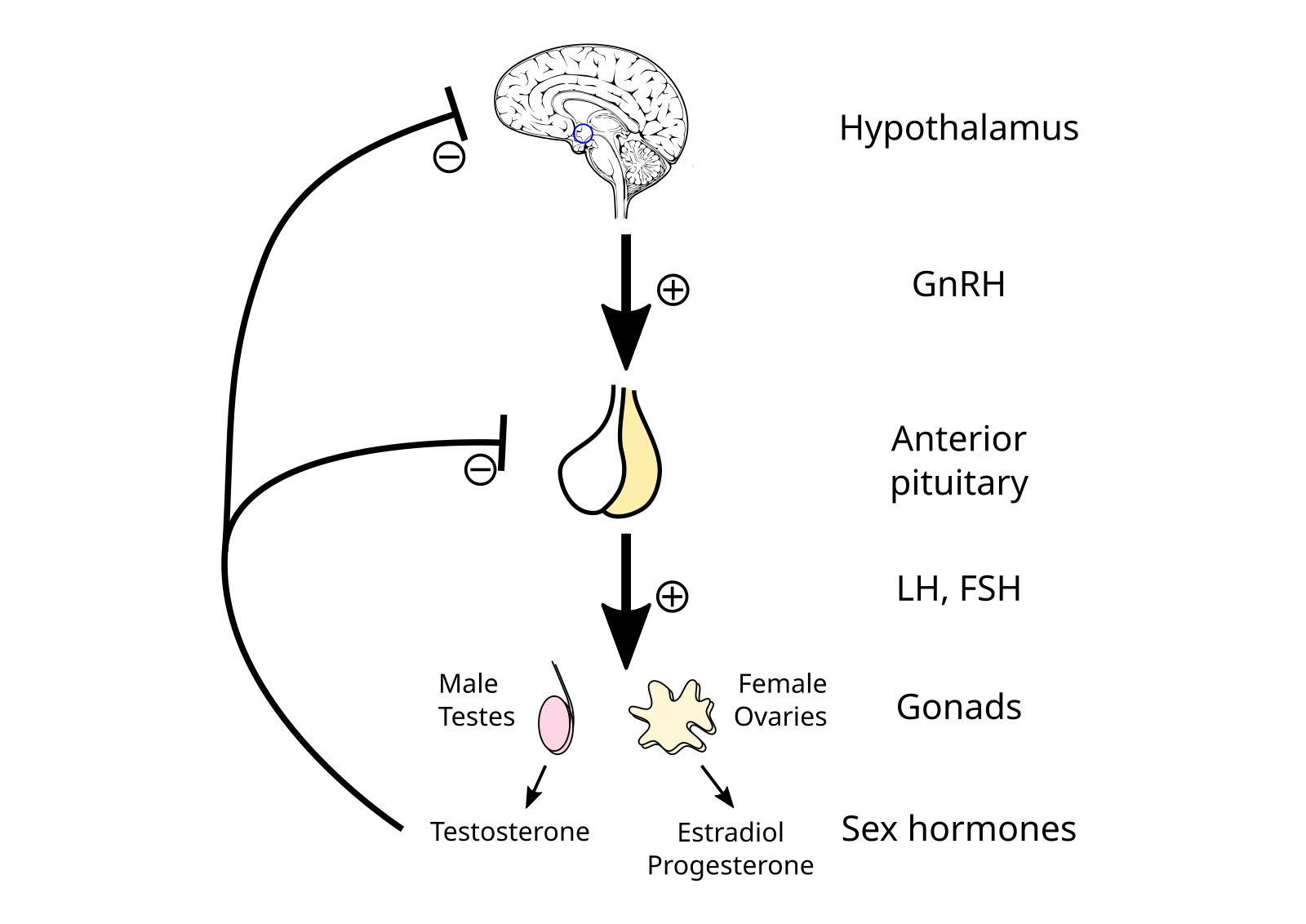
The HPG Axis: Chain of Command
The regulation of gonadal hormones follows the same hierarchical pattern as the thyroid and adrenal axes:
- Hypothalamus releases GnRH (gonadotropin-releasing hormone) in a pulsatile pattern
- GnRH stimulates the anterior pituitary to release FSH and LH
- FSH and LH act on the gonads to stimulate gamete production and hormone secretion
- Sex hormones feed back to inhibit the hypothalamus and pituitary (negative feedback)
The pulsatile nature of GnRH is critical. Constant, non-pulsatile GnRH actually downregulates LH and FSH receptors and suppresses gonadotropin release. This is the pharmacological basis for GnRH agonists used in certain treatments - continuous administration paradoxically shuts down the axis.
Testes: Testosterone and Spermatogenesis
The testes are located in the scrotum, which maintains a temperature 2-3 degrees C below core body temperature - optimal for sperm production. Two key cell types produce the two main testicular outputs:
Leydig cells (interstitial cells) - located between the seminiferous tubules. LH stimulates Leydig cells to produce testosterone. Testosterone is a steroid hormone derived from cholesterol.
Sertoli cells (sustentacular cells) - located inside the seminiferous tubules. FSH acts on Sertoli cells to support spermatogenesis. Sertoli cells also produce inhibin, which selectively feeds back to inhibit FSH release from the anterior pituitary (without significantly affecting LH).
Testosterone effects:
- Development of male reproductive organs
- Secondary sexual characteristics (facial hair, deepened voice, muscle mass, body hair)
- Maintains spermatogenesis (works alongside FSH)
- Anabolic effects on muscle and bone
- Influences libido
- Negative feedback on GnRH and LH
Ovaries: Estrogen, Progesterone, and the Menstrual Cycle
The ovaries contain follicles at various stages of development, each housing an oocyte (egg). Two key cell types in the follicle produce ovarian hormones:
Theca cells - the outer layer of the follicle. LH stimulates theca cells to produce androgens (androstenedione), which are then passed to granulosa cells.
Granulosa cells - the inner layer surrounding the oocyte. FSH stimulates granulosa cells to convert the androgens from theca cells into estrogen (primarily estradiol) via the enzyme aromatase. After ovulation, granulosa cells become part of the corpus luteum, which produces progesterone.
This two-cell model (theca + granulosa) is an important MCAT concept: neither cell type alone can produce estrogen efficiently. They must cooperate.
Estrogen effects:
- Development of female secondary sexual characteristics (breast development, wider hips, fat distribution)
- Stimulates endometrial growth during the follicular phase
- Stimulates LH surge at mid-cycle (positive feedback - a rare exception to the usual negative feedback)
- Maintains bone density (stimulates osteoblast activity)
- Negative feedback on FSH and GnRH (at moderate levels)
Progesterone effects:
- Maintains and stabilizes the endometrial lining for implantation
- Inhibits uterine contractions during pregnancy
- Raises body temperature slightly (basal body temperature rises after ovulation - used to detect ovulation)
- Negative feedback on GnRH, FSH, and LH during the luteal phase
Key Feedback Patterns
In males, testosterone provides straightforward negative feedback - high testosterone suppresses GnRH and LH, keeping the system stable.
In females, the feedback is more complex:
- Low-to-moderate estrogen (follicular phase) - negative feedback on FSH and LH
- High estrogen (just before ovulation) - switches to positive feedback on LH, triggering the massive LH surge that causes ovulation
- After ovulation - the corpus luteum produces progesterone, which returns the system to negative feedback on GnRH, FSH, and LH
This estrogen-mediated switch from negative to positive feedback at mid-cycle is one of the few examples of positive feedback in the endocrine system, and it is a high-yield MCAT concept.
| Feature | Testes | Ovaries |
|---|---|---|
| Gamete-producing cells | Spermatogonia (in seminiferous tubules) | Oocytes (in follicles) |
| Hormone-producing cells | Leydig (testosterone), Sertoli (inhibin) | Theca (androgens), Granulosa (estrogen, inhibin) |
| LH target | Leydig cells | Theca cells, triggers ovulation |
| FSH target | Sertoli cells | Granulosa cells |
| Primary hormones | Testosterone | Estrogen, progesterone |
| Negative feedback to pituitary | Testosterone, inhibin | Estrogen, progesterone, inhibin |