
Thyroid & Parathyroid
Your thyroid gland sets the speed at which your entire body runs. Every cell in your body has receptors for thyroid hormones. When thyroid levels are high, your metabolism runs hot - your heart beats faster, you burn more calories, you feel wired and restless. When thyroid levels are low, everything slows - your heart rate drops, you gain weight, you feel sluggish and cold. The thyroid is the body’s thermostat dial, and the MCAT expects you to understand exactly how it is turned up and turned down.
Sitting right behind the thyroid, the four tiny parathyroid glands handle a completely different job: keeping blood calcium in an extremely narrow range. Calcium is not just for bones - it is essential for muscle contraction, nerve transmission, blood clotting, and enzyme function. Even small deviations in blood calcium can be life-threatening.
Thyroid Hormones: T3 and T4
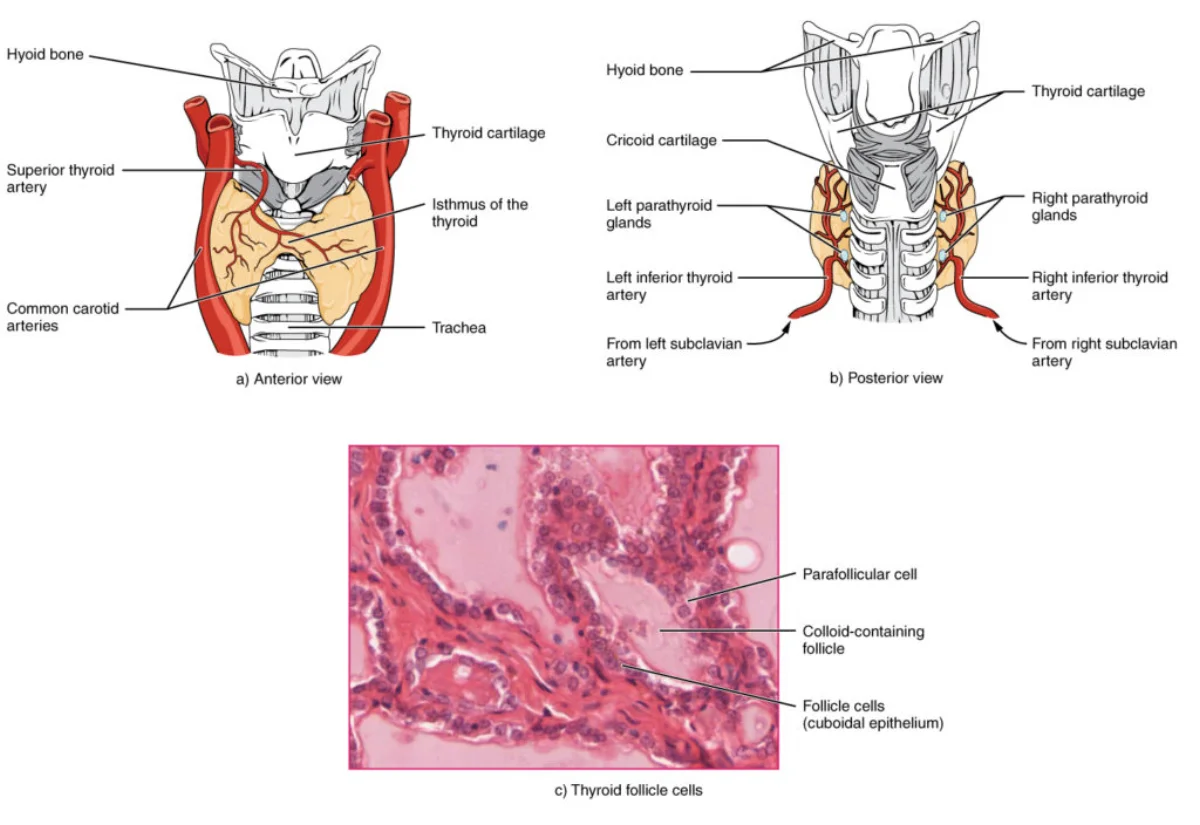
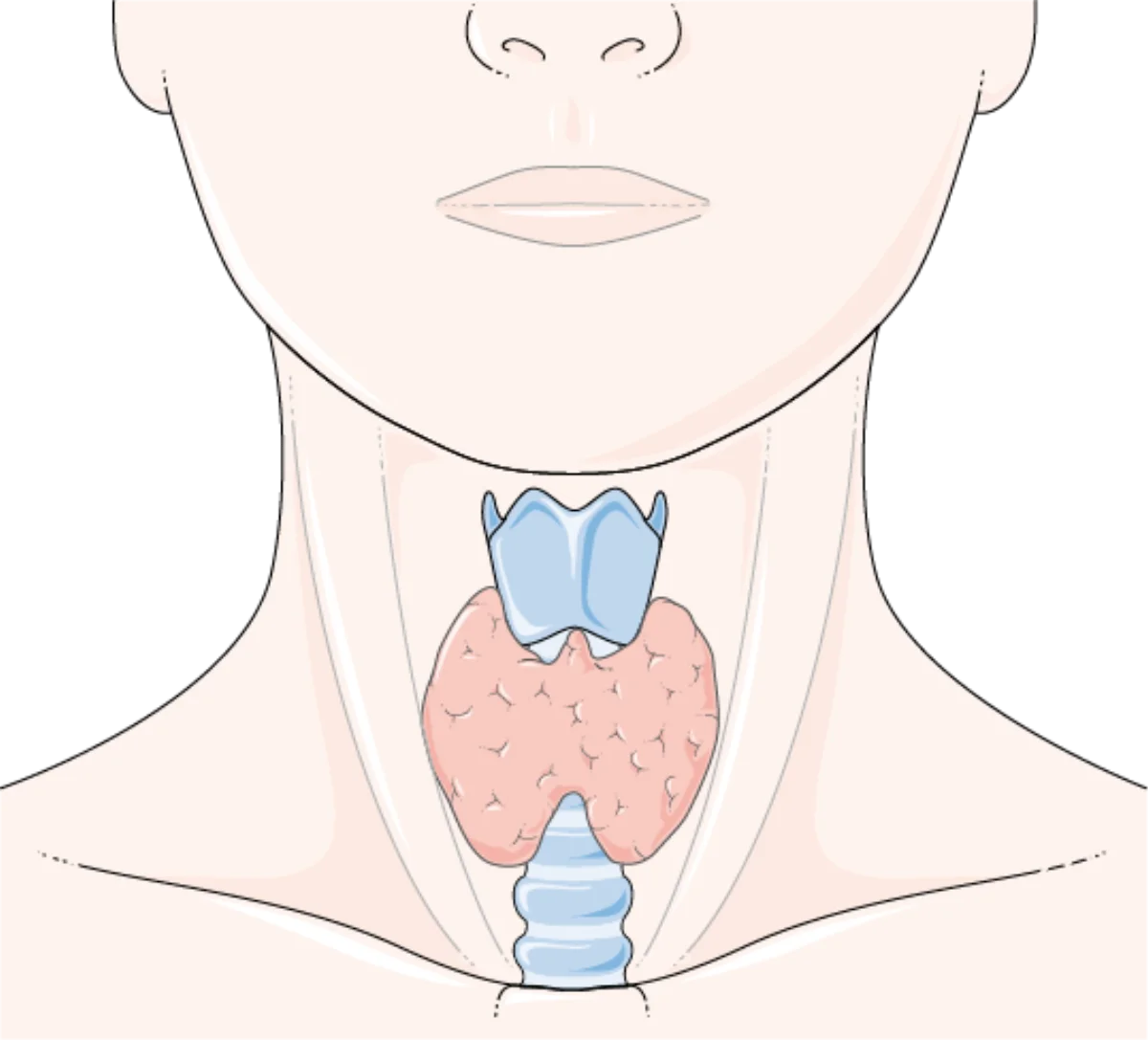
The thyroid gland is a butterfly-shaped gland located in the front of the neck, wrapped around the trachea. It produces two closely related hormones:
- T4 (thyroxine) - contains four iodine atoms. T4 is the primary hormone released by the thyroid, but it is relatively inactive. Think of T4 as the “storage form.”
- T3 (triiodothyronine) - contains three iodine atoms. T3 is the biologically active form - about 3-5 times more potent than T4. Most T3 is produced by conversion of T4 to T3 in peripheral tissues (primarily the liver and kidneys) by removing one iodine atom.
Both T3 and T4 are derived from the amino acid tyrosine, but they incorporate iodine during synthesis, making them lipid-soluble - unusual for amino acid derivatives. They travel in the blood bound to carrier proteins (thyroxine-binding globulin) and, once inside a target cell, bind to nuclear receptors to alter gene transcription.
Thyroid Hormone Regulation: The HPT Axis
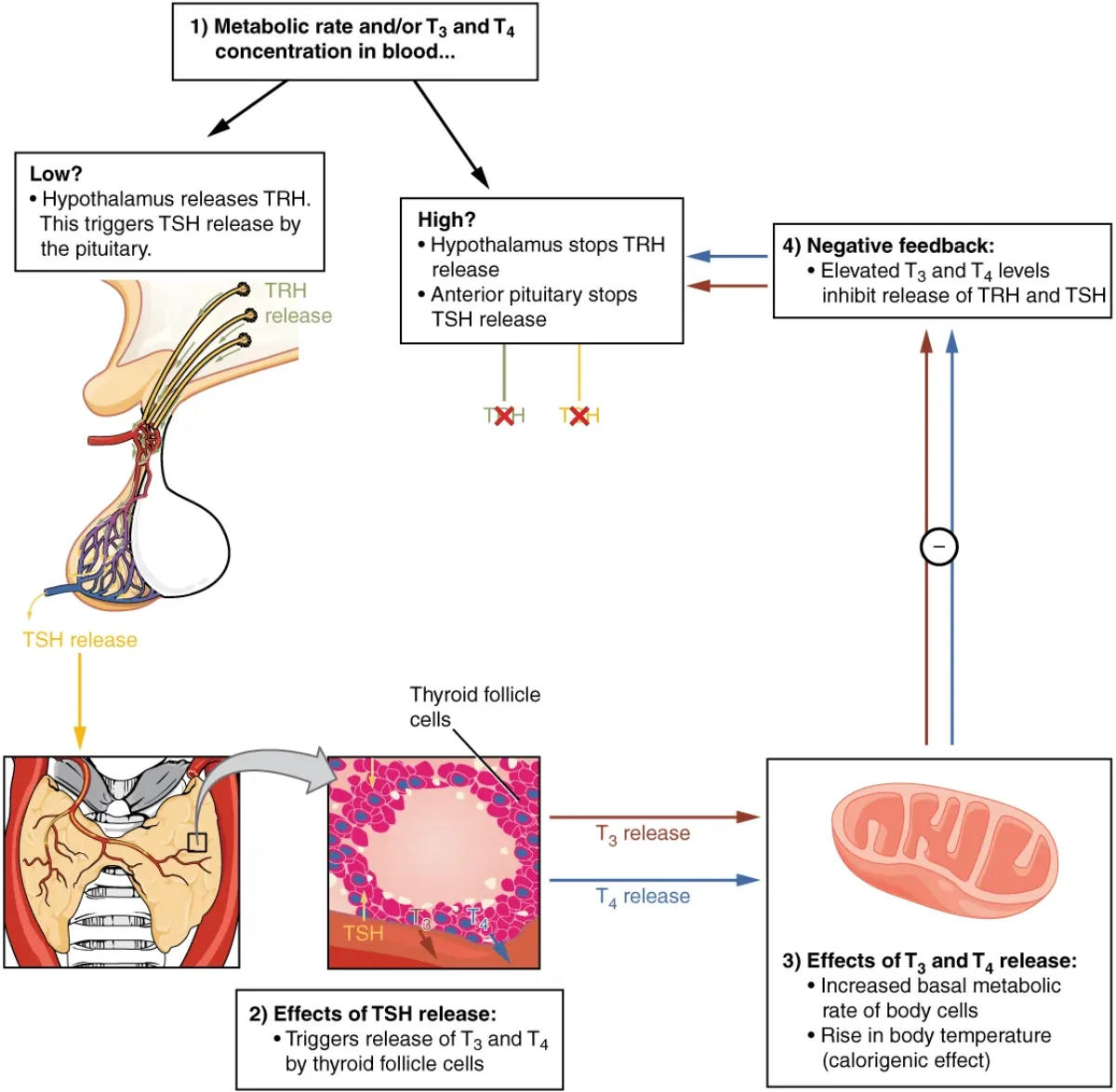
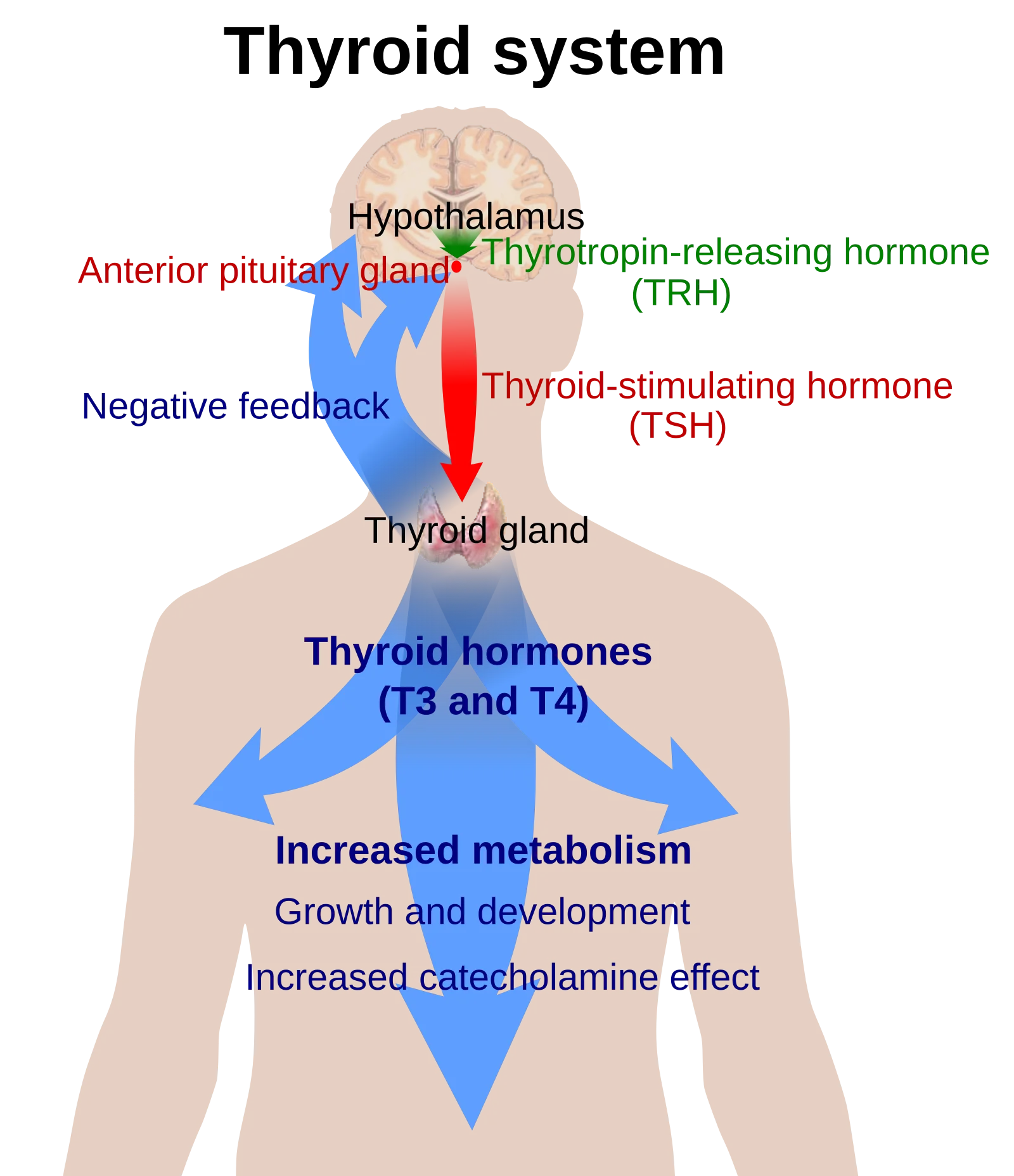
The hypothalamic-pituitary-thyroid axis is the classic example of a negative feedback loop:
- The hypothalamus detects low thyroid hormone levels and releases TRH (thyrotropin-releasing hormone)
- TRH stimulates the anterior pituitary to release TSH (thyroid-stimulating hormone)
- TSH stimulates the thyroid gland to produce and release T3 and T4
- Rising T3/T4 levels inhibit both the hypothalamus (reducing TRH) and the anterior pituitary (reducing TSH)
- With less TSH stimulation, the thyroid reduces hormone production
- When T3/T4 levels drop, the inhibition is lifted and the cycle restarts
This feedback loop keeps thyroid hormones in a tight range. On the MCAT, you must be able to predict what happens at every level when one component is disrupted.
Effects of Thyroid Hormones
Thyroid hormones affect virtually every organ system:
- Metabolism - increase basal metabolic rate, oxygen consumption, and heat production
- Cardiovascular - increase heart rate and cardiac output
- Nervous system - essential for brain development in fetuses and infants (deficiency during development causes cretinism - severe intellectual disability and growth failure); in adults, affect mood and alertness
- Growth - required for normal growth and development (work synergistically with growth hormone)
- GI tract - increase gut motility and nutrient absorption
- Bone - promote bone remodeling
Calcitonin
The thyroid gland also produces calcitonin from parafollicular cells (C cells). Calcitonin has one job: lower blood calcium when it gets too high.
Calcitonin works by:
- Stimulating osteoblasts (bone-building cells) to deposit calcium into bone
- Inhibiting osteoclasts (bone-destroying cells) to prevent calcium release from bone
- Increasing calcium excretion by the kidneys
- Decreasing calcium absorption in the gut
Parathyroid Hormone (PTH)
Four tiny parathyroid glands sit on the posterior surface of the thyroid. They produce parathyroid hormone (PTH), which does the exact opposite of calcitonin: it raises blood calcium.
PTH is released when blood calcium drops too low (hypocalcemia). It raises calcium through three mechanisms:
- Bone - stimulates osteoclasts to break down bone and release calcium into the blood (opposite of calcitonin)
- Kidneys - increases calcium reabsorption (less calcium lost in urine) and stimulates activation of vitamin D (converting 25-hydroxyvitamin D to active calcitriol in the proximal tubule)
- Gut - indirectly increases calcium absorption from food via calcitriol (active vitamin D)
When blood calcium is restored, elevated Ca2+ directly inhibits further PTH secretion from the parathyroid glands.
Calcitonin vs. PTH: The Calcium Seesaw
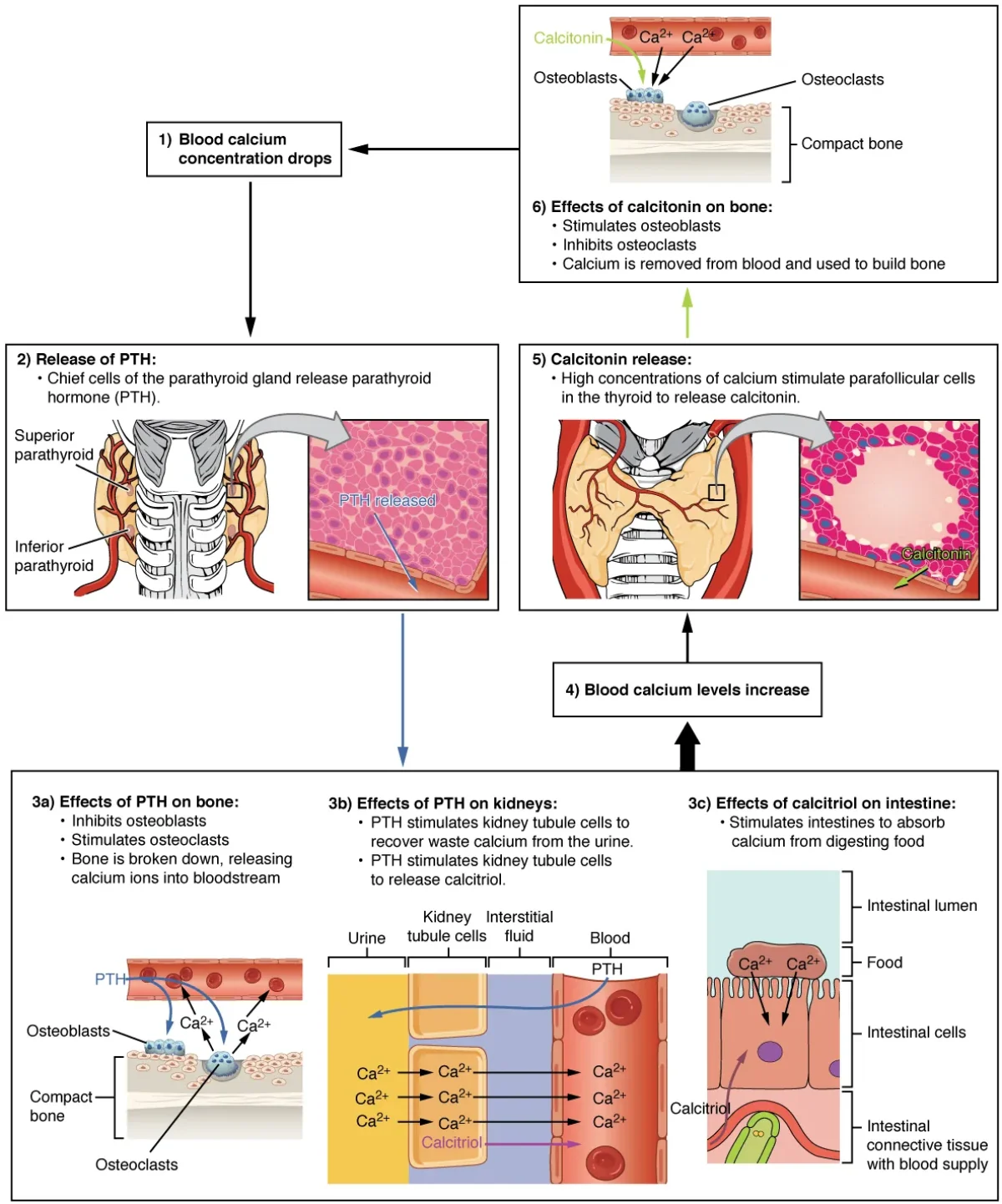
These two hormones work in opposition to keep blood calcium in its narrow optimal range (~8.5-10.5 mg/dL):
| Feature | Calcitonin | PTH |
|---|---|---|
| Source | Thyroid C cells | Parathyroid glands |
| Released when | Ca2+ too HIGH | Ca2+ too LOW |
| Effect on blood Ca2+ | Decreases | Increases |
| Effect on osteoblasts | Stimulates (build bone) | Inhibits |
| Effect on osteoclasts | Inhibits (stop breakdown) | Stimulates (break bone) |
| Kidney effect | Increases Ca2+ excretion | Decreases Ca2+ excretion, activates vitamin D |
| Gut effect | Decreases Ca2+ absorption | Increases Ca2+ absorption (via vitamin D) |
Thyroid Disorders
Hyperthyroidism (overactive thyroid) - too much T3/T4. Symptoms: weight loss, rapid heart rate, anxiety, tremor, heat intolerance, increased sweating. The most common cause is Graves’ disease, an autoimmune condition where antibodies mimic TSH and stimulate the thyroid. In Graves’ disease, TSH levels are actually LOW (because high T3/T4 suppress TSH via negative feedback, but the antibodies bypass this control).
Hypothyroidism (underactive thyroid) - too little T3/T4. Symptoms: weight gain, fatigue, cold intolerance, constipation, depression, dry skin. Can be caused by iodine deficiency, autoimmune destruction (Hashimoto’s thyroiditis), or surgical removal. In primary hypothyroidism, TSH levels are HIGH (because low T3/T4 cannot suppress TSH).
Goiter - enlargement of the thyroid gland. Can occur in both hyper- and hypothyroidism. In iodine deficiency, the thyroid enlarges as it tries to compensate for inadequate hormone production under constant TSH stimulation.