
Adrenal Glands
Sitting like small hats on top of each kidney, the adrenal glands are two organs in one. The outer layer (cortex) is an endocrine gland that produces steroid hormones on a timescale of hours to days. The inner core (medulla) is essentially a modified extension of the sympathetic nervous system that produces catecholamines for immediate fight-or-flight responses measured in seconds.
This dual identity makes the adrenal glands a bridge between chronic stress management and acute survival responses. The MCAT tests both layers extensively - and expects you to know exactly which hormones come from which zone.
Adrenal Cortex: Three Zones, Three Hormone Classes
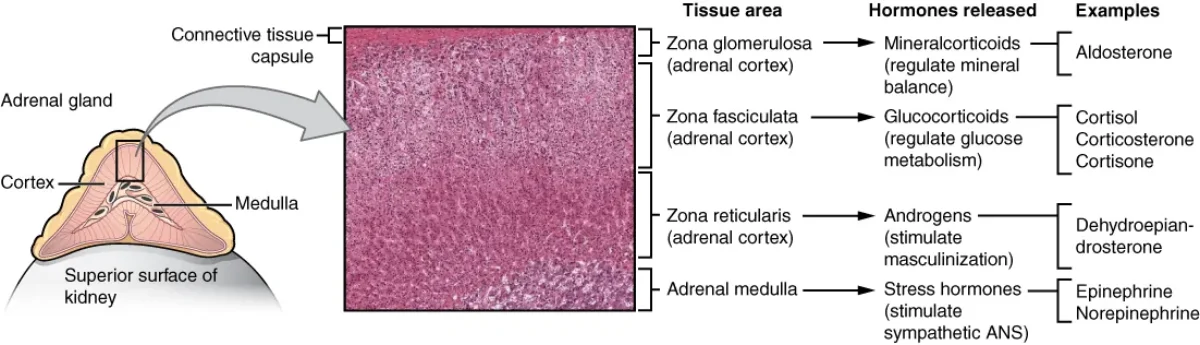
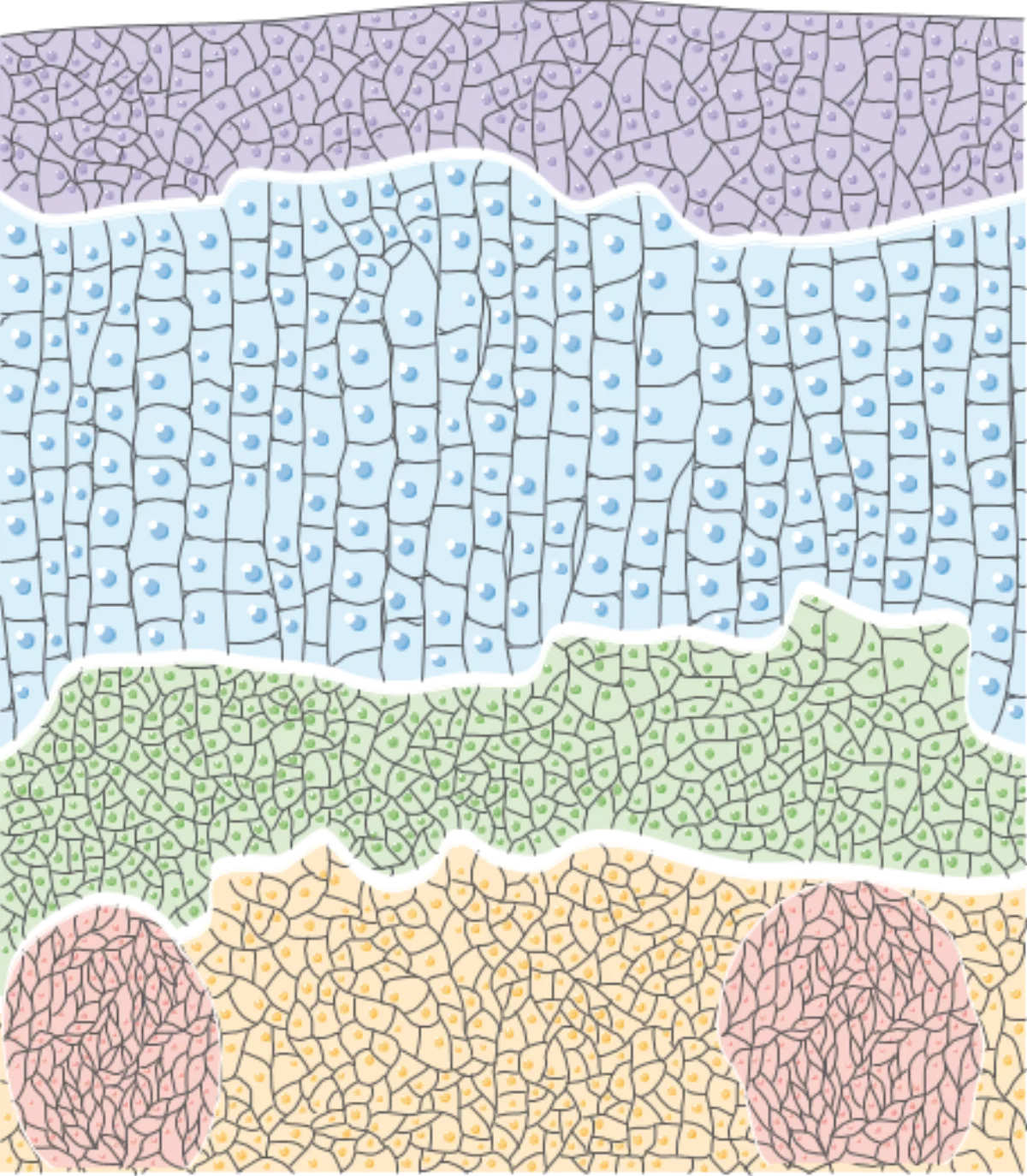
The adrenal cortex is organized into three concentric layers, each producing a different class of steroid hormone. All three classes are synthesized from cholesterol.
Zona Glomerulosa - Mineralocorticoids (Salt)
The outermost layer produces aldosterone, the primary mineralocorticoid. Aldosterone acts on the distal convoluted tubule and collecting duct of the kidney nephron to:
- Increase sodium reabsorption (Na+ moves from urine back into blood)
- Increase potassium secretion (K+ moves from blood into urine)
- Increase water retention (water follows sodium osmotically)
The net effect: blood volume increases, blood pressure rises.
Aldosterone is primarily regulated by the renin-angiotensin-aldosterone system (RAAS), not by ACTH. When blood pressure drops or sodium levels fall, the kidneys release renin, which converts angiotensinogen to angiotensin I. ACE (angiotensin-converting enzyme, primarily in the lungs) converts angiotensin I to angiotensin II. Angiotensin II is a potent vasoconstrictor AND stimulates aldosterone release from the zona glomerulosa.
High potassium levels also directly stimulate aldosterone release - this is a safety mechanism to prevent dangerous hyperkalemia.
Zona Fasciculata - Glucocorticoids (Sugar)
The middle (and largest) layer produces cortisol, the primary glucocorticoid. Cortisol is the body’s long-term stress hormone, regulated by the HPA axis (CRH from hypothalamus - ACTH from anterior pituitary - cortisol from adrenal cortex).
Cortisol’s effects:
- Raises blood glucose - stimulates gluconeogenesis in the liver, reduces glucose uptake in peripheral tissues
- Protein catabolism - breaks down muscle protein to provide amino acid substrates for gluconeogenesis
- Lipolysis - mobilizes fatty acids from adipose tissue
- Anti-inflammatory - suppresses immune cell activity, inhibits cytokine production, prevents T-cell proliferation
- Immunosuppressive - chronic elevation weakens the immune system
- Cardiovascular - increases vascular sensitivity to catecholamines, maintaining blood pressure
Cortisol follows a diurnal rhythm - highest in the early morning (preparing the body for the day) and lowest at night. Stress overrides this rhythm.
Zona Reticularis - Androgens (Sex)
The innermost cortical layer produces androgens - primarily DHEA (dehydroepiandrosterone) and androstenedione. These are weak sex hormones that serve as precursors. In peripheral tissues (especially the gonads and skin), they are converted into more potent forms: testosterone and estrogen.
In males, adrenal androgens are a minor source compared to testicular testosterone. In females, adrenal androgens are a significant source of circulating androgens and contribute to libido, pubic hair growth, and axillary hair growth.
Adrenal Medulla - Catecholamines (Fight or Flight)
The adrenal medulla is the inner core of the gland. It is not really a typical endocrine organ - it is a collection of modified postganglionic sympathetic neurons called chromaffin cells. These cells are directly innervated by preganglionic sympathetic neurons via the splanchnic nerves.
When the sympathetic nervous system is activated (stress, danger, exercise), acetylcholine from preganglionic neurons stimulates the chromaffin cells to release catecholamines directly into the bloodstream:
- Epinephrine (adrenaline) - ~80% of medullary output
- Norepinephrine (noradrenaline) - ~20% of medullary output
Both are derived from the amino acid tyrosine through the pathway: Tyrosine - L-DOPA - Dopamine - Norepinephrine - Epinephrine.
Epinephrine effects:
- Increases heart rate and cardiac output
- Bronchodilation (opens airways)
- Glycogenolysis and lipolysis (mobilizes energy)
- Dilates blood vessels in skeletal muscle
- Raises blood glucose
Norepinephrine effects:
- Primarily vasoconstriction (raises blood pressure)
- Increases alertness and attention
- Redirects blood from skin and viscera to muscles and brain
| Zone/Region | Hormone Class | Key Hormones | Primary Regulator | Main Effects |
|---|---|---|---|---|
| Zona Glomerulosa | Mineralocorticoids | Aldosterone | RAAS, K+ levels | Na+/H2O retention, K+ excretion |
| Zona Fasciculata | Glucocorticoids | Cortisol | ACTH (HPA axis) | Raise glucose, anti-inflammatory |
| Zona Reticularis | Androgens | DHEA, androstenedione | ACTH | Sex hormone precursors |
| Adrenal Medulla | Catecholamines | Epinephrine, norepinephrine | Sympathetic nervous system | Fight-or-flight response |