
Feedback Loops
Feedback loops are the operating system of the endocrine system. Without them, hormone levels would spiral out of control - a little too much cortisol would trigger more cortisol, which would trigger even more, until the system self-destructed. Instead, the body uses feedback to keep every hormone within a precise range.
The MCAT tests feedback loops constantly. You need to be able to predict what happens at every level of a hormonal axis when one component is blocked, destroyed, or overproduced.
Negative Feedback: The Thermostat Model
Negative feedback is the dominant control mechanism in the endocrine system. The principle is simple: the output of a process inhibits the process itself. When the product builds up, production slows down. When the product drops, production speeds up.
Major Negative Feedback Loops
HPA Axis (Cortisol Regulation)
- Stress triggers the hypothalamus to release CRH
- CRH stimulates the anterior pituitary to release ACTH
- ACTH stimulates the adrenal cortex to produce cortisol
- Cortisol feeds back to inhibit both CRH (hypothalamus) and ACTH (anterior pituitary)
- Result: cortisol levels rise during stress, then return to baseline as the feedback kicks in
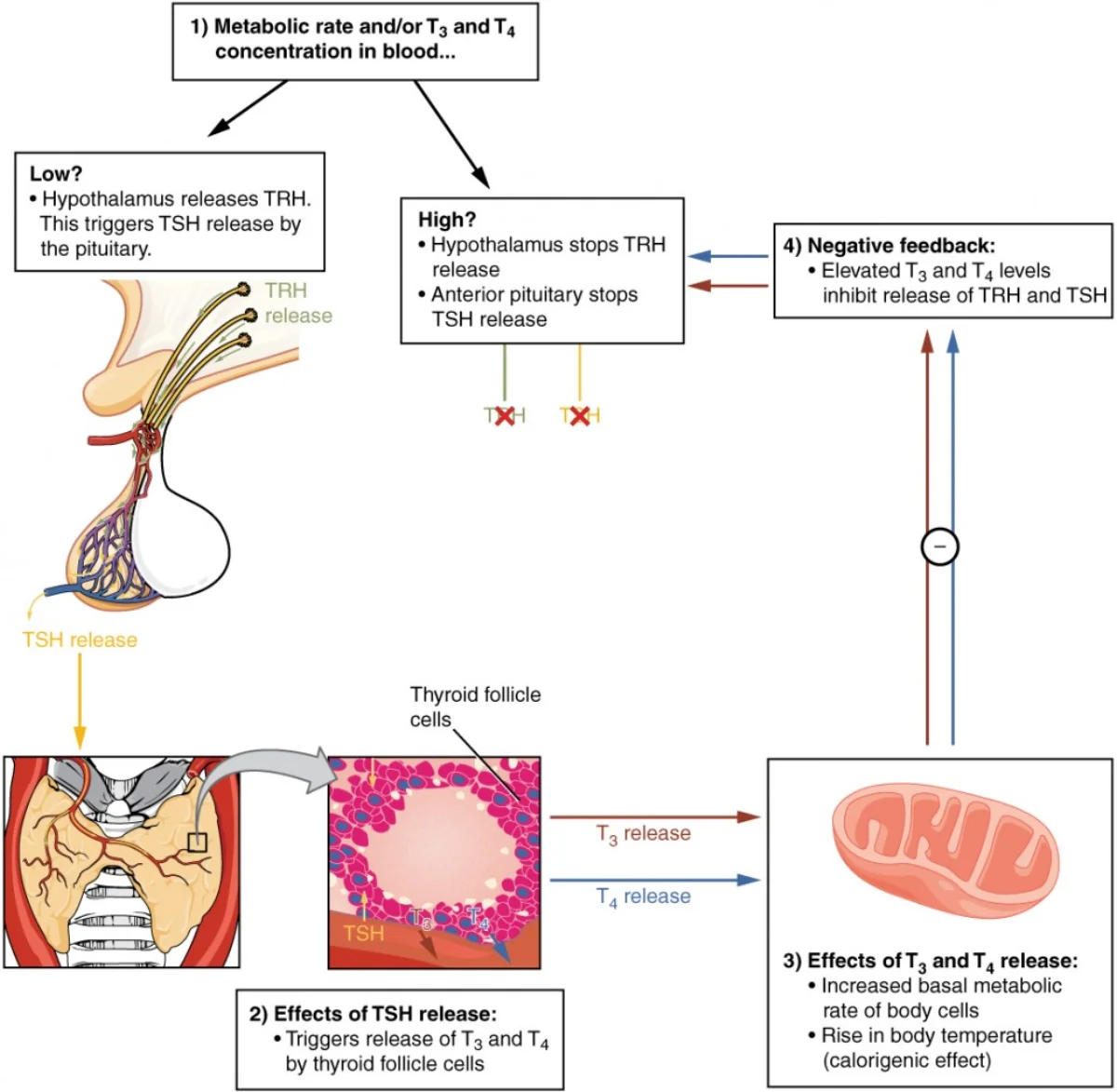
HPT Axis (Thyroid Regulation)
- Low thyroid hormones prompt the hypothalamus to release TRH
- TRH stimulates TSH from the anterior pituitary
- TSH stimulates T3/T4 production from the thyroid
- Rising T3/T4 inhibit TRH and TSH
- Result: thyroid hormones are maintained in a tight range
Blood Glucose Regulation
- High glucose after a meal triggers insulin from beta cells
- Insulin drives glucose into cells, lowering blood glucose
- Falling glucose reduces the stimulus for insulin secretion
- Low glucose triggers glucagon from alpha cells
- Glucagon raises blood glucose by stimulating the liver
- Rising glucose reduces the stimulus for glucagon
Calcium Homeostasis
- Low blood Ca2+ triggers PTH release from parathyroid glands
- PTH raises Ca2+ (bone resorption, kidney reabsorption, vitamin D activation)
- Rising Ca2+ inhibits further PTH secretion
- High blood Ca2+ triggers calcitonin from thyroid C cells
- Calcitonin deposits Ca2+ into bone, lowering blood levels
Water Balance (ADH)
- High blood osmolarity (dehydration) triggers ADH release from posterior pituitary
- ADH increases water reabsorption in collecting ducts, diluting the blood
- As osmolarity normalizes, ADH secretion decreases
Predicting Disruptions: The MCAT Strategy
The MCAT loves to present scenarios where one component of a feedback loop is damaged and asks you to predict the consequences. Here is the systematic approach:
Step 1: Identify the axis (HPA, HPT, HPG, etc.)
Step 2: Determine which level is affected (hypothalamus, pituitary, or target gland)
Step 3: Trace the consequences up and down the axis
Example: Primary hypothyroidism (thyroid gland is damaged)
- Thyroid produces less T3/T4
- Less T3/T4 means less negative feedback on the pituitary and hypothalamus
- Without feedback inhibition, TRH and TSH increase
- Result: Low T3/T4, HIGH TSH (“primary” = the problem is at the gland level)
Example: Secondary hypothyroidism (pituitary is damaged)
- Pituitary produces less TSH
- Less TSH means less thyroid stimulation
- Thyroid produces less T3/T4
- But TRH from hypothalamus increases (trying to compensate)
- Result: Low T3/T4, LOW TSH (“secondary” = the problem is at the pituitary level)
Positive Feedback: The Rare Amplifier
Positive feedback is the opposite of negative feedback: the output amplifies the process rather than inhibiting it. This creates an escalating cycle that continues until an external event breaks the loop. Positive feedback is rare in the endocrine system because runaway amplification is inherently dangerous.
Key positive feedback examples for the MCAT:
1. Oxytocin during labor
- Baby’s head pushes against the cervix
- Cervical stretch signals the hypothalamus to release more oxytocin
- Oxytocin causes stronger uterine contractions
- Stronger contractions push the baby harder against the cervix
- More cervical stretch triggers even more oxytocin
- Loop breaks when the baby is delivered (stimulus removed)
2. Estrogen and the LH surge
- Rising estrogen from the dominant follicle reaches a threshold
- High sustained estrogen switches from negative to positive feedback on the anterior pituitary
- LH surge occurs
- LH surge triggers ovulation
- After ovulation, the corpus luteum produces progesterone, which restores negative feedback
- Loop breaks when ovulation occurs
3. Prolactin during breastfeeding
- Suckling stimulates nerve endings in the nipple
- Signals to the hypothalamus reduce dopamine release
- Less dopamine means less inhibition of prolactin
- More prolactin means more milk production
- More milk encourages more suckling
- Loop breaks when the infant stops nursing
4. Blood clotting cascade (not endocrine, but a classic positive feedback example)
- Activated platelets release signals that activate more platelets
- The clot grows until the vessel is sealed
Negative vs. Positive Feedback Summary
| Feature | Negative Feedback | Positive Feedback |
|---|---|---|
| Effect | Output inhibits the stimulus | Output amplifies the stimulus |
| Goal | Maintain homeostasis (stability) | Drive a process to completion |
| Frequency | Extremely common | Rare |
| Duration | Continuous | Self-limiting (needs external break) |
| Examples | Cortisol, thyroid, insulin/glucagon, PTH/Ca2+ | Oxytocin in labor, LH surge, prolactin in lactation |