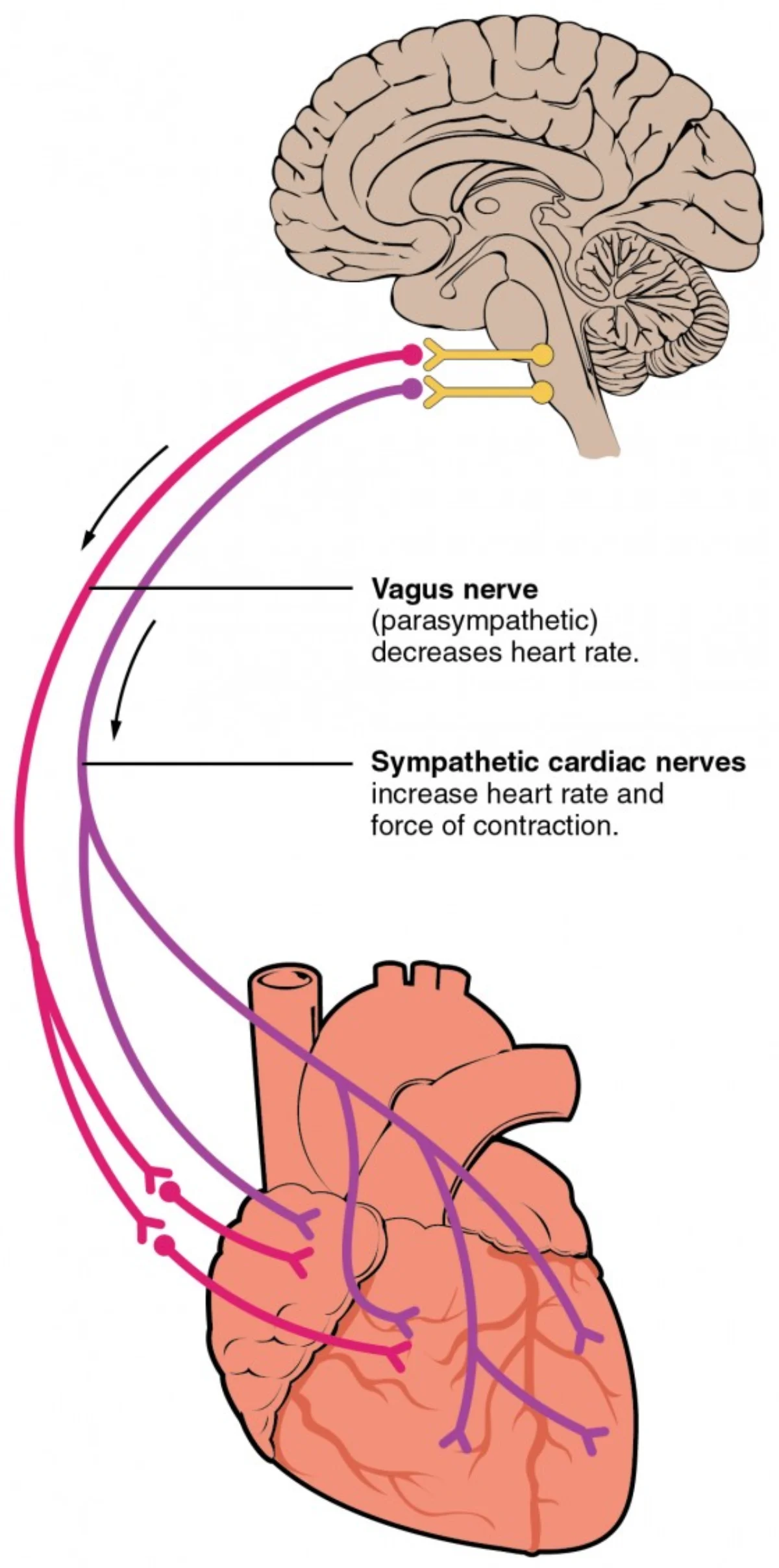
Cardiac Output
Cardiac output (CO) answers a simple question: how much blood does the heart pump per minute? It is the single most important measure of the heart’s performance, and the MCAT tests it relentlessly - both the formula itself and the physiological factors that change it. For the physics of blood flow through vessels (Poiseuille’s law, Bernoulli’s equation), see fluid dynamics in physics.
The Core Formula
Think of it this way: the total water flowing out of a pump per minute depends on how much water per squeeze (stroke volume) multiplied by how many squeezes per minute (heart rate). Increase either one, and cardiac output goes up.
Stroke Volume
Stroke volume is the amount of blood ejected from the left ventricle with each heartbeat. It is calculated as:
Ejection fraction (EF) is the percentage of blood ejected per beat: EF = SV/EDV. A normal EF is about 55-70%. An EF below 40% indicates heart failure - the ventricle is not emptying effectively.
The Three Determinants of Stroke Volume
Stroke volume is controlled by three factors. You must know all three:
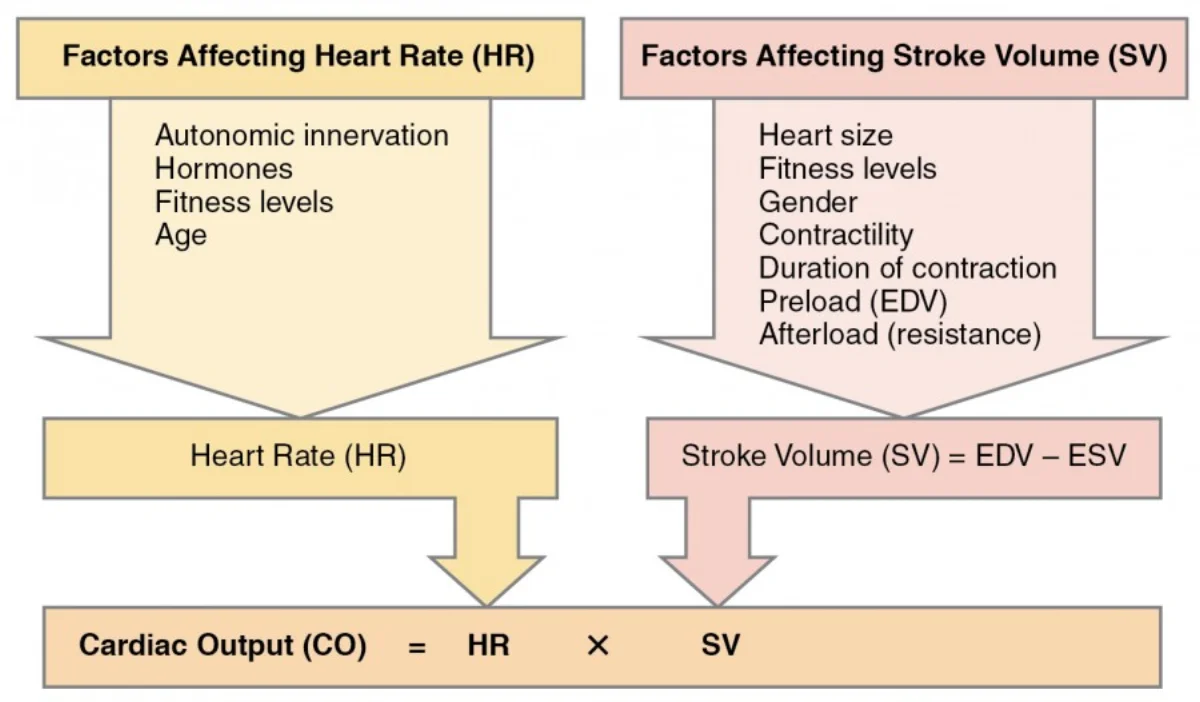
1. Preload - the degree of stretch on the ventricular wall at the end of diastole. More blood returning to the heart (increased venous return) = more stretch = more preload. Preload is essentially EDV.
2. Afterload - the resistance the ventricle must overcome to eject blood. In the left ventricle, afterload is determined primarily by aortic pressure (or total peripheral resistance). Higher blood pressure = higher afterload = harder for the ventricle to eject = decreased stroke volume.
3. Contractility (inotropy) - the intrinsic strength of contraction, independent of preload. Sympathetic stimulation and epinephrine increase contractility. Contractility increases stroke volume by reducing ESV (the ventricle squeezes more completely).
The Frank-Starling Mechanism
This is arguably the most important concept in cardiovascular physiology for the MCAT.
The Frank-Starling law states: the more the ventricle fills with blood during diastole (greater preload/EDV), the more forcefully it contracts during systole, ejecting a greater stroke volume.
Why? When cardiac muscle fibers are stretched more, actin and myosin filaments reach a more optimal overlap, generating stronger cross-bridge cycling. Up to a point, more stretch = more force.
The physiological power of Frank-Starling: it automatically matches the output of the right and left ventricles. If the right ventricle suddenly pumps more blood to the lungs, more blood returns to the left atrium, increasing left ventricular preload, which increases left ventricular stroke volume. The system is self-balancing.
Autonomic Regulation of Heart Rate
| Factor | Effect on HR | Effect on Contractility | Mechanism |
|---|---|---|---|
| Sympathetic stimulation | Increases (chronotropy) | Increases (inotropy) | Norepinephrine on beta-1 receptors |
| Parasympathetic (vagus) | Decreases | Minimal effect on ventricles | ACh on muscarinic receptors at SA/AV nodes |
| Epinephrine (adrenal) | Increases | Increases | Circulating catecholamine on beta-1 receptors |