
Blood Pressure
Blood pressure is the force that blood exerts on the walls of blood vessels. Without adequate pressure, blood cannot reach the brain, kidneys, or any other organ. Too much pressure damages vessel walls and leads to heart attacks and strokes. The body maintains blood pressure within a narrow range using a combination of rapid neural reflexes and slower hormonal systems.
Measuring Blood Pressure
Blood pressure is recorded as systolic/diastolic (e.g., mmHg).
- Systolic pressure (~120 mmHg) - the peak pressure during ventricular contraction
- Diastolic pressure (~80 mmHg) - the lowest pressure during ventricular relaxation
The pulse you feel in your wrist is the difference between these two values - the pulse pressure (systolic minus diastolic = 40 mmHg).
The Blood Pressure Drop Across the Circulation
Blood pressure is not the same everywhere. It drops progressively as blood moves further from the heart: highest in the aorta (~120 mmHg systolic), lower in the arteries, sharply lower across the arterioles (the biggest single drop), low in the capillaries (~35 → 15 mmHg), and near zero in the large veins.
The biggest pressure drop occurs across the arterioles - these small, muscular vessels are the primary site of resistance in the circulatory system. This is why arterioles are called the “resistance vessels.” By constricting or dilating, they control both blood pressure and blood flow distribution to individual organs.
Rapid Regulation: The Baroreceptor Reflex
The body’s fastest blood pressure correction system is the baroreceptor reflex, a neural feedback loop that operates in seconds.
Baroreceptors are stretch-sensitive nerve endings located in the walls of the carotid sinus (at the bifurcation of the common carotid artery) and the aortic arch. When blood pressure rises, the vessel walls stretch more, and baroreceptors fire more frequently. When blood pressure falls, they fire less.
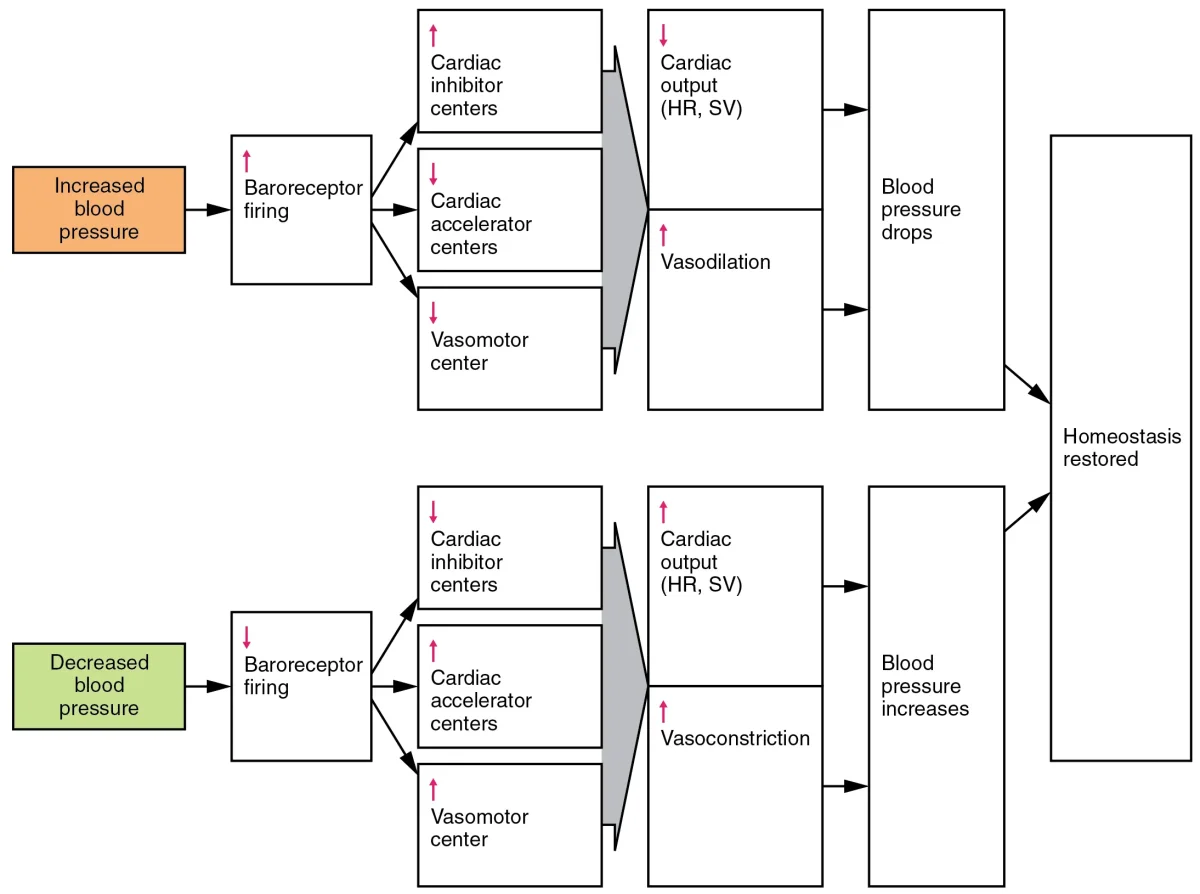
When blood pressure drops:
- Baroreceptors detect decreased stretch → fire less
- Cardiovascular center in the medulla increases sympathetic output and decreases parasympathetic output
- Heart rate increases, contractility increases, arterioles constrict
- Blood pressure rises back toward normal
When blood pressure rises:
- Baroreceptors detect increased stretch → fire more
- Medulla increases parasympathetic output and decreases sympathetic output
- Heart rate decreases, arterioles dilate
- Blood pressure falls back toward normal
Slow Regulation: Hormonal Systems
For longer-term blood pressure control, the body uses hormonal mechanisms that adjust blood volume and vascular tone over hours to days.
| Hormone/System | Trigger | Action | Net Effect on BP |
|---|---|---|---|
| RAAS (Renin-Angiotensin-Aldosterone) | Low BP, low Na+, sympathetic stimulation | Angiotensin II → vasoconstriction + aldosterone → Na+/water retention | Increases BP |
| ADH (Antidiuretic Hormone) | High osmolarity, low BP | Water reabsorption in collecting ducts → increases blood volume | Increases BP |
| ANP (Atrial Natriuretic Peptide) | Atrial stretch (high blood volume) | Na+ and water excretion, vasodilation, inhibits RAAS | Decreases BP |
| Epinephrine/NE | Sympathetic activation, stress | Vasoconstriction (alpha-1), increased HR and contractility (beta-1) | Increases BP |
The RAAS Pathway
The renin-angiotensin-aldosterone system is the most important long-term blood pressure regulator:
- Kidneys detect low blood pressure → juxtaglomerular cells release renin
- Renin converts angiotensinogen (from the liver) → angiotensin I
- ACE (angiotensin-converting enzyme, in the lungs) converts angiotensin I → angiotensin II
- Angiotensin II causes vasoconstriction (raises TPR) and stimulates aldosterone release from the adrenal cortex
- Aldosterone increases Na+ and water reabsorption in the kidneys → increases blood volume → increases CO → raises BP