When a blood vessel is damaged, the body must stop the bleeding quickly without clotting the entire circulatory system. This process - hemostasis - involves three overlapping stages that work together like a construction crew sealing a broken pipe.
Stage 1: Vascular Spasm
Immediately after injury, the damaged vessel’s smooth muscle contracts, narrowing the lumen and reducing blood flow to the area. This reflex vasoconstriction buys time for the other stages to kick in.
Stage 2: Platelet Plug Formation
When the endothelial lining is breached, the underlying collagen is exposed. Platelets stick to exposed collagen via von Willebrand factor (vWF), a sticky glycoprotein that acts as molecular glue.
Once adhered, platelets activate and undergo several changes:
Change shape from smooth discs to spiky spheres with extending pseudopods
Release chemical signals (ADP, thromboxane A2) that recruit more platelets
Aggregate together, forming a platelet plug that temporarily seals the wound
This positive feedback loop (activated platelets recruit more platelets) ensures rapid plug formation.
Stage 3: The Coagulation Cascade
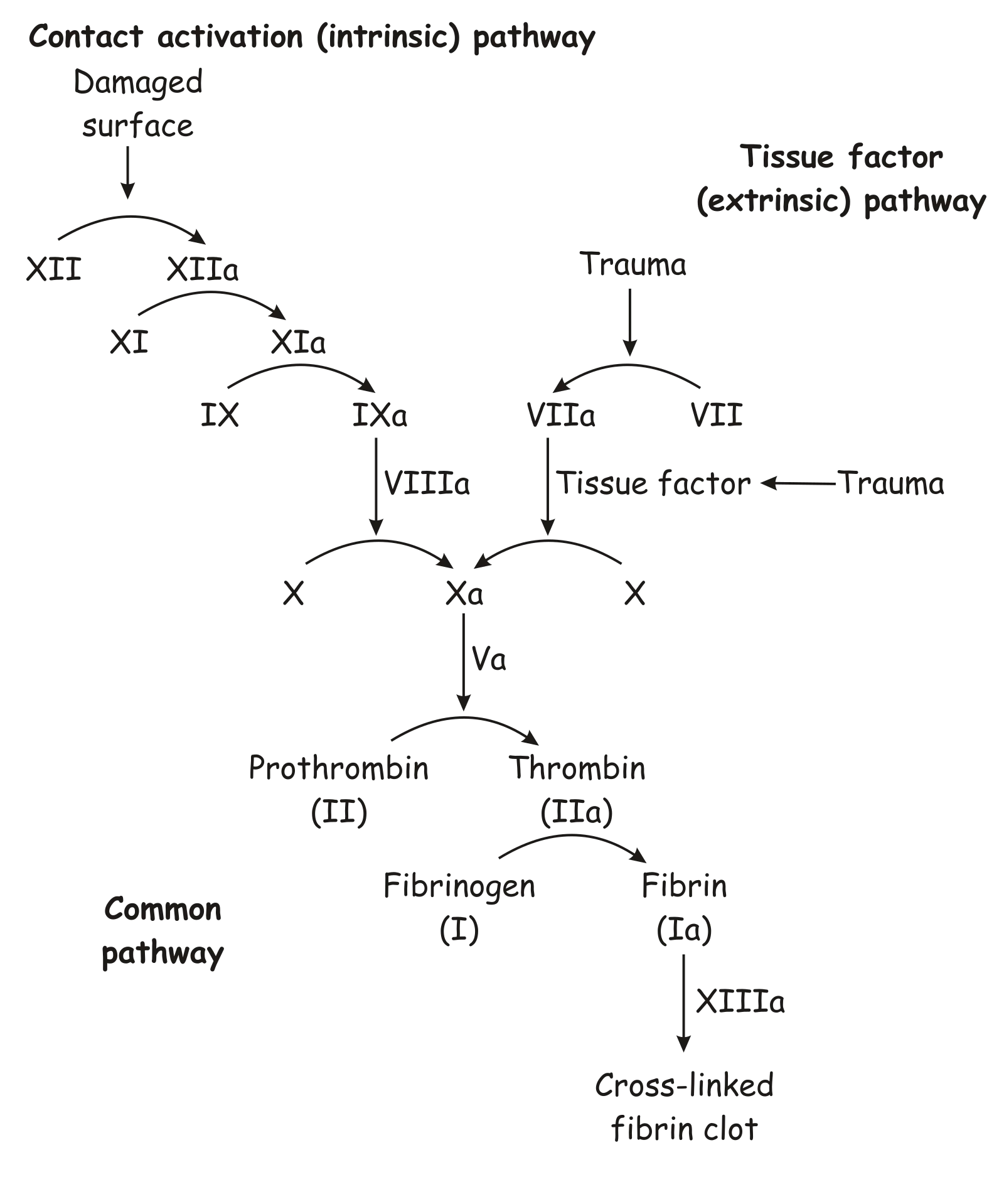
The coagulation cascade is a series of enzymatic reactions that converts soluble fibrinogen into insoluble fibrin threads, which weave through the platelet plug and harden it into a stable clot.
The coagulation cascade (simplified). Focus on: the intrinsic and extrinsic pathways converge on the common pathway, where prothrombin is converted to thrombin, which converts fibrinogen to fibrin. You do not need to memorize individual clotting factor numbers - just know the common pathway and that vitamin K is required. Credit: Wikimedia Commons, CC BY-SA 3.0
The key reaction to know is the common pathway:
A cascade of clotting factors (triggered by vessel damage) activates an enzyme that converts prothrombin → thrombin
Thrombin converts fibrinogen → fibrin
Fibrin polymerizes into a mesh that traps RBCs, platelets, and plasma, forming the stable clot
Vitamin K and Clotting
Vitamin K is essential for the liver to produce several functional clotting factors, including prothrombin. Without vitamin K, these factors cannot be properly activated, and the clotting cascade fails.
This is why newborns receive a vitamin K injection at birth - their gut flora, which normally produces vitamin K, has not yet been established.
Clot Dissolution
Once the vessel is repaired, the clot must be removed so it does not block normal blood flow. The enzyme plasmin breaks down fibrin threads, dissolving the clot. Plasmin is produced from its inactive precursor, plasminogen, which is embedded within the clot itself.
The body also has built-in safeguards to prevent clots from forming where they should not. Intact endothelial cells produce chemical signals (prostacyclin and nitric oxide) that inhibit platelet adhesion, keeping blood flowing smoothly through undamaged vessels.
What is the difference between the platelet plug and the fibrin clot? Which forms first?
Click to reveal answer
The platelet plug forms first. It is a temporary, loose aggregate of activated platelets that quickly seals the wound. The fibrin clot forms second through the coagulation cascade - fibrin threads weave through and reinforce the platelet plug, creating a stable, long-lasting clot. Think of the platelet plug as a quick patch and the fibrin clot as the permanent repair.
A patient has a vitamin K deficiency. Which stage of hemostasis is most directly impaired, and why?
Click to reveal answer
Stage 3 (the coagulation cascade) is most directly impaired. Vitamin K is required for the liver to produce functional clotting factors, including prothrombin. Without these factors, the cascade cannot convert fibrinogen to fibrin, so the permanent fibrin clot cannot form. Stages 1 (vascular spasm) and 2 (platelet plug) are unaffected because they do not depend on vitamin K.