
Lymphatic System
Every day, about 20 liters of fluid filters out of your capillaries into the interstitial space. About 17 liters is reabsorbed back into the capillaries at the venule end (via Starling forces). That leaves ~3 liters per day stranded in the tissues. Without a way to return this fluid to the blood, your tissues would swell until the pressure shut down circulation entirely.
That recovery system is the lymphatic system. It is not a separate circulatory loop - it is a one-way drainage network that collects excess interstitial fluid, filters it for pathogens, and dumps it back into the venous bloodstream.
Lymphatic Vessels
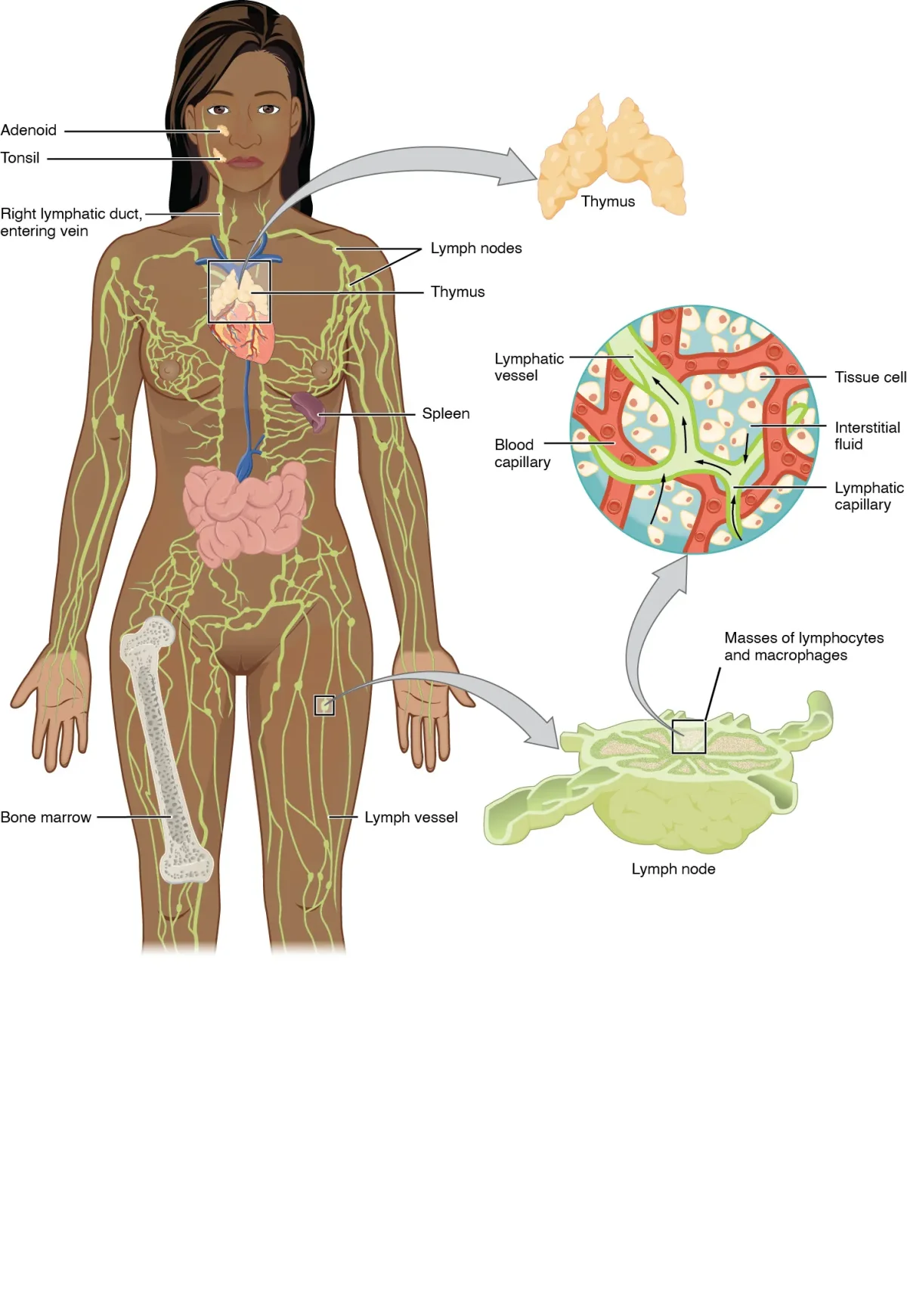
Lymph capillaries are tiny, blind-ended vessels found in nearly all tissues. They have overlapping endothelial cells that act as one-way flaps - interstitial fluid can push in, but cannot leak back out. They are more permeable than blood capillaries and can absorb large molecules, cell debris, and even bacteria.
Lymph capillaries merge into larger lymphatic vessels that resemble veins - they have thin walls, one-way valves, and rely on skeletal muscle contraction and respiratory movements to propel lymph forward (just like venous return).
All lymph eventually drains into the venous bloodstream at two points:
- The thoracic duct (left lymphatic duct) - drains about 75% of the body (left side + everything below the diaphragm) into the left subclavian vein
- The right lymphatic duct - drains the right arm, right side of the head, and right thorax into the right subclavian vein
Lymph Nodes
Lymph nodes are small, bean-shaped organs (1-25 mm) scattered along lymphatic vessels, clustered in the neck, axillae (armpits), and groin. Each node is packed with lymphocytes (B cells and T cells) and macrophages.
As lymph flows through a node, macrophages phagocytose pathogens and debris, and lymphocytes scan for foreign antigens. If an antigen is detected, an immune response is activated - beginning with the rapid, nonspecific defenses covered in innate immunity. This is why lymph nodes swell during infection - they are filling with proliferating immune cells.
Lymphoid Organs
Beyond lymph nodes, several organs play key roles in the lymphatic/immune system:
| Organ | Location | Function |
|---|---|---|
| Spleen | Upper left abdomen | Filters blood (not lymph); removes old/damaged RBCs; stores platelets; activates immune responses to blood-borne pathogens |
| Thymus | Behind the sternum | Site of T cell maturation; most active in childhood, involutes (shrinks) with age |
| Tonsils | Throat | First line of immune defense against ingested/inhaled pathogens |
| Peyer’s patches | Small intestine wall | Monitor intestinal bacteria; mount immune responses to gut pathogens |
| Bone marrow | Inside bones | Produces all blood cells (hematopoiesis); site of B cell maturation |
Three Functions of the Lymphatic System
- Fluid balance - returns ~3 liters/day of excess interstitial fluid to the blood, preventing edema
- Immune surveillance - lymph nodes filter lymph for pathogens; lymphocytes mount adaptive immune responses
- Fat absorption - specialized lymphatic vessels called lacteals in the small intestine absorb dietary fats (as chylomicrons) that are too large for blood capillaries. This is why lymph from the intestine looks milky and is called chyle.
Connection to the Cardiovascular System
The lymphatic system is the cardiovascular system’s essential partner:
- Without lymphatic drainage, the 3 liters/day of unrecovered filtrate would accumulate, causing progressive edema and eventually circulatory collapse
- Lymph returns to the blood at the subclavian veins, helping maintain blood volume and blood pressure
- The spleen serves as a blood reservoir and filter, recycling iron from old RBCs back into new hemoglobin production
If lymphatic drainage is blocked (surgical removal of lymph nodes, parasitic infection like filariasis), the affected area develops severe, chronic swelling called lymphedema. In extreme cases (elephantiasis), a limb can swell to many times its normal size.