
Saltatory Conduction
In Section 4.5 you saw that action potentials propagate by triggering the next patch of membrane to fire. In an unmyelinated axon, this happens at every point along the fiber - a slow, energy-expensive process. Evolution solved this problem with myelin, a fatty insulating sheath that transforms the way signals travel. The result is saltatory conduction, one of the most elegant speed upgrades in biology.
The word “saltatory” comes from the Latin saltare, meaning “to jump.” That is exactly what the action potential appears to do - it leaps from one gap in the myelin to the next, skipping over the insulated segments entirely.
Continuous Conduction: The Slow Lane
In unmyelinated fibers, voltage-gated Na+ and K+ channels are distributed along the entire length of the axon. When an action potential fires at one location, local currents depolarize the immediately adjacent membrane to threshold, and a new action potential is generated there. This repeats point by point.
This approach works, but it has two major drawbacks. First, it is slow - conduction velocities in unmyelinated fibers typically range from 0.5 to 2 m/s. Second, every patch of membrane that fires an action potential needs its Na+ and K+ gradients restored by the Na+/K+ ATPase, which costs ATP. Over a long axon, this adds up to significant energy expenditure.
Saltatory Conduction: The Express Lane
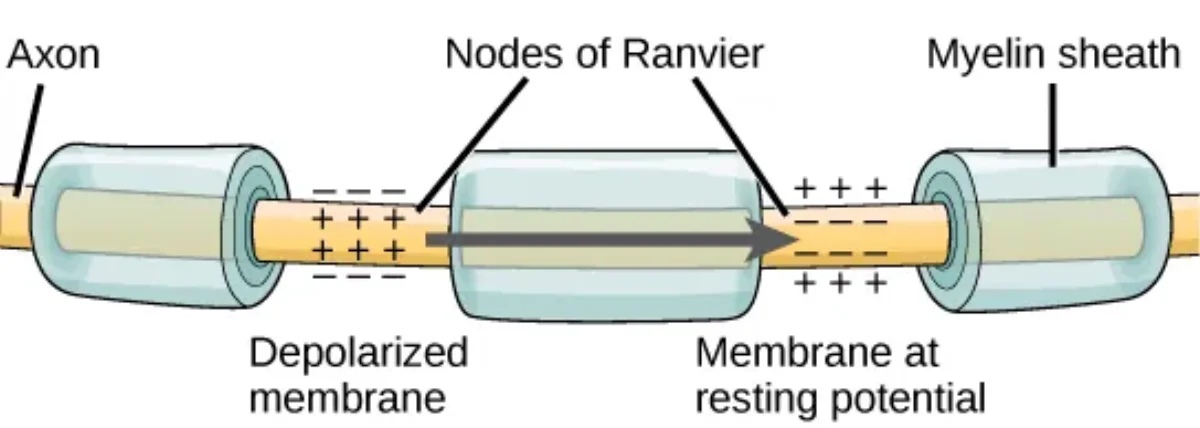
In myelinated fibers, the axon is wrapped in layers of myelin produced by glial cells - oligodendrocytes in the CNS and Schwann cells in the PNS. The myelin acts as an electrical insulator, preventing ion leakage across the membrane.
Between each myelinated segment are small exposed gaps called nodes of Ranvier. These nodes are packed with voltage-gated Na+ channels. When an action potential fires at one node, the resulting current flows passively through the myelinated segment (which resists ion leakage) and depolarizes the membrane at the next node to threshold.
The action potential effectively “jumps” from node to node. Because the signal only needs to be regenerated at the nodes - not at every point along the axon - saltatory conduction is both faster and more energy-efficient than continuous conduction.
Why Saltatory Conduction Is Faster
Two factors explain the speed increase:
-
Distance per regeneration step. In continuous conduction, the action potential regenerates at essentially every micrometer. In saltatory conduction, nodes of Ranvier are spaced roughly 1 mm apart. Each “jump” covers a much greater distance before the signal needs to be rebuilt.
-
Passive current flow is nearly instantaneous. The current flowing through a myelinated internode travels at close to the speed of electrical conduction in a cable - far faster than the time required for voltage-gated channels to open, ions to flow, and the membrane to depolarize.
Myelinated neurons can conduct signals at speeds of up to 120 m/s - roughly 60 to 100 times faster than unmyelinated fibers of similar diameter.
Why Saltatory Conduction Is More Energy-Efficient
Since action potentials only fire at the nodes of Ranvier, only those small regions experience Na+ influx and K+ efflux. That means the Na+/K+ ATPase only needs to restore ion gradients at the nodes, not along the entire length of the axon.
This dramatically reduces ATP consumption. For a neuron that fires thousands of action potentials per second, this energy savings is substantial.
Factors Affecting Conduction Velocity
Three main factors determine how fast an action potential travels:
| Factor | Effect on Speed | Explanation |
|---|---|---|
| Myelination | Greatly increases speed | Enables saltatory conduction; reduces capacitance and ion leakage |
| Axon diameter | Larger = faster | Wider axons have lower internal resistance, so current spreads farther |
| Temperature | Higher = faster (to a point) | Warmer temperatures increase ion channel kinetics and diffusion rates |
The MCAT often asks you to predict conduction velocity changes. A large, myelinated fiber (like an alpha motor neuron) conducts much faster than a small, unmyelinated fiber (like a C-fiber carrying dull pain). This is why sharp pain (carried by myelinated A-delta fibers) reaches the brain before dull, aching pain (carried by unmyelinated C fibers).