
Resting Potential
Every neuron in your body, even when completely “at rest” and not firing, maintains a voltage difference across its membrane of approximately -70 mV. This resting membrane potential is not a passive state - it is an actively maintained, energy-consuming condition that keeps the neuron primed and ready to fire at a moment’s notice. Understanding how this voltage is established, maintained, and calculated is one of the most tested topics in MCAT biology.
What Is Resting Membrane Potential?
The resting membrane potential is the voltage difference across the neuronal membrane when the neuron is not transmitting a signal. By convention, it is measured as the inside of the cell relative to the outside. At rest, the inside of a typical neuron sits at approximately -70 mV - meaning the interior is negatively charged compared to the extracellular fluid.
This negativity exists because of an unequal distribution of ions across the membrane and the selective permeability of the membrane to those ions.
Ion Distribution at Rest
The key ions involved are sodium (Na+), potassium (K+), chloride (Cl-), and large organic anions (A-, primarily proteins and nucleic acids that cannot cross the membrane).
At rest, the concentration gradients are:
| Ion | Higher Concentration | Lower Concentration |
|---|---|---|
| Na+ | Outside the cell (~145 mM) | Inside the cell (~12 mM) |
| K+ | Inside the cell (~140 mM) | Outside the cell (~4 mM) |
| Cl- | Outside the cell (~120 mM) | Inside the cell (~4 mM) |
| Organic anions (A-) | Inside the cell | Cannot cross membrane |
These gradients are not accidental. They are actively maintained by the Na+/K+ ATPase and represent a massive store of potential energy.
The Na+/K+ ATPase: The Master Pump
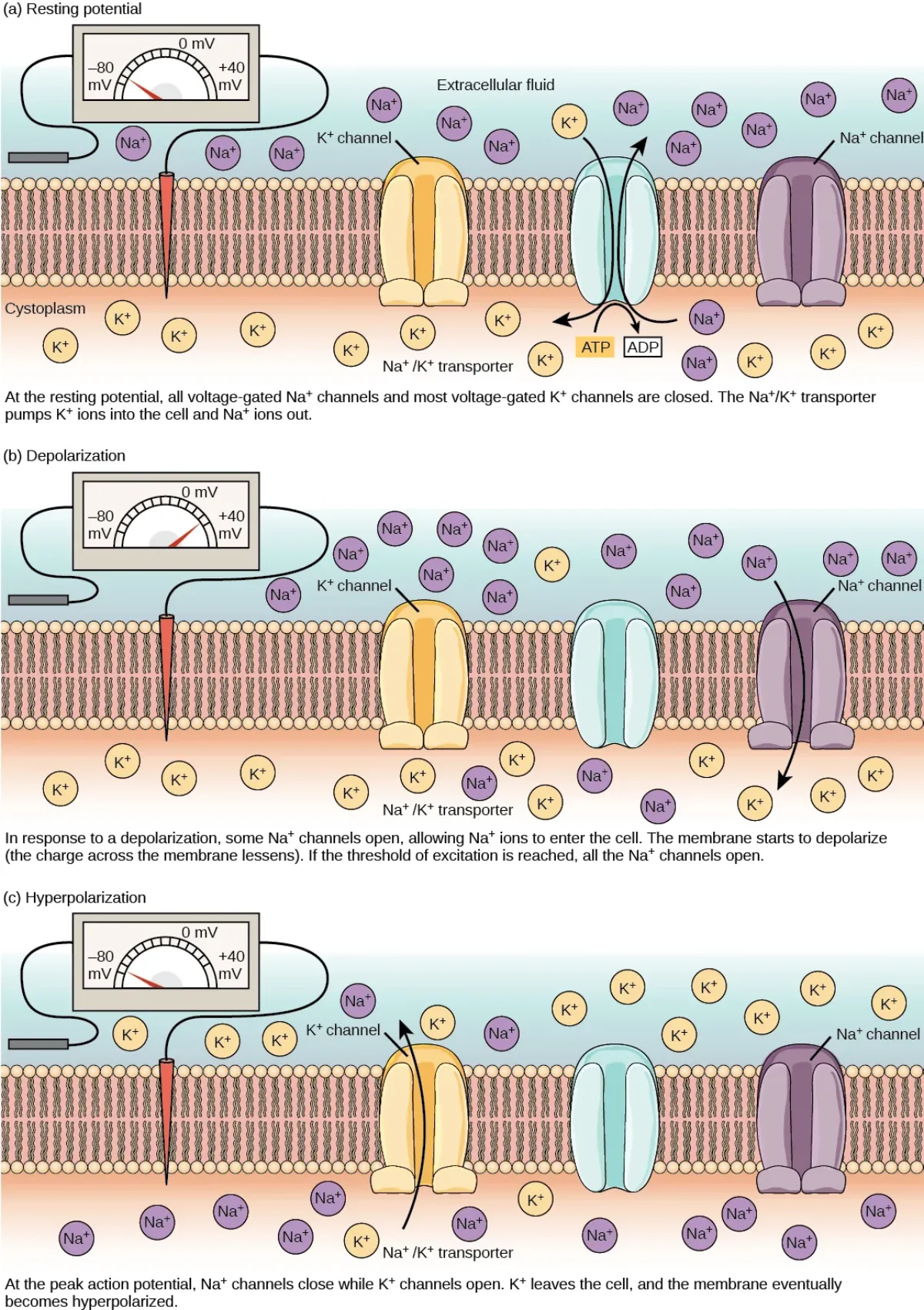
The sodium-potassium ATPase (Na+/K+ pump) is a transmembrane protein that uses the energy from one ATP molecule to pump 3 Na+ ions out of the cell and 2 K+ ions in. This 3-out, 2-in ratio is critical for two reasons:
- It maintains the concentration gradients: Na+ is kept high outside and K+ is kept high inside.
- It is electrogenic: Each cycle exports one more positive charge than it imports, creating a net loss of positive charge from the cell interior. This directly contributes about -3 to -5 mV to the resting potential.
The pump consumes a staggering amount of energy - neurons spend roughly 70% of their total ATP on Na+/K+ ATPase activity alone.
Leak Channels: Why K+ Dominates at Rest
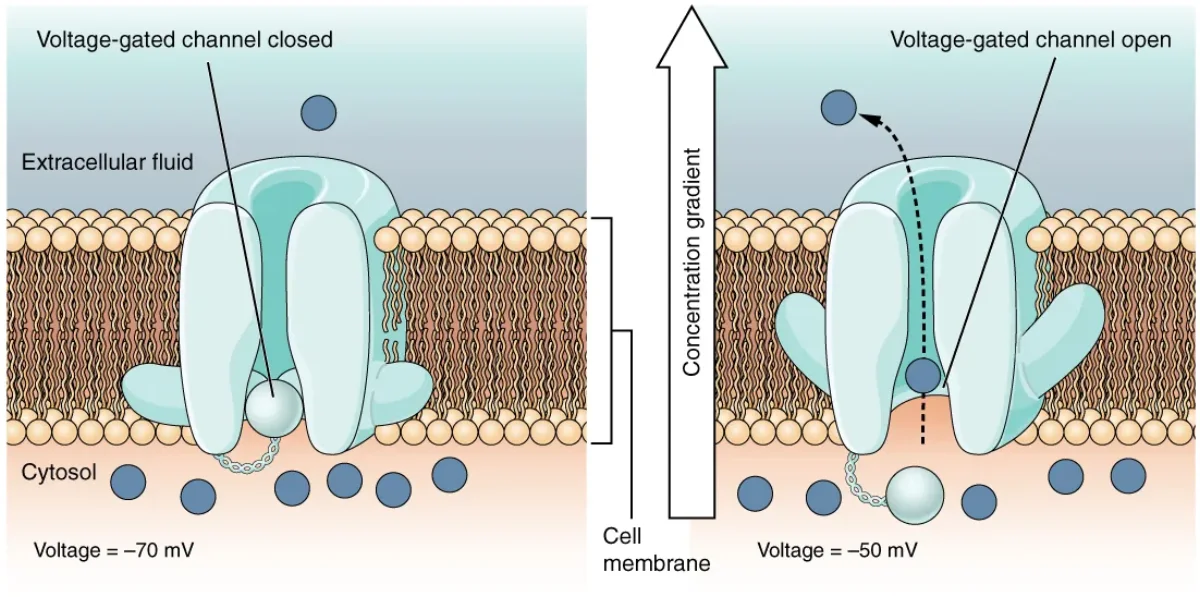
While the Na+/K+ pump creates the concentration gradients, leak channels determine the resting potential. The neuronal membrane at rest is far more permeable to K+ than to Na+ because it contains many more K+ leak channels than Na+ leak channels (roughly 50-100 times more permeable to K+).
Here is what happens: K+ ions, which are concentrated inside the cell, flow outward through leak channels down their concentration gradient. As each positive K+ ion leaves, it leaves behind unmatched negative charges (the large organic anions that cannot cross the membrane). This outflow of positive charge makes the interior increasingly negative.
But this process does not continue indefinitely. As the inside becomes more negative, the growing electrical gradient begins to pull K+ back in. Eventually, the outward chemical driving force (concentration gradient pushing K+ out) is exactly balanced by the inward electrical driving force (negative interior pulling K+ back in). This balance point is the equilibrium potential for K+, approximately -90 mV.
The actual resting potential (-70 mV) is slightly less negative than the K+ equilibrium potential because the membrane is also slightly permeable to Na+. A small, steady leak of Na+ into the cell partially offsets the K+ effect. The resting potential thus sits between the K+ equilibrium potential (-90 mV) and the Na+ equilibrium potential (+60 mV), but much closer to K+ because the membrane is far more permeable to K+ at rest.
The Nernst Equation: Equilibrium Potential for a Single Ion
The Nernst equation calculates the equilibrium potential for a single ion species - the membrane voltage at which there is no net movement of that particular ion across the membrane. This is the same Nernst equation from electrochemistry - learn it once, apply it in both subjects.
Let’s apply it to K+:
EK+ = (61.5 mV / +1) × log(4 / 140) = 61.5 × log(0.029) = 61.5 × (-1.54) = -94.7 mV
And for Na+:
ENa+ = (61.5 mV / +1) × log(145 / 12) = 61.5 × log(12.08) = 61.5 × (1.08) = +66.5 mV
These calculations reveal why K+ equilibrium is deeply negative (K+ wants to leave the cell, making the inside negative) and why Na+ equilibrium is strongly positive (Na+ wants to enter, making the inside positive).
The Goldman Equation: The Full Picture
The Nernst equation only handles one ion at a time. In reality, the membrane is permeable to multiple ions simultaneously. The Goldman-Hodgkin-Katz (GHK) equation accounts for all permeable ions and their relative permeabilities to calculate the actual membrane potential.
The key conceptual takeaway: the Goldman equation weights each ion’s contribution by its permeability. At rest, PK is roughly 50-100 times larger than PNa, so the resting potential (-70 mV) is close to EK (-90 mV). During an action potential, Na+ channels open and PNa skyrockets - the membrane potential shifts toward ENa (+60 mV). This is depolarization.
Factors That Alter Resting Membrane Potential
Several conditions can shift the resting potential, and the MCAT expects you to predict which direction:
Hyperkalemia (elevated extracellular K+): Reduces the K+ concentration gradient, so less K+ leaves the cell. The resting potential becomes less negative (depolarized), making the neuron more excitable and prone to spontaneous firing. This is why hyperkalemia is a medical emergency - it can cause fatal cardiac arrhythmias.
Hypokalemia (low extracellular K+): Increases the K+ gradient, so more K+ leaves the cell. The resting potential becomes more negative (hyperpolarized), making the neuron harder to excite.
Blocking the Na+/K+ ATPase: If the pump is inhibited, it stops maintaining gradients. Over time, Na+ accumulates inside and K+ leaks out, and the resting potential drifts toward 0 mV as concentration gradients dissipate.