
Action Potentials
The resting membrane potential you learned in Section 4.4 is like a loaded spring - it stores energy, waiting for something to release it. That release is the action potential, a rapid, self-propagating electrical signal that travels the length of an axon without losing strength. Action potentials are the language of the nervous system: every thought, movement, and sensation depends on them.
This is one of the most heavily tested topics on the MCAT. You need to know each phase, every ion channel involved, and why the signal never fades as it travels.
Threshold: The Tipping Point
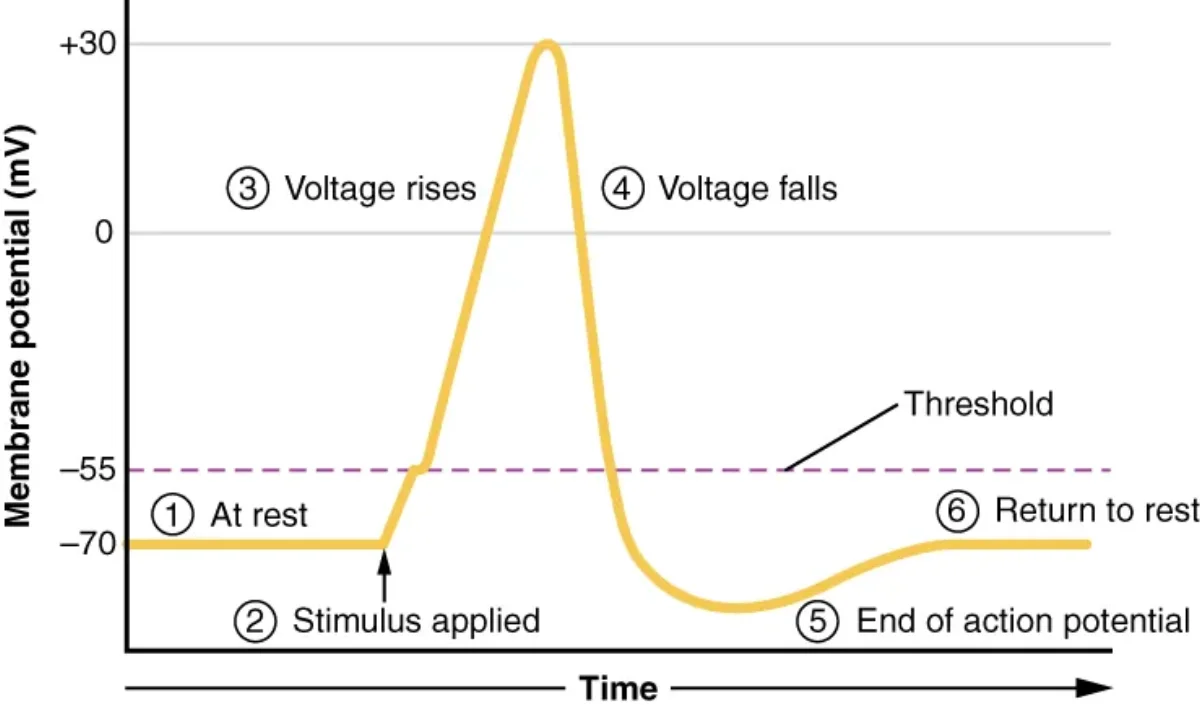
A neuron at rest sits at roughly -70 mV. Small depolarizations (graded potentials) can nudge the membrane potential upward, but nothing dramatic happens until the membrane reaches threshold, approximately -55 mV.
At threshold, a critical number of voltage-gated Na+ channels snap open, and the positive feedback loop begins: Na+ rushes in, depolarizing the membrane further, which opens even more Na+ channels. This is the point of no return. Any stimulus too weak to reach threshold will simply fade away - the neuron will not fire.
Phase 1: Depolarization
Once threshold is reached, voltage-gated Na+ channels open rapidly. Na+ floods into the cell down both its concentration gradient and electrical gradient. The membrane potential rockets from -55 mV all the way to approximately +30 mV in less than a millisecond.
This is the rising phase of the action potential. The interior of the cell briefly becomes positive relative to the outside - a complete reversal of the resting polarity.
Why does it stop at +30 mV? Two things happen almost simultaneously: (1) Na+ channels inactivate (a separate process from closing - more on this below), and (2) voltage-gated K+ channels finally open (they are slower to respond to voltage changes).
Phase 2: Repolarization
With Na+ channels inactivated and K+ channels now open, K+ rushes out of the cell. This outward flow of positive charge drives the membrane potential back down toward the resting value. The falling phase is repolarization.
Notice the key distinction: Na+ channels inactivate (a ball-and-chain mechanism physically blocks the channel pore), while K+ channels open. Both events contribute to repolarization, but they involve entirely different channel behaviors.
Phase 3: Hyperpolarization (The Undershoot)
Voltage-gated K+ channels are slow to open, and they are also slow to close. Even after the membrane potential returns to -70 mV, K+ continues to flow out. This drives the membrane potential briefly below the resting level, to about -80 to -90 mV. This dip is called hyperpolarization or the undershoot.
The Na+/K+ ATPase and K+ leak channels eventually restore the resting membrane potential to -70 mV, but the hyperpolarization phase has important consequences for refractory periods.
An action potential is all-or-nothing: below −55 mV you get only a small graded depolarization that decays back to rest, and at or above −55 mV you get one spike of fixed size and duration. Stimulus strength is coded by firing frequency, never by spike amplitude.
The All-or-Nothing Principle
An action potential is all-or-nothing. If threshold is reached, the neuron fires a full-strength action potential. If threshold is not reached, nothing happens. There is no such thing as a “half” action potential or a “strong” versus “weak” one.
This raises an important question: if all action potentials have the same amplitude, how does your nervous system distinguish between a light tap and a hard punch? The answer is frequency coding. A stronger stimulus causes a neuron to fire more action potentials per second, not bigger ones. It also recruits more neurons to fire simultaneously. The brain interprets higher frequency and greater neuron recruitment as a more intense stimulus.
The Three States of Na+ Channels
Understanding Na+ channel states is critical for understanding refractory periods:
- Closed (resting): The channel is closed but capable of opening. This is the state at resting membrane potential.
- Open (activated): The channel is open and Na+ flows through. This happens during depolarization.
- Inactivated: A separate inactivation gate blocks the channel even though the activation gate is open. The channel CANNOT be opened again until it resets to the closed state. This requires repolarization.
The difference between “closed” and “inactivated” is the single most important detail for understanding refractory periods.
Absolute Refractory Period
During the absolute refractory period, it is impossible to fire another action potential regardless of how strong the stimulus is. This corresponds to the time when Na+ channels are either open or inactivated - they physically cannot be activated again.
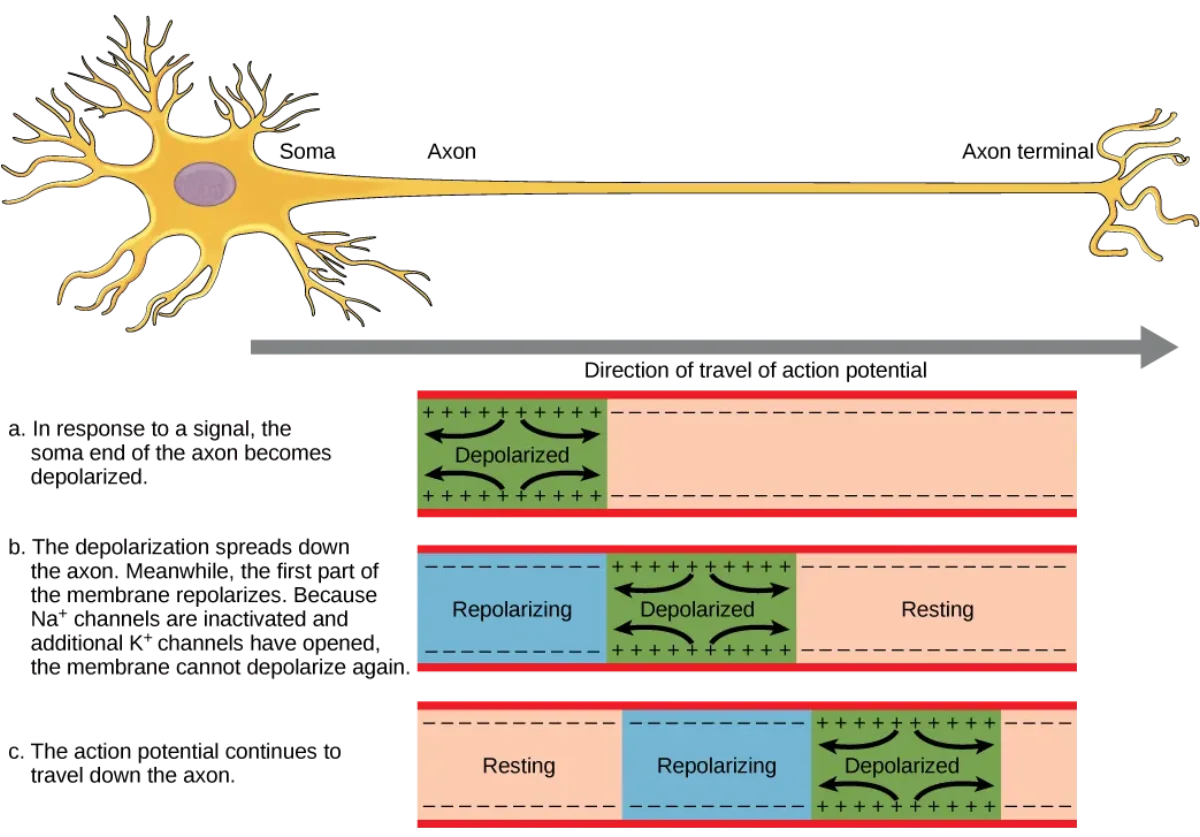
The absolute refractory period spans from the moment threshold is reached through most of repolarization. Its purpose is to ensure that the action potential propagates in one direction only. The region of membrane that just fired cannot be re-excited, so the signal moves forward.
Relative Refractory Period
During the relative refractory period, a neuron can fire again, but only if it receives a stronger-than-normal stimulus. This corresponds to the hyperpolarization phase, when voltage-gated K+ channels are still open and the membrane potential is more negative than usual.
Because the membrane starts from a more negative baseline, a larger depolarization is needed to reach threshold. A normal stimulus will not do it, but a very strong one can.
Action Potential Propagation
Once an action potential fires at one spot on the axon, it does not stay there. The influx of Na+ at one location creates a local current that depolarizes the adjacent membrane to threshold, triggering a new action potential there. This process repeats continuously down the length of the axon.
In unmyelinated fibers, this happens at every point along the membrane - continuous conduction. It works, but it is relatively slow because every patch of membrane must go through the full action potential cycle.
In myelinated fibers, the action potential appears to “jump” from one node of Ranvier to the next - saltatory conduction (covered in detail in Section 4.6). This is dramatically faster and more energy-efficient.
Key Ions and Channels Summary
| Phase | Channel Activity | Ion Movement | Membrane Potential |
|---|---|---|---|
| Resting | K+ leak channels open, voltage-gated channels closed | K+ slowly leaks out | -70 mV |
| Depolarization | Voltage-gated Na+ channels open | Na+ rushes in | -55 mV to +30 mV |
| Repolarization | Na+ channels inactivate, voltage-gated K+ channels open | K+ rushes out | +30 mV to -70 mV |
| Hyperpolarization | K+ channels slow to close | K+ continues leaving | -70 mV to -90 mV |
| Return to rest | K+ channels close, Na+/K+ ATPase restores gradients | Na+ pumped out, K+ pumped in | Back to -70 mV |