Volume I: Foundations · Chapter 2
Most of what you read on the Logical Reasoning section is an argument. Before you can strengthen one, weaken one, find its assumption, or name its flaw, you have to see how it is built. This chapter teaches you to take any block of text apart and label its pieces. It is the single most important skill in the book, because every Logical Reasoning question type that follows is just one more way of looking at the structure you learn to see here. The vocabulary introduced now (premise, conclusion, assumption, the gap) is used in every later chapter without re-explanation, so read slowly.
An argument is a set of statements in which one or more premises are offered as support for a conclusion. That is the whole definition. A premise is a statement the author puts forward as a reason. A conclusion is the claim those reasons are meant to establish. If you can find at least one statement being used to support another, you are looking at an argument.
Not everything on the LSAT is an argument. Some stimuli are a fact set: a group of statements with no conclusion, where nothing is offered as support for anything else. The author simply reports several things and stops. Compare these two short stimuli:
The new bridge cut the average commute across the river by eleven minutes. Traffic on the old ferry route fell by forty percent in the first month. The city expects ferry service to end within a year.
That is a fact set. Three claims sit side by side. None is presented as the reason for another; the author is describing a situation, not arguing for a position.
The new bridge cut the average commute across the river by eleven minutes. So the city was right to approve it over the objections of the ferry operators.
That is an argument. The first sentence is now a premise, and the word so introduces a conclusion: the city was right to approve the bridge. The author is no longer just reporting. The author is taking a position and giving you a reason to accept it.
Roughly three out of four LR stimuli are arguments; the rest are fact sets. Your first move on every stimulus is to classify which one you have. Ask: is any statement here being used to support another? If yes, it is an argument, and you must find the conclusion. If no, it is a fact set, and you work with the facts as a group. Hunting for a conclusion in a fact set, or treating a real argument as a pile of loose facts, leads you straight into the trap answers.
Here is the cleanest way to tell a premise from a conclusion. The premises are the facts the author treats as already settled. The conclusion is the opinion the author is trying to get you to accept.
Premises are offered as given. On the LSAT you do not argue with them, even if they sound false (more on this below). They are the author’s starting capital.
The conclusion is always a claim, a judgment, an opinion, a prediction, or a recommendation. It is the part that is up for debate, the thing the author wants to be true and is asking you to grant on the strength of the premises. When a sentence is the author “taking a side,” “making a call,” or “telling you what to do,” you have probably found the conclusion.
A quick test: a premise answers the question “What is your evidence?” A conclusion answers “What is your point?” If a statement sounds right after “My point is that…,” it is the conclusion. If it sounds better after “I know this because…,” it is a premise. You already sort claims this way in conversation. When a friend says, “You should watch this show, it is only six episodes and the ending is incredible,” the recommendation is the point and the two reasons are the evidence. Ask “what is the point?” and you land on “you should watch it” every time.
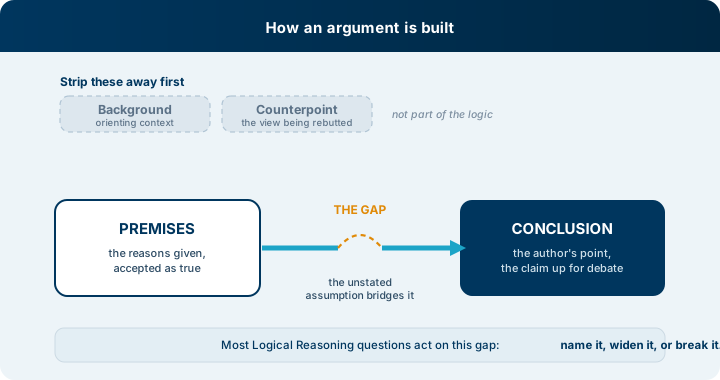
Two kinds of material are neither premise nor conclusion, and both exist mainly to slow you down.
Background is orienting context. It sets the scene so the argument makes sense, but it is not offered as support and it is not the author’s point. In the bridge argument, a sentence like “The river has divided the city’s two halves since the town was founded” would be background. It tells you where you are; it does nothing logical. Strip background away so you can see the actual premise and conclusion underneath. A good habit: once you find the conclusion, ask “Why?” The sentences that answer “Why?” are your real premises. Everything else that just describes the setting is background.
Counterpoints (also called opposing views or counter-premises) are claims that run against the author’s position. The author raises them, often to push back on them. These are dangerous because they are stated right there in the text, and a tired reader grabs them as if they were the author’s own view. They are not. They are the view the author is arguing against.
Counterpoints are usually flagged by a contrast word. When you see but, however, yet, although, admittedly, while it is true that, or critics contend, read carefully: the material on one side of that word belongs to someone the author disagrees with, and the material on the other side is the author’s real claim. Consider:
Some economists argue that the tax cut will pay for itself through faster growth. But the last three cuts of this kind all widened the deficit. The current proposal will do the same.
The first sentence is a counterpoint, the view of “some economists.” The author’s actual conclusion is the last sentence, and the contrast word But marks the turn from the opposing view to the author’s own. If you mistook the first sentence for the conclusion, you would have the argument exactly backward.
The test makers hand you signals, and you should physically mark them as you read. Circle or underline indicator words every time you see one. They are the fastest route to the structure. Learn these four lists cold.
Premise indicators (a reason is coming):
because, since, for, given that, as shown by, as indicated by, for the reason that, in that, owing to
Conclusion indicators (the point is coming):
therefore, thus, hence, so, consequently, as a result, accordingly, clearly, it follows that, which shows that, this means that
Counter and contrast indicators (an opposing or contrasting idea is coming):
but, however, yet, although, even though, admittedly, on the other hand, in contrast, despite, while, whereas
Two more families matter enormously because the LSAT exploits the exact wording.
Quantity words tell you how much of a group is covered: all, every, most, many, some, several, few, none, not all. The gap between all and most, or between some and most, is where a huge number of wrong answers live. We treat these formally in Chapter 4 (Quantifiers and Numbers).
Probability words tell you how certain a claim is: must, will, always, likely, probably, could, might, can, never, not necessarily. A conclusion that says something could be true is a very different claim from one that says it must be true. Mark these, because matching the strength of a claim is a constant theme in later chapters.
A warning that applies to all of these: indicators are tendencies, not laws. The test plants a because that introduces background, or a so that introduces a minor point rather than the main one. The words point you to the structure; they do not replace your judgment. Use them as a first read, then confirm with the test below.
When the conclusion is not obvious, use the move that all three of the major guides teach independently. We call it the Therefore Test.
Take the two statements you suspect are the premise and the conclusion. Provisionally arrange them as “X, therefore Y.” Then read it. If “X, therefore Y” makes logical sense, then Y is the conclusion. If it sounds backward, flip them: “Y, therefore X.” The arrangement that a reasonable person would actually say out loud is the one with the conclusion in the Y slot.
Here is why it works. Premises support conclusions, never the reverse. So the support always flows in one direction. The Therefore Test forces you to make the direction of support explicit, and only one direction will sound right. Try it:
Statement 1: The museum’s attendance has fallen every year for a decade.
Statement 2: The museum should change its exhibition strategy.
“Attendance has fallen for a decade, therefore the museum should change its strategy” makes sense. The reverse, “The museum should change its strategy, therefore attendance has fallen for a decade,” is nonsense; a strategy change cannot be the reason attendance already fell. So Statement 2 is the conclusion.
The conclusion can appear anywhere. Do not assume it is the last sentence. The test makers know that students reflexively grab the final line, so they deliberately bury conclusions. The conclusion can open the stimulus, with the premises following to support it. It can sit in the middle, sandwiched between a counterpoint before it and the supporting evidence after it. A common buried-conclusion pattern looks like this: opposing view, then the author’s conclusion, then the premises that back it up. If you grab the last sentence by habit, you grab a premise and miss the point entirely.
(1) City officials have proposed replacing the downtown parking lot with a public park. (2) Supporters say a park would draw more visitors to nearby shops. (3) But foot traffic in that district already exceeds the shops’ capacity during peak hours. (4) The park would therefore do little to help local businesses.
Work it in order:
Run the Therefore Test to confirm: “Foot traffic already exceeds capacity, therefore the park would do little to help businesses.” That holds. The reverse does not. The structure is Premise (3) → Conclusion (4), with (1) as background and (2) as the view being rebutted.
Some arguments have more than one conclusion. A statement can be supported by a premise and go on to support a further claim. We call such a statement an intermediate conclusion (you will also see it called a subsidiary conclusion). It is a conclusion relative to what comes before it and a premise relative to what comes after it. The structure looks like this:
Premise → Intermediate Conclusion → Main Conclusion
Only the final claim in that chain is the main conclusion, the author’s ultimate point. The intermediate conclusion is a stepping stone. Telling them apart matters, because many later question types (especially Main Conclusion in Chapter 9 and Role of a Claim in Chapter 18) are built precisely on the difference.
The danger here is the fake-out therefore. A conclusion indicator like thus or therefore marks a conclusion, but not necessarily the main one. When you see therefore, you have found the start of a conclusion; you have not yet proven it is the final one. Apply the Therefore Test again to check: does this therefore-claim support a still-later claim? If it does, it is intermediate, and the claim it supports is the real conclusion.
(1) Every employee who completed the safety course had a lower accident rate the following year. (2) So the course clearly reduces on-the-job accidents. (3) The company should therefore require the course for all new hires.
Both (2) and (3) carry conclusion indicators (So and therefore). That is the fake-out. Test the direction of support:
Because (2) is supported by (1) and in turn supports (3), it is the intermediate conclusion. The main conclusion is (3): the company should require the course. The chain is Premise (1) → Intermediate Conclusion (2) → Main Conclusion (3). If a Main Conclusion question asked for the author’s point, (2) would be the trap answer and (3) would be correct.
The conclusion you need is often stated with a pronoun or a pointer word that borrows its meaning from an earlier sentence. Watch for this, that, these, those, such, it, and similar words. The claim “This would be a serious mistake” is a conclusion, but it tells you nothing until you go back and replace “This” with the specific thing being called a mistake.
You must unpack the reference before you can state the real conclusion. Take:
Several council members want to fund the stadium by raising the sales tax. That would be unwise, since the tax falls hardest on residents who would never attend a game.
The conclusion is “That would be unwise.” But “That” is borrowed language. Unpacked, the conclusion is: funding the stadium by raising the sales tax would be unwise. When a question asks you to identify or paraphrase the conclusion, the correct answer will state the unpacked version, never the bare pronoun. Train yourself to substitute the full meaning automatically.
This is the mindset shift that separates strong scorers from everyone else. The LSAT does not care whether an argument’s premises are true in the real world. It cares whether the conclusion follows if you grant the premises. That property, “does the conclusion follow from the premises,” is called validity, and it is different from truth.
You grant the premises. Always. Even when a premise is plainly false or absurd, you accept it for the sake of the argument and ask only one thing: given this, does the conclusion hold up? An argument can rest on a false premise and still be perfectly valid in structure, and an argument can have entirely true premises and still be a logical disaster. The LSAT is testing your eye for structure, not your knowledge of the world. This is why “But that’s not actually true” is never a reason to attack a premise. If a stimulus tells you that a certain town has no paved roads, you do not object that all towns have paved roads. You accept it and reason forward.
Two rules keep you in the right frame:
Think of it as stepping into the “LSAT world,” a closed room where the only facts are the premises in front of you.
Now the central idea that the rest of the book builds on. Almost every LSAT argument leaves something unstated. There is a gap between what the premises actually establish and what the conclusion claims. The unstated claim that would bridge that gap is called an assumption: a statement the author never says out loud but must be taking for granted in order for the argument to work.
Look again at the safety-course argument. The premises were about lower accident rates among employees who completed the course. The conclusion was that the course reduces accidents. But maybe the kind of employee who signs up for a safety course is already the careful kind, the kind who would have had fewer accidents anyway. The author has assumed that the course itself, not the type of person who takes it, is doing the work. That unstated bridge is the assumption. It is exactly where the argument is vulnerable.
Here is why this matters so much. Most Logical Reasoning question types are different views of the same gap. A Necessary Assumption question asks you to name the bridge. A Strengthen question asks you to reinforce it. A Weaken question asks you to knock it out. A Flaw question asks you to describe what is wrong with relying on it. A Sufficient Assumption question asks you to build a bridge so solid the conclusion becomes airtight. Once you can see the gap, you are most of the way to answering whatever the stem asks.
You do not need to master assumption-finding yet. Chapters 11 and 12 develop it in full, and the flaw catalog in Chapter 6 names the specific ways arguments go wrong. For now, build the habit: after you find the premises and the conclusion, pause and ask, “What is this author taking for granted? What has to be true for this leap to work?” That question is the engine of the entire section.
Premise → Intermediate Conclusion → Main Conclusion) and the fake-out therefore; only the final claim is the main conclusion.