Volume II: Logical Reasoning · Chapter 7
Every Logical Reasoning question on the LSAT, no matter how strange it looks, is built from the same parts and yields to the same routine. The type chapters that follow each teach a specialized move. This chapter teaches the master method underneath all of them. Learn it cold. By the time you finish the book, this process should run on autopilot, and the type-specific moves should feel like minor adjustments to one habit, not eleven separate skills.
Three pieces, always in the same physical order on the page:
Hold onto that last number. It reframes the whole section. You are not hunting for the one good answer. You are clearing away four bad ones, and the survivor wins.
Here is the routine, distilled from the way the strongest LR programs all teach it. Five steps. Run them in order, every time, until you no longer have to think about the order.
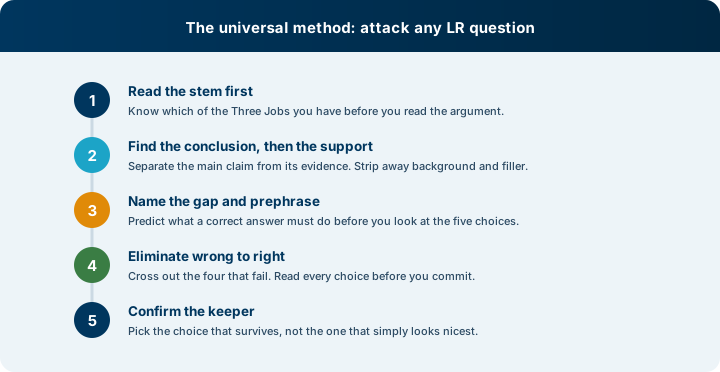
Read the stem before the stimulus, and use it to fix your job (more on the three jobs below). A Weaken stem tells you to read the stimulus as a target you are about to attack. A Must Be True stem tells you to read it as a set of facts you will mine for what follows. You read the same hundred words very differently depending on which one you are doing, so find out first.
Prep methods disagree here, and you should know where it lands. Most say stem-first; one well-known method argues you should read the stimulus first in LR, because a single stem word can mislead you about the type. We side with stem-first, for two reasons. It is the majority view, and it pays off most on exactly the types where reading stance matters: Strengthen, Weaken, Assumption, and Parallel all want you primed before you read. And the dissent’s real worry is narrow: do not let one keyword lock you into a type prematurely. That is good advice, and we fold it in. Read the whole stem and name your job, but stay open. You are setting your reading posture, not committing to a sub-type from a single word.
One honest caveat: LR stimuli are short. On a two-sentence argument you will absorb the stimulus on your first pass no matter what, so stem-first sometimes means little more than a half-second glance down before you read up. Take the glance anyway. It costs nothing and saves you on the long ones.
Now read the stimulus with your job in mind. Three things to nail down:
Read closely. Know exactly what was said, in exactly the terms it was said. Do not paraphrase the stimulus into something tidier in your head, because the tidier version usually erases the gap the test is built on.
Before you read a single answer choice, prephrase: say, in your own words, what the right answer should do. Predict the inference, or name the gap, or state the flaw, or describe the move. It does not need to be perfect. It needs to exist.
This is the single most important habit in the method, and here is exactly why. The four wrong answers are not random. They are reverse-engineered to attract you: an answer that weakens when you wanted to strengthen, an answer one degree too strong, an answer about the right topic but the wrong claim. If you walk into the choices with nothing in your head, you are reading them cold, and a cold reader is exactly who those traps are designed to catch. A prephrase gives you a standard to measure each choice against. You stop asking “does this sound good?” and start asking “is this what I predicted, or close to it?” That shift is most of the defense.
Read every choice, A through E, in order. Do not stop at the first one that looks right; the test routinely plants a tempting wrong answer just before the correct one. On this first pass, sort fast and do not deliberate:
The discipline has two halves. First, you only kill with a reason. “I don’t like it” is not a reason. “This strengthens, and I was asked to weaken” is a reason. Second, once you have killed an answer, it is dead. Do not resurrect it on the second pass. If your first-pass reason was sound, reconsidering only invites the trap to work on you a second time.
After the first pass, look only at your keepers. If one survives, that is your answer. If two or three survive, now you compare them, and you compare each one back to the stimulus and your prephrase, not to each other. The winner is the answer that is most accurate and complete against the stem’s exact demand. Attractiveness is not a criterion.
Sometimes you kill all five. When that happens, the problem is almost never the test. You misread something: the conclusion, the direction of the stem, a quantity word, the scope. Go back to the stimulus and read it again, slowly. Nine times out of ten the error was yours, and the right answer is sitting in a choice you eliminated too fast.
Underneath the dozen-plus official question types are exactly three jobs. Every stem hands you one of them. Knowing which job you are doing tells you instantly what a right answer is allowed to be and where the traps will come from. This is the organizing map of the whole book, so carry it everywhere.
| The job | What the stem is asking | Can the answer add new info? | Question types |
|---|---|---|---|
| Read It | The answer is already proven by the text. Accept the stimulus as true; bring nothing from outside. | No | Must Be True / Inference, Main Conclusion, Cannot Be True |
| Fix It or Break It | The stimulus is a flawed argument. Act on the gap, to support it or to attack it. | Yes | Necessary Assumption, Sufficient Assumption, Strengthen, Weaken, Evaluate, Resolve the Paradox, Flaw |
| Describe It | Name the structure or technique. Do not judge whether it is good. | No (must match the text) | Method of Reasoning, Role of a Claim, Parallel Reasoning, Parallel Flaw, Point at Issue |
Here is why naming the job first is worth the half-second.
Read It questions hand you the stimulus as gospel. Every word of the stimulus is true, and the right answer must follow from it. The fastest test: can you point to the exact text that proves the answer? If you cannot point to it, kill it. The signature trap is the answer that could be true, or is probably true in the real world, but is not provable from these words. On a Read It job, “could be true” is a losing answer.
Fix It or Break It questions hand you a broken argument and ask you to operate on the gap. Here, and only here, the right answer is allowed to introduce new information, because new facts are how you strengthen, weaken, or bridge an argument. The signature trap is the Opposite: on a Strengthen question there is almost always an answer that weakens, and vice versa. If you have not fixed the direction of your job in your head, you will walk straight into it.
Describe It questions ask you to name what happened, not to evaluate it. The argument might be terrible; that is irrelevant unless the stem specifically asks about a flaw. The right answer is a true description in abstract terms, and every word of it must match something that actually occurred in the stimulus. The signature trap is the answer that describes a reasonable-sounding move the argument never actually made.
So before you touch the choices, you already know the rules of the game: whether new info is allowed, whether you are judging or just describing, and which Opposite trap is lying in wait. That is what the job buys you.
A few rules ride along on top of the method, regardless of job:
One structural fact about LR answer sets makes the keeper-and-cut discipline pay off. The five choices are not five independent guesses. The single correct answer has one logical quality the stem demands, and the four wrong answers typically share the opposite quality. On a Must Be True question, one answer must be true and four need not be. On a Weaken question, one weakens and four do not (and at least one usually strengthens). On a Flaw question, one names a flaw the argument committed and four name flaws it did not, features that are not flaws at all, or the wrong flaw entirely.
This is why elimination works so reliably. You are not looking for the most impressive answer. You are looking for the one answer that is on the correct side of a single dividing line, while the other four sit on the wrong side together. When two answers seem to share the correct quality, that is your signal to slow down and find the exact word in one of them that pushes it to the wrong side. There almost always is one.
Let us run the entire method on one short question.
Stimulus: The city’s bike-share program added forty new stations last year, and ridership rose by thirty percent over the same period. The program’s director concluded that the new stations were responsible for the increase in ridership.
Stem: Which one of the following, if true, most weakens the director’s argument?
(A) The forty new stations were among the most expensive the program has ever installed.
(B) Ridership at the program’s older stations did not change last year.
(C) Last year the city also lowered the bike-share membership fee by half, and most of the new riders cited the lower fee as their reason for joining.
(D) The director has overseen the bike-share program since it began.
(E) Some cities with no new bike-share stations saw ridership decline last year.
Step 1, stem first. “Most weakens the argument.” My job is Break It. New information is allowed, and there will almost certainly be an Opposite trap that strengthens.
Step 2, read the stimulus. Argument or fact set? There is a conclusion, so it is an argument. The conclusion, by the Therefore Test: the new stations caused the ridership increase. The premise: stations were added and ridership rose over the same period. The structure is a correlation used to support a causal claim. The gap is the classic causal one: maybe something else drove the ridership up, and the stations and the increase just happened together.
Step 3, prephrase. To weaken a causal argument, give an alternative cause for the effect. The right answer should name some other reason ridership went up that year.
Step 4, eliminate wrong-to-right.
Step 5 is unnecessary. One keeper survived. The answer is (C).
Notice what carried the question. The job (Break It) told me new info was fair game and warned me an Opposite trap was coming. The prephrase (find an alternative cause) gave me a standard, so (C) was an instant keeper and (E) could not impersonate it. Every choice died with an exact reason. That is the whole method, and it is the same method you will run on every question for the rest of the book.
