Volume III: Reading Comprehension · Chapter 26
The job: Read two short related passages, then describe what they share, what they retrieve in common, and how they relate. Almost everything is an overlap test.
Frequency: exactly one of the four RC sets per section. Difficulty: medium.
One of the four Reading Comprehension sets you face is not a single long passage. It is a comparative set: a pair of shorter passages, which we will call Passage A and Passage B, printed together and followed by a normal cluster of questions. Each passage runs roughly 200 to 275 words, so the two together are about the length of one ordinary passage. The two are always on the same topic or two closely related topics, and they are always chosen so that they both agree about some things and disagree about others. That tension is the point of the format, and it is what the questions mine.
A comparative set is not harder than a single passage. It is organized differently, and it rewards one specific adjustment to the reading method from Chapter 24 (Passage Mapping). Make that one adjustment and the rest of your toolkit carries straight over.
The single most useful fact about this set, the one that should shape how you spend your time: more than 80 percent of the two-passage questions test similarity and overlap, not difference. Students brace for a debate. The test mostly asks what the two passages have in common. Read with that expectation.
Your normal reading method (Chapter 24) is to map each paragraph’s main point, circle the pivot words, lightly underline the key details, and then string the paragraph main points together into one summary. For a comparative set you do all of that, but you do it twice, separately. Build a Summary A for Passage A and a Summary B for Passage B, and keep them apart in your head. Do not blend them into one mushy impression of “the passages.”
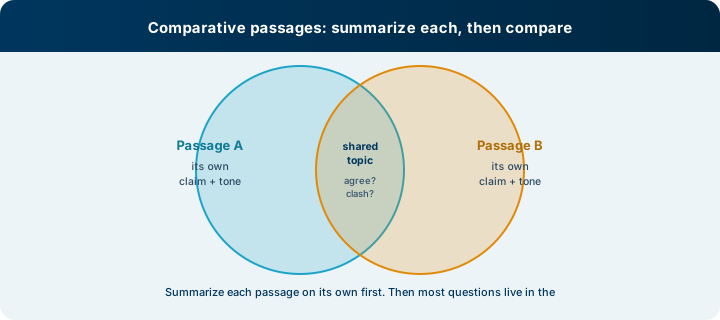
Why separate summaries? Because the first thing every comparative set is asking is: what is the relationship between A and B? You cannot name a relationship until you have two clean things to relate. Once you hold Summary A and Summary B side by side, the relationship usually snaps into focus. Common relationships include:
You do not need to label the relationship before you reach the questions, only to have built the two separate summaries so the relationship is available the moment a question asks. After you finish reading, spend a few seconds deciding in one phrase how B stands to A: rebuts it, elaborates it, broadens it, or complicates its evidence.
Here are two short snippets, written for this chapter, that show the structure you will meet.
Passage A (excerpt). “Cities that have replaced metered street parking with flat daily rates report fuller curbs and longer dwell times. The lesson is straightforward: drivers dislike feeding meters, so removing the meter removes the friction, and removing the friction brings them downtown. Municipalities chasing foot traffic should therefore abolish metering.”
Passage B (excerpt). “The downtown-parking debate too often fixates on price structure. But the variable that actually moves foot traffic is availability: a driver will not visit a district where no space can be found, whatever the rate. Flat rates can fill curbs precisely because they encourage all-day occupancy, which then starves later arrivals of any space at all. Pricing that turns curb space over, including metering, is one tool among several for keeping spaces open.”
Notice what your two summaries capture. Summary A: abolishing meters reduces driver friction, which raises downtown foot traffic, so cities should abolish meters. Summary B: the real driver of foot traffic is space availability, not price structure; flat rates can hurt availability by encouraging all-day parking, so metering is one legitimate tool for turnover. The relationship: B broadens the frame (from “price friction” to “availability”) and, inside that larger frame, B’s reasoning challenges A’s conclusion. They share a topic and a goal (more foot traffic) but disagree about the mechanism. Hold onto both the overlap and the split. The questions test both, the overlap far more often.
One or two questions in the set will ask about only one passage: “Passage A indicates which of the following,” or “Passage B’s author would most likely agree that.” Handle these exactly like ordinary RC questions (Chapter 25). Read the stem, go back to the named passage, find the support, and work answer by answer. Retrieval, not recall, still rules.
The one new danger: the answer writers will plant a choice that is a perfect statement of the OTHER passage. If the stem asks about Passage A, expect a trap answer that is true, well-phrased, and lifted straight from Passage B. It feels right because you did read it; you just read it in the wrong passage. This is the comparative version of the “attributes the view to the wrong person” trap from Chapter 25, except the wrong person is the wrong passage. For a single-passage question, support must come from the named passage, and a true statement from the other passage is wrong every time. In everyday terms: if someone asks what your roommate Jordan is doing Saturday, answering with Casey’s plans is wrong even when it is perfectly accurate about Casey, because you were asked about Jordan.
Most of the questions ask about both passages. There are two main kinds.
These ask for something that is true of, stated in, or supported by both passages. Stems look like “Which of the following is mentioned in both passages,” or “Both passages provide support for which one of the following claims,” or “Both authors would agree that.”
The right answer is a point that appears in both A and B. The method is to take the passages one at a time:
Working one passage at a time keeps you out of the trap. The signature trap is a choice true of only one passage, often quoted attractively from the passage you read more vividly. A flawless statement of Passage B is still wrong if Passage A never supports it, and the screen-A-first habit kills it on the first pass. Do not approve a choice just because it is strongly present in one passage; “both” means both.
These are the comparative set’s Main Idea questions. Stems look like “Both passages are primarily concerned with,” “Which one of the following describes the relationship between the two passages,” or “The passages are most similar in that they both.”
Lean on your two separate summaries. For a common-topic question, find the subject both summaries are about and state it at the right altitude. For a relationship question, name how B stands to A using the menu above (rival thesis, elaborates, broadens to a containing frame, challenges the evidence).
Two traps govern these answers, the same two altitude errors you know from single-passage Main Idea (Chapter 25):
The correct answer is the one both summaries can stand behind: narrow enough to be supported by each, wide enough to cover both.
Some questions ask how the two authors relate as people with views: “The author of Passage B would most likely regard the conclusion of Passage A as,” or “The two authors would be most likely to disagree about which of the following.” Treat these as a blend of Tone (Chapter 25) and the relationship work above. Pin down each author’s stance on the claim at issue, using valence and intensity, then ask what one author’s stance implies about the other’s claim. In our parking pair, the author of B does not think A is lying about fuller curbs; B grants the data and rejects the inference, because B holds that fuller curbs can mean worse availability. So B regards A’s conclusion as too quick, drawn from a real correlation but the wrong mechanism. The disagreement is rarely total; answers that make one author reject everything the other said usually overshoot. Everyday version: two parents look at the same B on a report card and do not dispute the grade itself; they part ways only on what it means, one reading it as slacking, the other as a harder class this year. Author-attitude splits work the same way, landing on the inference, not the facts.
Passage A. Defenders of year-round school argue that the long summer break erodes learning, since students forget over the summer what they learned in spring. Districts that shortened the summer break and spread the same number of days across the year saw their fall test scores rise. The remedy is clear: to stop summer learning loss, districts should adopt the year-round calendar.
Passage B. The familiar complaint about summer learning loss assumes that the calendar is what matters. But the districts that switched to a year-round schedule also, in the same years, expanded tutoring and lengthened the school day. The relevant question is not how the days are arranged but how much instruction students receive and of what quality. Rearranging an unchanged number of days, by itself, has no clear effect on retention.
Stem. Both passages are concerned with which one of the following?
(A) Whether the total number of school days affects student retention.
(B) Whether the arrangement of the school calendar is the key to preventing summer learning loss.
(C) Whether expanded tutoring improves fall test scores.
(D) Whether students forget material over a long summer break.
(E) Whether year-round schooling raises costs for districts.
Walk-through. First, the two summaries. Summary A: summer break causes learning loss; districts that shortened summer raised fall scores; so adopt the year-round calendar. Summary B: the calendar is not what matters; those same districts also added tutoring and longer days, so gains may come from more instruction, not from rearranging days; rearranging days alone has no clear effect. The relationship: B challenges A’s evidence and reframes the question from calendar arrangement to amount and quality of instruction. The shared concern is the question both engage: does rearranging the calendar prevent summer learning loss? A says yes; B says that is the wrong variable. That common question is the answer.
Now screen the choices against both passages, A first.
(B) is correct. Passage A argues that the calendar arrangement is the key (shorten summer, beat learning loss). Passage B is built to deny exactly that (the calendar is not what matters; instruction is). Both passages are concerned with whether calendar arrangement is the key to preventing summer learning loss. They answer it oppositely, which is fine: a common-topic answer names the shared question, not a shared answer. It is supported by both, so it survives both screens.
(A) is wrong: only Passage B. B raises total instruction and the number of days; A never discusses whether the total number of days matters. Fails the Passage A screen. This is the one-passage trap.
(C) is wrong: only Passage B, and even there a detail. B mentions expanded tutoring as an alternative explanation, but tutoring is not a concern of Passage A. Fails the A screen, and too narrow even for B.
(D) is wrong: too narrow and one-sided. Summer forgetting is a premise in A, but B does not dispute that students forget; B disputes that the calendar is the fix. The choice captures a corner of A, not the shared concern of the pair.
(E) is wrong: in neither passage. Costs are never mentioned by either author. This is the too-broad, supported-by-neither trap; it imports a topic the passages do not raise.
The credited answer (B) is the question both passages engage, stated at an altitude each can stand behind. You found it through the two summaries plus an A-first screen, the two moves that carry the whole set.
Put it to work: drill comparative reading sets in the practice platform, free during early access, with every answer choice explained.
