Volume II: Logical Reasoning · Chapter 13
The job: Fix It or Break It. Pick the answer that, if true, makes the argument more likely to be true.
Frequency: roughly 3 to 5 per section. Difficulty: low to medium, with a hard tail.
A Strengthen question hands you a flawed argument and asks you to help it. Your task is to find the one answer choice that, added to the argument, makes its conclusion more likely to be true. You are not proving the conclusion or making the argument airtight; you are giving it a push, and any positive movement counts. Because the stem says “if true,” you also treat every answer as true: you do not get to argue that an answer is implausible in the real world. Grant it, then ask the only question that matters: does granting it help the argument? In everyday terms, it is like a friend saying “just assume the elevator is working” while you plan how to move the couch upstairs: you do not stop to debate whether it really is, you grant it and ask only what follows if it is.
This is a Job 2 question, “Fix It or Break It” (Chapter 7). The stimulus is a suspect argument with a gap between its premises and its conclusion, and the answers may bring in new information the stimulus never mentioned. That last point matters. Unlike a Necessary Assumption answer (Chapter 11), which must be something the argument already silently relies on, a Strengthen answer is free to introduce facts, studies, comparisons, and cases that appear nowhere in the stimulus. You cast a wider net here. But “help the link” still means you must know what the link is before reading the choices. Find the conclusion and the gap it leaves open (the gap-finding skill from Chapter 2 and Chapter 11), then look for the answer that shores up that exact connection. An answer that supports a true but unrelated point, or a point next door to the real conclusion, does nothing for you.
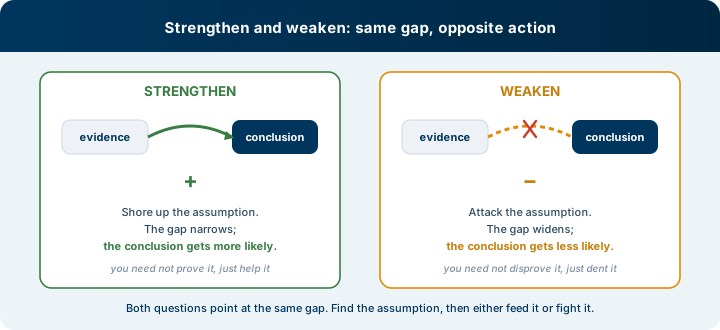
The stem almost always contains “strengthen” or “support” plus the phrase “if true.” Look for:
A few look-alikes to keep separate:
One discipline ties this together: strengthen the argument, not the conclusion in isolation. It is not enough to assert something pleasant about the topic; the answer has to make the reasoning better by reinforcing the bridge from premise to conclusion. An answer that merely cheerleads the conclusion adds no support.
A regional health agency studied two groups of office employees. The first group switched from sitting desks to standing desks for one year; the second group kept sitting desks for that same year. At the end of the year, the standing-desk group reported markedly lower levels of back pain than the sitting-desk group. The agency concluded that using a standing desk reduces back pain among office workers.
Which one of the following, if true, most strengthens the agency’s argument?
(A) Several workers in the standing-desk group said they would recommend standing desks to friends and colleagues.
(B) Standing desks have become substantially more affordable over the past decade, so more offices can now provide them.
(C) The two groups were closely matched at the start of the study for age, baseline back pain, exercise habits, and type of job.
(D) Workers who already suffer from chronic back pain are more likely than others to ask their employers for a standing desk.
(E) Some workers in the sitting-desk group reported that their back pain improved over the course of the year.
Find the structure first. The premises report a correlation: the standing-desk group ended the year with less back pain. The conclusion is causal: standing desks reduce back pain. Run the checklist from Chapter 5. Could a third factor explain the gap? If the two groups differed at the start in some way that affects back pain (the standing-desk group might have been younger or already healthier), that pre-existing difference, not the desks, could explain the result. The strongest strengthener slams that door by ruling out alternative causes.
(C) is correct. Matching the two groups for age, baseline back pain, exercise habits, and job type rules out the obvious third factors that could otherwise explain the difference in outcomes. With those alternatives off the table, the standing desks are left as the most likely explanation. This is move 2, rule out an alternative cause, closing the third-factor door.
Here is why each wrong choice fails:
Only (C) removes a competing explanation and leaves the causal conclusion standing, so only (C) strengthens.
Sometimes the stem reads “Each of the following, if true, strengthens the argument EXCEPT.” Flip your process. Now four answers strengthen, and your job is the lone outlier, which either weakens the argument or has no effect at all. Do not assume it must weaken; an irrelevant answer that leaves the conclusion where it was is just as correct here. Cross off the four that push the argument forward, and keep the one that does not.
For each item, find the conclusion, name its flavor and gap, then answer the question. Try all four before checking.
A bookstore added a small café last spring, and over the next six months its book sales rose 15 percent over the prior six months. The owner concluded the café caused the rise. Which would most strengthen this: (a) the café itself turned a modest profit, or (b) a comparable bookstore across town that added no café saw its book sales hold flat over the same six months?
Researchers found that adults who report sleeping at least seven hours a night score higher on memory tests than adults who sleep less, and concluded that getting more sleep improves memory. Name one fact that would strengthen this by ruling out reverse causation.
A school district introduced free breakfast at all its elementary schools, and the next year average attendance rose. An administrator concluded the breakfast program raised attendance. To rule out an alternative cause, which is the better strengthener: (a) the district ran a popular new sports program the same year, or (b) the district made no other changes that year?
A gardener notices that the tomato plants she fertilizes with a new compound grow taller than the ones she does not, and concludes the compound makes tomato plants grow taller. Give one answer that strengthens by adding consistent data and one that strengthens by shoring up reliability.
(b) is the strengthener. A comparable store with no café whose sales stayed flat shows the rise tracking with the café’s presence and absent without it, making the café a likelier cause. (a) is out of scope: whether the café was itself profitable says nothing about whether it drove book sales.
Anything that fixes the direction of the arrow works. A follow-up study found that when short sleepers were assigned to sleep more, their memory scores then improved. Or, more simply: memory performance cannot reach back in time to change last night’s sleep, so the link cannot run from memory to sleep. Either rules out good memory causing more sleep rather than the reverse.
(b) is the better strengthener. “No other changes that year” rules out rival explanations for the attendance rise (move 2). (a) weakens instead: a popular new sports program is a ready alternative cause for higher attendance, opening the very door you were trying to shut.
Add consistent data: show that across several seasons and beds, the treated plants consistently outgrow the untreated ones; the more the pattern repeats, the likelier the compound is the cause. Shore up the reliability: show she measured height the same way in both groups and used the same variety, seed batch, light, and water throughout, removing measurement sloppiness and pre-existing differences and leaving the compound as the live cause.
Put it to work: drill Strengthen questions in the practice platform, free during early access, with every answer choice explained.
