Volume II: Logical Reasoning · Chapter 22
The previous chapters taught you how to answer one question at a time. This chapter is about the other half of your score: how to run the whole section. Two students with identical question-by-question skill can finish far apart, and the gap is almost entirely how they spend their 35 minutes. The skill on display here is not reasoning. It is management. Treat it as its own trainable skill, drill it on every practice section, and protect it on test day.
Each scored Logical Reasoning section gives you about 24 to 26 questions in 35 minutes. There are two scored LR sections on the current test, so together they make up two of your three scored sections. Do the division and you get roughly 1 minute 25 seconds per question on average. Hold the word “average” in your mind, because no single question should actually take exactly that long. Some take twenty seconds. Some take three minutes. The 1:25 is a budget for the section, not a stopwatch for each item.
The questions are loosely ordered from easier to harder, but loosely is the operative word. Do not trust the order. Hard questions get sprinkled into the late stretch, an easy question sometimes sits at the very end behind the hardest ones, and the difficulty you feel is partly about your own strengths, not the official rating. The order is a tendency, not a promise. Navigate the section yourself rather than marching straight through it.
Here is the single most important idea in this chapter, and most students get it backwards. You do not have to finish. There is no prize for reaching the last question, and there is no penalty for the questions you never touch beyond the points you would have earned. The goal is to maximize correct answers, not to maximize attempts.
Run the math and it becomes obvious. Suppose there are 26 questions. A student who carefully answers 20 of them at 90 percent accuracy gets 18 right. A student who rushes all 26 at 65 percent accuracy, because rushing is what it takes to reach all 26, gets about 17 right and spends the whole section anxious. The careful student scored higher while doing less. Speed bought the second student nothing because it cost them accuracy, and accuracy is what the scale rewards. Going faster only helps if you stay accurate while doing it. Most people cannot, so for most people the lever is the other one: slow down, get more of what you attempt right, and let the hardest questions go unanswered. In everyday terms: at a buffet you do not win by piling every dish on your plate; you win by eating well the dishes you can actually finish. Maximize what you get right, not how many you reach.
How many questions you should attempt depends on the score you are reasonably aiming for. The framework is simple: higher scorers attempt more questions, because their accuracy holds up across more of the section. You do not need a precise table. You need to know roughly which band you are in and pace accordingly.
| If you are aiming for | Plan to seriously attempt | And you can afford to skip |
|---|---|---|
| A mid-range score | about 16 to 18 of the questions | the rest, with deliberate guesses |
| An above-average score | about 20 to 22 | a handful of the hardest |
| A top score | nearly all of them | almost none |
These are starting points to refine with your own practice data, not laws. The principle behind the table is what matters: decide before the section how many questions you are realistically going to fight for, and let that number set your pace. A student fighting for 18 can spend real time on each of those 18. A student trying to win all 26 cannot, and pays for it in careless errors. Pick a number you can sustain at high accuracy, and pace to it.
There is no wrong-answer penalty on the LSAT. A blank and a wrong answer cost you exactly the same: nothing beyond the point you did not earn. A guess costs nothing and has a one-in-five chance of being right. So there is never, under any circumstances, a reason to leave a bubble empty.
Build this into your routine. With a couple of minutes left, stop solving and fill in every remaining bubble with a guess. Pick one letter and use it for all of them; it is as good as any system and faster than choosing. The questions you genuinely worked deserve your reasoning. The questions you never reached deserve a letter. Either way, every bubble gets filled. Walking out with blanks is leaving free points on the table, and it is the most avoidable mistake on the test.
If you are not going to do every question, you need a method for choosing which ones to do, and the method has to run in real time without burning the clock. Here is the discipline.
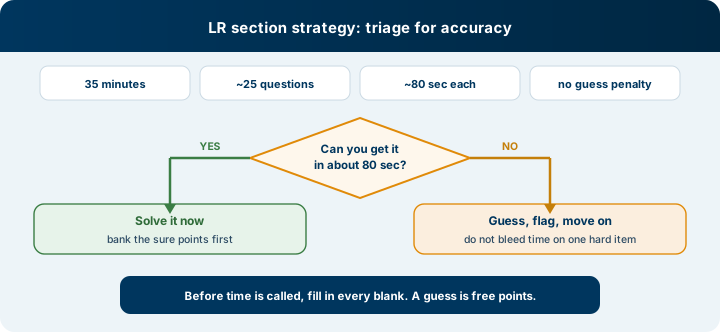
Work the section in a first pass and, if time allows, a second pass. On the first pass, do the questions you can clearly handle and bank their points. The moment a question resists you, make a fast decision: fight or flag.
The rule for flagging is strict. If you do not understand a question after one careful read, skip it and star it. Do not read it a second time on this pass, and certainly not a third. Rereading a confusing stimulus three times is the most common way students bleed time, and the third read rarely rescues you anyway. One read, no traction, star it, move on. You will come back on the second pass with a fresh eye and whatever time you have banked.
This sounds simple and is hard to actually do, because skipping feels like giving up and your instinct is to grind. Train the instinct out on practice sections. The student who calmly stars a brutal question and pockets three easy ones in the time it would have taken to grind that one is the student who scores higher.
A few fixed rules sit on top of the general triage:
Every question you start, consciously re-identify the type from the stem before you do anything else. This is the gear-shift, and it is a real performance skill, not a formality. The types ask for opposite things. Strengthen wants you to help the argument; Weaken wants you to hurt it; Must Be True wants you to accept the stimulus whole; Flaw wants you to find what is broken. If you carry the posture of the last question into the next one, you make careless errors: you weaken on a Strengthen question, you hunt for a flaw on an Inference question, you pick the answer that would have been right for the type you just finished.
The fix is a habit. Read the stem, name the job in your head (“this is a Weaken”), set your reading posture for that job, and only then read the stimulus. The half-second it costs is repaid many times over in errors avoided. Most careless mistakes in LR are not reasoning failures. They are gear-shift failures, where a student answered the question they expected instead of the question on the page.
Use the loose easy-to-hard ordering to your advantage by banking time early. The questions in the first stretch of the section tend to be quicker, so do them quickly. Aim to move through that first chunk faster than your 1:25 average, not slower. Every question you finish in 45 seconds puts 40 seconds in the bank.
That banked time is what you spend on the hard questions later, and on the second pass through your starred items. Students who linger on the easy early questions arrive at the hard middle and end with no reserve and start to panic. Students who move briskly through the easy opening build a cushion and meet the hard questions calmly. The first chunk should be your fastest, not your most careful, because careful is cheap there and expensive later. Bank early, spend late.
A small word in the stem can flip the entire task, and missing it turns a question you understand into a guaranteed wrong answer. Watch for EXCEPT and LEAST. The test always capitalizes them, precisely because they reverse what you are looking for.
Take “Each of the following weakens the argument EXCEPT.” Without the EXCEPT, the right answer weakens. With it, the relationship inverts: four of the five answers weaken, and the credited answer is the one that does not. That outlier might strengthen the argument, or it might simply have no effect at all. Either way, your job is now to find the answer that fails to do what the other four do. The same flip happens with LEAST: “which of the following LEAST strengthens” means four answers strengthen and you want the one that strengthens least or not at all.
Handle these stems with a fixed routine:
The danger with these stems is not the logic. It is autopilot. You know how to weaken an argument, so you breeze in, find an answer that weakens, and select it, which is exactly the wrong move. Slowing down at the stem is the whole defense.
The test is built so that the most attractive answer is frequently not the correct one. A tempting wrong answer is usually planted just before the credited answer in the list, so the student who stops reading at the first good-looking choice gets caught. Always read all five choices, even when choice B looks perfect, because the trap is engineered to look better than the truth until you compare them side by side.
The harder problem is what to do when you have selected an answer and a doubt creeps in. Should you change it? The honest rule:
The distinction is between a reason and a feeling. Reasons earn changes; feelings do not. This is also why the elimination discipline from Chapter 7 matters here: if you killed an answer for a stated reason, do not resurrect it. Reopening dead answers is how the trap gets a second chance.
The mental game is straightforward to state and hard to live. Stay calm, and work one question at a time. A single hard question is worth exactly one point, the same as the easiest question in the section. So when a question rattles you, the worst thing you can do is let it bleed into the next one, second-guessing, rushing, and trying to make up imagined lost ground. That is how one missed point becomes five.
Treat every question as a fresh start, walled off from the one before it. The brutal question you just starred is gone; it cannot hurt your score on the next question unless you let it live in your head. When you feel the panic rising, return to your routine: read the stem, name the job, read the stimulus, prephrase, eliminate. The routine carries you through the moments when your nerves want to take over. Trust it, run it one question at a time, and let the section take care of itself.
Put it to work: run a full timed Logical Reasoning section in the practice platform, free during early access, with every answer choice explained.
