Reference · Appendix C
Read the question stem first. The stem fixes the task, and the task fixes how you read the stimulus. This appendix maps the phrasings you will see to the question type, the Job that type belongs to (Read It / Fix-or-Break It / Describe It), and the chapter to review.
The phrasings below are generic paraphrases. Real stems vary the wording, but the structure is stable. Learn the structure, not the exact words.
A reminder on the Three Jobs:
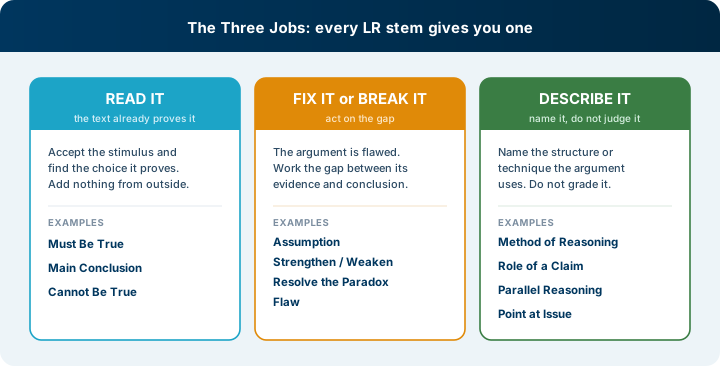
| Stem language (generic) | Question type | Job | Chapter |
|---|---|---|---|
| Which one of the following must be true given the statements above? | Must Be True / Inference | Read It | 8 |
| The statements above, if true, most strongly support which of the following? | Must Be True / Inference | Read It | 8 |
| Which of the following can be properly inferred from the passage? | Must Be True / Inference | Read It | 8 |
| Which of the following is the main conclusion of the argument? | Main Conclusion | Read It | 9 |
| The argument’s overall point is best expressed by which choice? | Main Conclusion | Read It | 9 |
| If the statements above are true, which of the following CANNOT be true? | Cannot Be True | Read It | 10 |
| Which of the following is most incompatible with the passage? | Cannot Be True | Read It | 10 |
| The argument depends on assuming which of the following? | Necessary Assumption | Fix-or-Break It | 11 |
| Which of the following is an assumption required by the argument? | Necessary Assumption | Fix-or-Break It | 11 |
| The argument’s conclusion follows logically if which choice is assumed? | Sufficient Assumption (Justify) | Fix-or-Break It | 12 |
| Which of the following, if assumed, allows the conclusion to be properly drawn? | Sufficient Assumption (Justify) | Fix-or-Break It | 12 |
| Which of the following, if true, most strengthens the argument? | Strengthen | Fix-or-Break It | 13 |
| Which choice, if true, provides the most support for the conclusion? | Strengthen | Fix-or-Break It | 13 |
| Which of the following, if true, most weakens the argument? | Weaken | Fix-or-Break It | 14 |
| Which choice, if true, casts the most doubt on the conclusion? | Weaken | Fix-or-Break It | 14 |
| The answer to which question would be most useful in evaluating the argument? | Evaluate | Fix-or-Break It | 15 |
| Knowing which of the following would most help to assess the argument? | Evaluate | Fix-or-Break It | 15 |
| Which of the following, if true, most helps to resolve the apparent discrepancy? | Resolve the Paradox | Fix-or-Break It | 16 |
| Which choice, if true, best explains why both facts hold? | Resolve the Paradox | Fix-or-Break It | 16 |
| The reasoning is flawed because the argument… | Flaw | Fix-or-Break It | 17 |
| Which choice describes a vulnerability in the argument’s reasoning? | Flaw | Fix-or-Break It | 17 |
| The argument proceeds by which of the following methods? | Method of Reasoning | Describe It | 18 |
| The claim that [X] plays which role in the argument? | Role of a Claim | Describe It | 18 |
| Which argument is most similar in its reasoning to the argument above? | Parallel Reasoning | Describe It | 19 |
| The flawed reasoning above is most similar to which of the following? | Parallel Flaw | Describe It | 19 |
| The two speakers disagree over whether… | Point at Issue | Describe It | 20 |
| Which claim would the two speakers most likely disagree about? | Point at Issue | Describe It | 20 |
| Which of the following principles, if valid, most justifies the reasoning? | Principle (justify mode) | Fix-or-Break It | 21 |
| Which of the following conforms most closely to the principle above? | Principle (apply mode) | Read It | 21 |
| Stem language (generic) | Question type | Job | Chapter |
|---|---|---|---|
| Which of the following best states the main idea of the passage? | Main Idea / Primary Purpose | Read It | 25 |
| The author’s primary purpose in the passage is to… | Main Idea / Primary Purpose | Read It | 25 |
| According to the passage, [the author / the study] says which of the following? | Detail / Retrieval | Read It | 25 |
| The passage states that… | Detail / Retrieval | Read It | 25 |
| It can be inferred from the passage that… | Inference | Read It | 25 |
| The passage most strongly suggests which of the following? | Inference | Read It | 25 |
| The author uses the phrase in line [X] primarily to… | Line / Function | Read It | 25 |
| The second paragraph functions to… | Line / Function | Read It | 25 |
| The author’s attitude toward [X] is best described as… | Tone / Attitude | Read It | 25 |
| Which of the following, if true, would most strengthen / weaken the author’s claim? | Arguments-style | Fix-or-Break It | 25 |
| Both passages are primarily concerned with… | Comparative | Read It | 26 |
| The author of Passage A would most likely respond to Passage B by… | Comparative | Read It | 26 |
The LSAT engineers stems to look alike. The difference is often one word or the direction of support. Read slowly here.
“Support which of the following” vs. “which of the following supports.”
Direction of support decides the type. If the stimulus supports the answer, the text proves the answer and you accept the stimulus as true: that is Inference (ch 8, Read It). If the answer supports the argument, you are adding a new fact to help the conclusion: that is Strengthen (ch 13, Fix-or-Break It). Ask: which way does the arrow point? Toward the answer is Inference. Toward the argument is Strengthen. Everyday tell: “the spec sheet already shows phone A has more storage” reads a fact straight off the page (Inference), while “and it just got a glowing review” adds a fresh fact to boost your pick (Strengthen).
“If assumed, allows the conclusion to be drawn” vs. “assumption required / on which the argument depends.”
Both say “assumption,” but they ask opposite questions. Sufficient Assumption (ch 12) wants a choice that, added to the premises, makes the conclusion airtight; the tells are “if assumed,” “allows the conclusion to be properly drawn,” “the conclusion follows logically if.” Necessary Assumption (ch 11) wants a choice the argument cannot do without; the tells are “depends on,” “requires,” “is assumed by.” Test method differs too: for sufficient, plug it in and check the conclusion is now proven; for necessary, run the Negation Check (negate the choice; if the argument collapses, it is required).
“Most justifies / most supports” vs. “allows the conclusion to be properly drawn.”
The word most signals a matter of degree, which means Strengthen (ch 13): you want the choice that helps the most, not one that proves the conclusion to 100%. “Allows the conclusion to be properly drawn” (no most) demands airtight proof, which is Sufficient Assumption (ch 12). When you see “most,” think “more likely, not certain.” When you see “properly drawn” or “follows logically,” think “100% or nothing.”
Method vs. Flaw.
Both describe how the argument works. Method (ch 18) asks for a valid, neutral description of the technique: “proceeds by,” “the argument does which of the following.” Flaw (ch 17) asks for a description of an error: the stem signals fault with words like “flawed,” “vulnerable to criticism,” “questionable because.” If the stem assumes something went wrong, it is Flaw. If it is neutral about quality, it is Method. A useful check: a Flaw answer must name a mistake; a Method answer may describe a perfectly sound move. Everyday tell: “she seared the steak, then finished it in the oven” just describes the technique (Method), while “she overcooked it” calls out a mistake (Flaw).
Main Conclusion vs. Inference.
Both can read like “which of the following is…” Main Conclusion (ch 9) asks you to find a claim already stated in the argument, the author’s main opinion, and restate it. Inference (ch 8) asks for a claim that is not stated but is proven by combining the text. Tell: Main Conclusion stimuli always contain an argument and the answer is a paraphrase of a sentence in it; Inference answers are new statements the text guarantees.
Cannot Be True vs. Weaken.
Cannot Be True (ch 10, Read It) accepts the stimulus as true and asks which answer is impossible given it; you do not act on a flaw. Weaken (ch 14, Fix-or-Break It) asks which answer makes a flawed conclusion less likely; you attack the link and may add outside facts. Tell: Cannot Be True has no “if true” hedge on the answers (they are tested against fixed facts); Weaken answers begin “which of the following, if true.”
Role of a Claim vs. Method of Reasoning.
Both live in ch 18. Role points at one specific claim and asks what it does (premise? subsidiary conclusion? the view being rebutted?). Method asks about the whole argument’s technique. Tell: Role quotes or refers to a single statement; Method describes the overall move.
Resolve the Paradox vs. Strengthen / Weaken.
Resolve (ch 16) stimuli have two facts in tension and no conclusion; the answer explains why both hold. Strengthen and Weaken stimuli have an argument with a conclusion. Tell: if there is no opinion to support or attack, only a surprising pair of facts, it is Resolve. Everyday tell: “the umbrella stand sold out on a cloudless day” is a surprising pair of facts to explain (a big storm is forecast for tomorrow), not an opinion to defend or attack, which is exactly what makes it Resolve.
Principle: apply mode vs. justify mode.
A principle stem can point either way (ch 21). Apply / conform gives you a rule and asks which case it governs: the rule is fixed and you match a situation to it (Read It). Justify gives you an argument and asks which broad rule would support its reasoning: the principle fills the gap (Fix-or-Break It). Tell: “conforms to the principle” means apply; “principle that most justifies the reasoning” means justify.
