Volume I: Foundations · Chapter 4
The previous chapter taught you conditional logic, where every statement is a guarantee. This chapter covers two tools that sit right beside conditionals and trip up just as many test takers.
The first is the family of quantifiers: the words all, most, some, and none. These tell you how much of a group has some property. The test treats each as a precise quantity and punishes you for reading them loosely.
The second is the gap between numbers and percentages: a percentage and a raw count are not the same thing, and you cannot get one from the other. The test exploits this constantly, both as a flaw to spot and as a trap answer to avoid.
Both tools are formal, which is good news. Once you learn the rules, the inferences are mechanical, and the right answer stops being a matter of intuition.
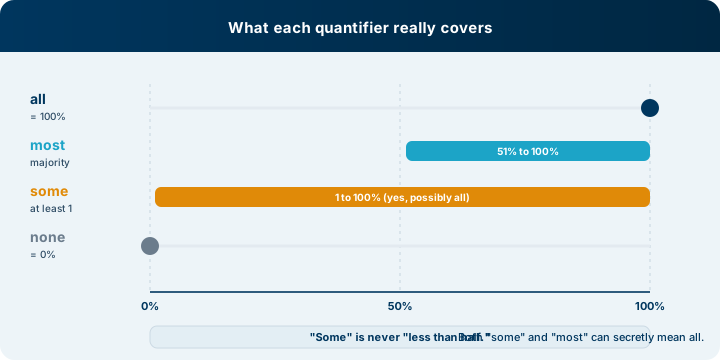
Read these definitions slowly. The whole chapter depends on them.
Two negative forms come up often:
“Some” and “most” both leave open the possibility of “all.” That overlap is exactly where the test hides its inferences.
Each quantifier statement licenses inferences on its own. The key question is reversibility: if you know something about A’s relationship to B, what can you say about B’s relationship to A?
Some reverses. Most and all do not.
Start with some. If some A are B, then some B are A. The relationship runs both ways, because “some A are B” just says at least one thing is both an A and a B, and that thing is equally a B that is an A. We write this with the some-notation, which has no direction:
A --some-- B is identical to B --some-- A
Now most. If most A are B, can you conclude most B are A? No. Picture a small club and a large city. Most members of the club live in the city. That tells you nothing about what most of the city does, because the city dwarfs the club. We write most with a one-directional arrow:
A --m--> B
The arrow points one way on purpose. Going backward, the most-arrow gives you only “some.” From most A are B you may infer some B are A, but never most B are A.
The same holds for all, with one important existence caveat. All squares are rectangles; that does not make all rectangles squares. Because “all A are B” behaves like a conditional, it does not by itself prove that any A’s exist. If you also know at least one A exists, then you may infer some B are A. Without that separate existence fact, going backward from all A are B gives you no inference.
Here is the rule to memorize:
Some runs both directions. Most and all run only forward. Reversed, “most” gives you only some; reversed, “all” gives you some only if existence is separately established.
Reversing a “most” or an “all” into another “most” or “all” is a Mistaken Reversal, the same error you met with conditionals in Chapter 3. The test will offer you reversed quantifiers as wrong answers on Must Be True questions. Recognize them and cross them out.
The real power of quantifiers shows up when two statements share a term and you ask what must overlap. This is where most of the points live, so work through each case carefully.
Suppose two statements both describe the same group. Call the group A, and call the two properties B and C. When can you guarantee that some members have both B and C?
Some plus some guarantees nothing. Say some employees take the bus and some employees ride bikes. Does any employee do both? Not necessarily. The bus riders and the bike riders could be entirely separate people. No overlap is forced.
Most plus some guarantees nothing. Say most employees take the bus and some employees ride bikes. Still no forced overlap. The few bike riders could all sit inside the minority who do not take the bus. “Some” is just too weak to be cornered.
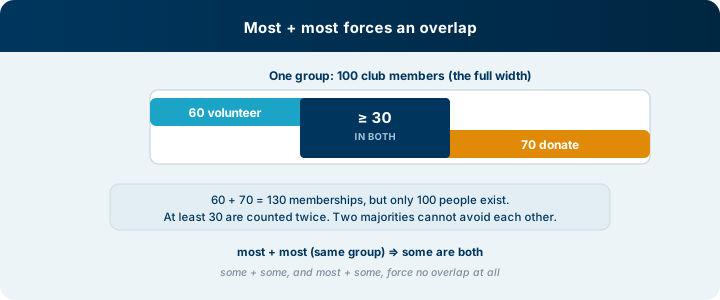
Most plus most guarantees overlap. This is the single highest-value quantifier inference on the test, so learn it cold. If most of a group has one property and most of the same group has a second property, then some members must have both.
Here is why, with real numbers. Imagine a club of 100 members. Most of them, say 60, volunteer on weekends. Most of them, say 70, donate money. Add 60 and 70 and you get 130, which is 30 more than the club has members. Those 30 extra slots have to be people counted in both groups, so at least 30 members both volunteer and donate. The two majorities cannot avoid each other; there are not enough people for them to stay separate.
Stated formally: if most A are B and most A are C, then some B are C, written B --some-- C.
Notice three things. First, both statements must be about the same group A; two majorities of different groups need not overlap. Second, the conclusion is only “some,” not “most.” Third, the direction of the result does not matter, because some reverses freely.
The key overlap rule: two “most” statements about the same group force
some B are C. Some plus some, and most plus some, force nothing.
You can sometimes link quantifier statements end to end the way you chained conditionals. A few high-value cases are worth knowing; the exotic combinations live in Appendix A.
The friendliest links involve all, because “all” behaves like the conditional arrow from Chapter 3. If all A are B and all B are C, then all A are C, a plain conditional chain A → B → C.
You can also ride a “some” link across an “all” track. If some A are B and all B are C, then some A are C: at least one thing is both an A and a B, and since everything that is a B is also a C, that thing is a C too. The some-relationship carries through the all-arrow. In everyday terms: some of my coworkers are vegetarians, and all the vegetarians in the office get the special lunch, so some of my coworkers get the special lunch. The “some” rides across the “all” and comes out the far side intact.
Mixing in “most” is more restrictive, and this is the part students get wrong. A “most” link is one-directional, so you may only travel along the arrow, and you generally need an “all” or “none” link to complete a chain into a strong conclusion. Two “most” links do not chain into a “most” conclusion the way two “all” links do; the most you can usually extract is a “some” relationship, and only when the arrows cooperate.
The practical takeaway: an “all” or “none” statement is the engine of any chain. It is the only link strong enough to carry a guarantee all the way through; “some” and “most” links are passengers. If a chain has no “all” or “none” in it, be skeptical that it produces anything beyond a bare “some” overlap. In practice the test’s quantifier inferences are almost always the most-plus-most overlap or a clean some-plus-all ride. Master those two and you have the bulk of the points.
Switch now from quantifiers to the related trap the test builds around counting. Here is the principle the whole part rests on:
A percentage tells you nothing about a raw number, and a raw number tells you nothing about a percentage, unless you also know the total.
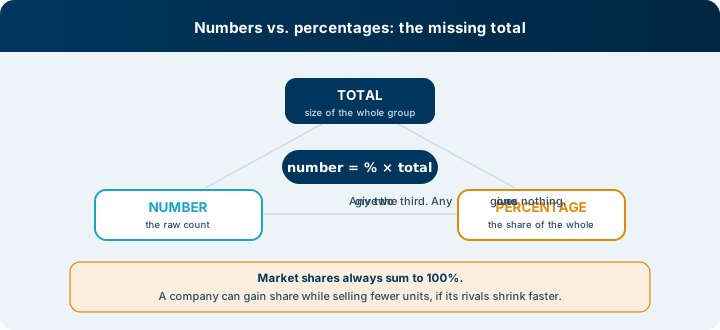
There are three quantities in play: the total (the size of the whole group), the raw number (how many have the property), and the percentage (what share of the total that raw number is). They are tied together by one relationship: the raw number equals the percentage times the total. Because of that, you need any two of the three to pin down the third.
Give me a percentage alone, and I cannot tell you the count. Forty percent of a village is a few dozen people; forty percent of a nation is millions. Give me a count alone, and I cannot tell you the share. Five hundred infections is a catastrophe in a town of 800 and a rounding error in a city of five million. Only the total unlocks one from the other.
Burn this in: whenever an argument hands you a percentage and draws a conclusion about an amount, or hands you an amount and draws a conclusion about a share, it has almost certainly skipped over the total it needed. That skip is the flaw.
The relationship above fails in six specific directions, and the test mines all six. None of these inferences is valid, because the total can move on its own:
Every one of these fails for the same reason: the total is free to move independently. When you see an argument leap from a count to a share, or back, ask the single diagnostic question: what happened to the total? If the argument never tells you, it has no business drawing the conclusion.
The test signals whether it means counts or shares through its word choice. Flag these on sight.
Numerical words point at a raw count: amount, quantity, total, count, number, sum, tally. These describe things you could line up and count.
Percentage words point at a share or rate: percent, proportion, fraction, ratio, rate, likelihood, probability, share, segment, incidence. These describe a relationship to a whole.
The trap is an argument that opens with one kind of word and closes with the other. A premise about a rate and a conclusion about a total, with no population size in between, is the classic numbers-versus-percentages flaw. The shift in vocabulary is your alarm bell.
Market share is the test’s favorite playground for this trap, because share behaves in a way that feels backward until you see it.
All market shares in a market always add up to 100 percent, no matter how big or small the market is.
That fixed total is the whole trick. Because the shares must sum to 100 percent, a company can gain share while selling less, and lose share while selling more. Its share depends not only on its own sales but on everyone else’s.
Here is an original example. A regional coffee roaster, Northwind, sold 2 million bags last year and held 40 percent of its local market, so the whole market was 5 million bags. This year a health scare cuts coffee drinking, and the total market shrinks to 3 million bags. Northwind sells only 1.5 million bags, down a quarter from last year. But its competitors collapsed even harder, so Northwind now holds 50 percent of the market. Its share rose from 40 to 50 percent while its sales fell from 2 million to 1.5 million bags.
So a triumphant press release about gaining market share can sit right on top of a sales decline. Told only that share rose, you know nothing about whether the company sold more or fewer units. You would need the market totals to say.
This concept appears in two main places.
As a flaw. An argument confuses a count with a share, and you must identify the error or weaken the argument. A typical structure: “The clinic treated more patients for a certain illness this year than last, so the illness is becoming more common in the area.” That ignores the population. If the area grew, or the clinic drew patients from a wider region, the number treated can rise while the rate holds steady or falls. The weakener supplies the missing total. You will meet this flaw again, with its formal name, in Chapter 6, the flaw catalog.
In Must Be True answers. When a stimulus gives only percentages, any answer asserting a raw number is unprovable, so you cross it out. When a stimulus gives only raw numbers, any answer asserting a percentage is unprovable. Only when the stimulus supplies two of the three quantities can an answer bridge from one to the other. This is a fast, mechanical elimination. (See Chapter 8, Must Be True / Inference.)
Try each item before reading the answers. For the quantifier items, state what must be true. For the numbers items, name the error or say what you would need to know.
Most of the trees in a forest are oaks. Most of the trees in that same forest are over fifty years old. What, if anything, must be true?
Some physicists at the institute study cosmology. All cosmologists at the institute have published a book. What, if anything, follows about physicists and books?
All licensed electricians passed the safety exam. Marisol passed the safety exam. Can you conclude Marisol is a licensed electrician? Why or why not?
A newspaper reports that the percentage of households in a county that own a pet rose from 55 percent to 62 percent over a decade. The editor concludes that more households own pets now than ten years ago. Is the conclusion guaranteed? What would you need to know?
A software firm announces that its share of the tablet market fell from 30 percent to 22 percent last year, and laments its declining business. Does the falling share establish that the firm sold fewer tablets? Explain.
Some oaks in the forest are over fifty years old. This is the most-plus-most overlap, both statements about the same group. Two majorities of one set must share members, written oak --some-- over-fifty. You cannot conclude that most oaks are over fifty, or that most old trees are oaks. The overlap is only a “some.”
Some physicists at the institute have published a book. Ride the some-link across the all-track: physicist --some-- cosmologist and cosmologist → book. The physicist who studies cosmology is therefore a published author. This is the some-plus-all chain.
No. “All licensed electricians passed the exam” diagrams as electrician → passed. Marisol passed, which puts her at the necessary condition, not the sufficient one. Concluding she is an electrician is a Mistaken Reversal: passing is required of electricians but not exclusive to them. Backward, the statement gives you no route to identify Marisol. If you separately knew at least one licensed electrician existed, you could infer that some people who passed were electricians, but that still would not identify Marisol.
Not guaranteed. You would need the total number of households. This is the percentage-up-does-not-mean-number-up misconception. If the county lost population, the share of pet-owning households could rise while the count falls. You have only the percentage, in two snapshots; give the editor the household totals for both years and the conclusion becomes checkable.
No. Market share always sums to 100 percent, so a falling share is consistent with rising, flat, or falling unit sales depending on how the overall market moved. If the tablet market grew fast enough, the firm could sell more tablets while claiming a smaller slice of a bigger pie. The lament assumes share tracks sales, which it does not. You would need the firm’s unit sales, or the total market size in both years, to know.
some B are C. This is the highest-value quantifier inference. Some plus some, and most plus some, force no overlap at all.