Volume II: Logical Reasoning · Chapter 11
The job: Fix It or Break It. Find an unstated premise the argument requires to work.
Frequency: the most common Logical Reasoning type, roughly four to six per section. Difficulty: medium, with a hard upper tier.
This is the single most common question type on the LSAT, and it sits at the heart of everything the test does. Learn this chapter cold. The skill you build here, finding the gap an argument quietly depends on, is the same skill underneath Strengthen, Weaken, Flaw, and Sufficient Assumption. Get this one right and four other chapters get easier.
Every LSAT argument leaves something unsaid. The author states some premises, draws a conclusion, and somewhere in the leap from one to the other relies on an idea they never put on the page. A necessary assumption is that unstated idea, but only the part the argument genuinely needs. It is a premise the author must believe for the argument to hold together at all. Take it away, and the argument falls apart.
Hold onto the word necessary. It is doing precise work. You are not looking for an idea that would help the argument, or make it stronger, or finish the job. You are looking for the idea the argument cannot survive without. That is a much narrower target, and it is the source of almost every mistake on this type. Students reach for the answer that would prove the conclusion, when the question only wants the answer the conclusion silently leans on.
Here is the relationship in one line. If the conclusion is correct, the assumption must be true. Flip it: if the assumption is false, the conclusion fails. A necessary assumption is the minimum the author is committed to. Not the whole bridge. Just a plank the bridge cannot stand without. This is the exact contrast with the next chapter, Sufficient Assumption (Chapter 12), which asks for an idea big enough to guarantee the conclusion. Necessary is the small thing the argument needs; sufficient is the large thing that would settle the matter. Keep them in separate boxes, because the wrong-answer trap on this type is frequently a sufficient-style answer that does too much.
The stem asks for something the argument leans on. Look for these:
The tell is necessary-condition language: required, depends, relies, presupposes, assumes.
Do not confuse this with two look-alikes. If the stem says “if assumed, allows the conclusion to be properly drawn” or “the conclusion follows logically if which is assumed,” that is Sufficient Assumption (Chapter 12), a different and stronger target. And if the stem says “which, if true, most supports / strengthens the argument,” that is Strengthen (Chapter 13), where new helpful facts are fair game even if the argument does not strictly need them. The single word required versus supports versus if assumed changes what counts as right. Read the whole stem.
Build the argument skeleton first, the way you learned in Chapter 7. Find the conclusion with the Therefore Test, then ask “Why?” to find the premises. Now look at the seam between them.
The fastest way to locate the gap is the language gap procedure. Scan the conclusion for a term or concept that appears there for the first time, an idea the premises never actually mentioned. That is the new term. Then find the premise term that does the opposite: it appears in the support but then drops out and never makes it into the conclusion. The argument has quietly swapped one for the other. The assumption is the plank that connects the dropped term to the new term. Most necessary-assumption arguments have exactly this shape: the premises talk about X, the conclusion talks about Y, and the author is taking for granted that X and Y are linked. Everyday version: a neighbor says an apartment must be quiet because it is on the top floor. The support talks about the floor, the conclusion talks about noise, and the unstated plank is that top-floor apartments are quiet ones. Find that swap, premise term to conclusion term, and you have found the gap.
Not every necessary assumption looks like a tidy bridge. There are two kinds, and knowing both is what separates a confident solver from a confused one.
A bridge assumption links the gap. It connects the dropped premise term to the new conclusion term, stated positively. Bridge assumptions are visible. You can usually prephrase them: “the author is assuming that X actually leads to Y.” When the gap is a clean term shift, hunt for the bridge.
A shield assumption does something stranger. Instead of building the link, it defends the argument by ruling out a threat. It is the author quietly assuming that some thing which would wreck the argument does not happen. Shield assumptions are often phrased negatively (“no other factor fully explains the result,” “the sample was not skewed,” “the measurement was not misleading”), and they are hard to prephrase, because the number of possible threats is nearly infinite. You usually cannot predict the exact shield. You can only recognize it when you see it and confirm it.
This is why some correct answers look weird. A causal argument (Chapter 5) silently assumes the observed effect was not fully explained by some other cause, so its necessary assumption is a shield: “the effect was not entirely produced by some other factor.” A study-based argument silently assumes the study was not rigged. These negative, defensive answers are correct precisely because the argument cannot survive the threat they rule out. Which leads to a rule you must internalize now: do not reflexively reject a negative answer. On many other question types a strange-sounding negative is a trap, but on Necessary Assumption a negative answer is often a perfectly good shield.
This is the signature verification technique for this type, and it is decisive. When you have a candidate answer and you are not sure, negate it and read it back into the argument. If the negated version destroys or wrecks the argument, the original was necessary, and it is your answer. If the negated version leaves the argument standing, the original was not necessary, and you can kill it.
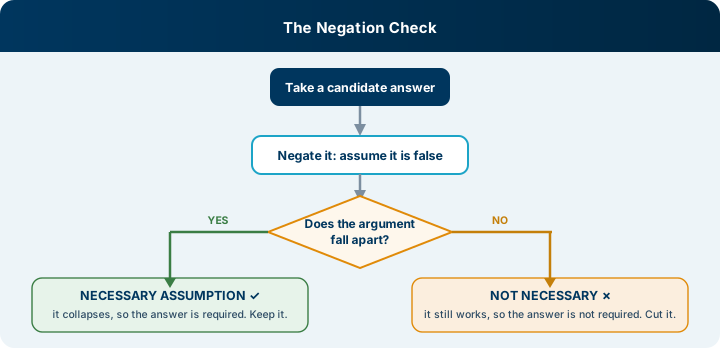
Why does this work? Because that is exactly what “necessary” means. If an idea is truly required, then denying it has to break things. If denying it leaves the argument fine, the argument never needed it.
The Negation Check only works if you negate correctly, and the most common error is over-negating. Use logical (minimal) negation, the smallest change that makes the statement false. Do not jump to the most extreme opposite.
Polar negation (all to none, always to never) overshoots. It will sometimes wreck an argument that the minimal negation leaves standing, and you will pick a wrong answer because you used too big a hammer. Negate gently.
A worked micro-version: suppose the assumption candidate is “the survey respondents answered honestly.” Minimal negation: “the survey respondents did not all answer honestly,” or simply “at least some respondents did not answer honestly.” If that cracks an argument built on the survey, the answer is necessary. You did not need to negate all the way to “every respondent lied.”
Stimulus: A regional health agency tracked two groups of adults over five years. Adults who drank at least one cup of green tea daily had notably lower rates of high blood pressure than adults who drank none. The agency concluded that drinking green tea daily lowers a person’s risk of developing high blood pressure.
Stem: The agency’s argument depends on assuming which one of the following?
(A) Green tea is more effective at lowering blood pressure than any other beverage studied by the agency.
(B) The lower blood-pressure rates among daily green tea drinkers were not entirely attributable to some other difference between the groups.
(C) Most adults who want to lower their blood pressure are willing to drink green tea every day.
(D) Adults who drank green tea daily had lower rates of high blood pressure than adults who drank none.
(E) No adult can develop high blood pressure while drinking green tea daily.
Step 1, the stem. “Depends on assuming.” This is Necessary Assumption. My job is to find the plank the argument cannot stand without, and I should expect a sufficient-style answer that overreaches and a shield answer that might be the credited one.
Step 2, build the skeleton and find the gap. Conclusion: drinking green tea daily lowers the risk of high blood pressure (a causal claim). Premise: green tea drinkers had lower rates than non-drinkers (a correlation). The shape is correlation used to prove causation, which you met in Chapter 5. The gap is the classic causal one. The premise establishes that tea-drinking and lower blood pressure went together; the conclusion claims tea-drinking causes the lower risk. The assumption has to defend that leap. Because this is causal, I expect a shield: the argument silently assumes nothing else about the tea drinkers explains their lower rates.
Step 3, eliminate wrong-to-right.
One keeper survives. The answer is (B).
Notice the engine. Naming the argument as causal told me to expect a shield assumption, so the negative, defensive shape of (B) looked right rather than suspicious. The Negation Check then did the deciding: only (B) broke the argument when denied, and only by the minimal negation. Every wrong answer died with an exact reason.
Each of these is engineered to attract you. Learn the one-line tell for each.
B → A when the argument needs A → B. Tell: the right ideas, wrong direction. On any conditional-flavored argument, check the direction of the arrow before you commit.And the counter-trap, worth repeating: do not reflexively reject a negative answer. Shield assumptions are negative by nature (“no other factor fully explains the result,” “the data were not flawed”). On this type, a negative answer is frequently the credited one. Test it with the Negation Check instead of dismissing it on sight.
Find the necessary assumption. Prephrase the gap, then test your pick with the Negation Check. Answers follow in the next section; cover them and try first.
1. Critic: This novel cannot be considered great literature. Truly great literature endures for generations, and this novel has been out of print within a decade of its publication.
Which one of the following is an assumption required by the critic’s argument?
(A) No novel that goes out of print within a decade has ever been reprinted.
(B) This novel has not endured for generations.
(C) Most novels that are great literature stay in print indefinitely.
(D) This novel was widely read during the decade it was in print.
(E) Enduring for generations is the only mark of great literature.
2. Manager: Our new scheduling software will save the company money. Since we installed it last quarter, overtime hours have dropped by fifteen percent.
The manager’s argument depends on assuming which one of the following?
(A) The scheduling software was the cheapest option the company considered.
(B) Overtime hours will continue to drop in future quarters.
(C) The drop in overtime hours was not entirely caused by some factor other than the new software.
(D) The company’s employees prefer the new scheduling software to the old system.
(E) Reducing overtime is the most effective way for the company to save money.
3. Columnist: The city should build the proposed riverside park. A recent poll shows that a majority of residents support the project, and a government should act in accordance with the wishes of the majority of those it governs.
Which one of the following is an assumption on which the columnist’s argument depends?
(A) The poll did not indicate majority support where no majority of residents actually supported the project.
(B) No resident who opposes the park has a strong reason for doing so.
(C) The riverside park would be used by most of the city’s residents.
(D) Building the park is the best possible use of the proposed site.
(E) Most other cities of comparable size have built similar parks.
4. Researcher: Children who were read to daily before age five score higher on reading tests in third grade than children who were not. Therefore, reading to young children daily improves their later reading ability.
The researcher’s argument relies on which one of the following assumptions?
(A) Reading to children daily is more beneficial than any other early educational activity.
(B) The higher reading-test scores of children read to daily were not entirely due to other advantages that improve reading ability.
(C) All children who are read to daily before age five score well on third-grade reading tests.
(D) Parents who read to their children daily value education highly.
(E) Third-grade reading tests are the only accurate measure of a child’s reading ability.
1. (B). The gap is a term shift: the premise says this novel went out of print within a decade; the rule is about enduring for generations; the conclusion denies the novel is great literature. The argument needs this novel to lack the necessary condition, endurance. (B) supplies exactly that link, a bridge assumption. Negation Check: “This novel has endured for generations.” Then the stated standard would no longer exclude it, and the conclusion collapses. Necessary. (A) is too strong (reprinting is irrelevant, and “no novel ever” overreaches); its negation, that some such novel was reprinted, does not touch this novel’s case. (C) “most” is not required; the argument needs only that this novel failed to endure, and (C)‘s negation leaves that intact. (D) “widely read” is out of scope; popularity is not endurance. (E) is the conclusion-restater’s cousin and far too strong: the argument needs endurance to be one requirement of greatness, not the only mark; its negation (there are other marks too) leaves the argument fine.
2. (C). Conclusion: the software will save money (causal). Premise: overtime dropped after installation (correlation in time). Classic causal gap, so expect a shield. (C) rules out an alternative cause as the full explanation. Negation Check: “The drop was entirely caused by some other factor.” Maybe business simply slowed, or a hiring wave covered the hours; then the software did not produce the savings the manager claims, and the argument collapses. Necessary. (A) “cheapest option” is out of scope; cost-ranking is not needed, and its negation does not stop the software from saving money. (B) “continue in future quarters” overreaches; the conclusion is not a guarantee of perpetual savings, and its negation leaves the past savings standing. (D) employee preference is out of scope. (E) “most effective way” is a primary/most-important trap; the argument needs only some savings, not that this is the best method.
3. (A). Conclusion: the city should build the park. Premises: a poll shows majority support, and government should follow the majority’s wishes. The argument leans on the poll’s majority finding not being wrong. (A) is that plank. Negation Check: “The poll indicated majority support even though no majority actually supported the project.” Then there is no established majority wish for the park, and the conclusion loses its footing. Necessary. (B) “no strong reason to oppose” is out of scope; the principle is about majority wishes, not the quality of the minority’s reasons. (C) “used by most residents” shifts to usage, which the argument never relied on; supporting and using are different. (D) “best possible use” is too strong; the principle only requires acting on majority wishes, not optimizing the site. (E) other cities are irrelevant; the negation changes nothing.
4. (B). Conclusion: reading daily improves later reading ability (causal). Premise: children read to daily scored higher (correlation). Causal gap, expect a shield. (B) rules out other advantages as the full explanation. Negation Check: “The higher scores were entirely due to other reading-boosting advantages.” Then those advantages, not the reading, explain the scores, and the causal claim falls. Necessary. (A) “more beneficial than any other activity” is a most-important trap and far more than the argument needs. (C) “all children” is too strong; the premise was about a group tendency, and its negation (some such children scored poorly) is fully consistent with reading helping on average. (D) “value education highly” describes the parents, not whether reading caused the improvement; it is out of scope. (E) overreaches: the argument does not need third-grade reading tests to be the only accurate measure of reading ability. (B) is the necessary assumption; (E) is a plausible-sounding distractor that the argument does not strictly require.
Put it to work: drill Necessary Assumption questions in the practice platform, free during early access, with every answer choice explained.
