Volume II: Logical Reasoning · Chapter 19
The job: Describe It. Find the answer whose argument has the same logical structure as the stimulus.
Frequency: roughly 1 to 2 per section. Difficulty: high, and time-consuming.
A Parallel Reasoning question gives you a complete argument, then asks you to find, among five other complete arguments, the one whose reasoning works the same way. The match you are after is structural. Two arguments are parallel when they make the same logical move: same kind of premises feeding the same kind of conclusion by the same kind of inference. The topics will be different, and that is by design.
This is a Describe It job, the same family as Method of Reasoning (Chapter 18). You are not asked whether the argument is good or bad, true or false. You are asked to recognize its shape and find that shape again. The Parallel Flaw variant adds one wrinkle: the stimulus is a broken argument, and the right answer must be broken in the same way. A valid argument cannot be the answer to a Parallel Flaw question no matter how cleanly built it is, and a flawed argument cannot be the answer to a standard Parallel Reasoning question whose stimulus is valid.
The single most important thing to internalize is that topic is a trap, not a clue. If the stimulus is about migratory birds, the answer that is also about migratory birds is almost certainly bait. The test writers know you will reach for the familiar subject, so they plant a same-topic answer with the wrong structure and hide the real match inside an argument about tax policy or bridge maintenance. Train yourself to strip the subject away and read the bones.
The second thing to internalize is that order does not matter. Logical structure is not organizational structure. The stimulus might state its conclusion last; the credited answer might state its conclusion first, or bury it in the middle. Two arguments are parallel if they contain the same parts doing the same jobs, in any sequence. Never eliminate an answer because it puts the conclusion in a different place.
This type is slow. There is no way around comparing one full argument against five others, and that is six arguments to process where most question types give you two. Because it eats time, section strategy (Chapter 22) tells you to leave Parallel questions for last. Get the fast points first; come back to these when the cheap points are banked.
The stem asks for similarity in reasoning or pattern, not for a judgment:
The Parallel Flaw variant flags the defect right in the stem:
When the stem says “flawed” or “questionable,” switch into Parallel Flaw mode: you are now matching a broken move, and any valid answer is dead on arrival. When the stem just says “similar in reasoning” with no mention of a defect, the stimulus is usually valid and you match the valid move.
One look-alike. Method of Reasoning (Chapter 18) describes one argument in the abstract; the answers are descriptions, not arguments. Parallel gives you five full arguments and asks which one matches. If the answer choices are themselves little arguments, you are in Parallel.
Decide immediately which variant you have. “Flawed” or “questionable” in the stem means Parallel Flaw, and your first cut will be to throw out every answer that argues validly. No such word means you match a sound structure.
Reduce the argument to a one-sentence summary with the subject matter stripped out, or to a skeleton in symbols. Three skeleton families cover most of what you will see.
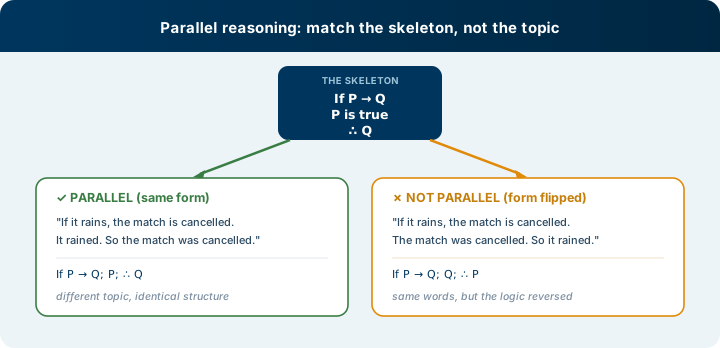
All X are Y; Z is X; so Z is Y is a valid form. All X are Y; Z is Y; so Z is X is the Mistaken Reversal, a flawed form (see Chapter 3). Once it is in arrows, matching is mechanical.If you can name the family in one breath, you can eliminate fast. If you cannot, write the one-sentence abstraction and test each answer against it.
Do not check everything at once. Run the four checks in this order and eliminate the moment an answer fails one. The early checks are the fastest and kill the most answers.
The discriminator between the last two contenders is almost always a tiny qualifier. “Can cause” is not “causes.” “Probably will not” is not “will not.” “A cause” is not “the cause.” “Most” is not “all.” The test alters one small word to break a structural match that is otherwise perfect. When two answers both seem to fit, the swapped modifier is what splits them. In everyday terms, telling your boss you will “probably” finish by Friday is not the same as telling her you “will” finish by Friday; one small word resets the whole promise, and Parallel answers bury their mismatch in a word exactly that size.
Once an answer matches on all four priorities, stop. You do not need to diagram the rest. Two shortcuts save real time:
Every building on campus that has a green roof was constructed after 2010. The new physics laboratory has a green roof. So the new physics laboratory was constructed after 2010.
Which one of the following is most similar in its reasoning to the argument above?
(A) Every novel that won the city’s literary prize was written by a local author. Some local authors have never entered the prize competition. So some local authors have not won the prize.
(B) Every restaurant that earned a health citation last year failed its follow-up inspection. The corner bistro failed its follow-up inspection. So the corner bistro earned a health citation last year.
(C) Every employee who received the bonus exceeded the sales target. Whoever exceeded the sales target worked overtime. So every employee who received the bonus worked overtime.
(D) Every bridge inspected this spring was rated structurally sound. The river crossing was inspected this spring. So the river crossing was rated structurally sound.
(E) Most of the trees in the old grove are oaks. This particular tree is in the old grove. So this particular tree is probably an oak.
Build the abstraction first. The stimulus is conditional. “Has a green roof” is sufficient for “built after 2010”: green roof → after 2010. The second premise tells you the physics lab triggers the sufficient condition (it has a green roof). The conclusion fires the necessary condition (it was built after 2010). The skeleton is All X are Y; Z is X; so Z is Y, a valid form. The stem does not say “flawed,” which fits: this is a clean argument.
So my target is: valid, conditional, all-statement plus a case that triggers the sufficient condition, concluding the necessary condition with certainty.
(A) is conditional, but trace it. prize-winner → local author. Then “some local authors never entered,” concluding “some local authors have not won.” This argues from the necessary term (local author) to a “some” conclusion. The method is conditional but the structure is a different move entirely (it works backward from the necessary condition and concludes with some, not a certain single-case result). The conclusion’s quantity is wrong: some, not a flat all-style certainty about one case. Eliminate.
(B) is the bait, and it is the most tempting wrong answer. It is conditional, all-statement, single case, certain conclusion: structurally it looks close. But trace the arrows. citation → failed follow-up. The case triggers the necessary condition (the bistro failed the follow-up), and the conclusion fires the sufficient one (it earned a citation). That is a Mistaken Reversal (Chapter 3): valid form would be triggering the sufficient and concluding the necessary, but this does the opposite. The stimulus is valid; (B) is flawed. Validity mismatch. Eliminate.
(C) is conditional but chains two rules. bonus → exceeded target, exceeded target → overtime, so bonus → overtime. This is a valid chain (Chapter 3), but the stimulus is not a chain. The stimulus applies one rule to one case; (C) links two rules across a shared term. The premise type and function differ. Eliminate.
(D) is conditional, all-statement: inspected this spring → rated sound. The river crossing triggers the sufficient condition (it was inspected this spring). The conclusion fires the necessary condition (it was rated sound) with certainty. Valid, single case, certain conclusion. This is All X are Y; Z is X; so Z is Y. Dead match. (D) is correct.
(E) swaps the modifier. “Most of the trees are oaks” is a most-statement, not an all-statement, and the conclusion is hedged: “probably an oak.” The stimulus uses all and concludes with certainty. Quantity and force both mismatch. This is the modifier trap in Step 4. Eliminate.
Once you confirm (D), you stop. The match on method, force, premises, and validity is exact.
For each, find the answer whose reasoning is most parallel to the stimulus. Cover the explanations and self-test first.
1. Anyone who has read the committee’s report understands the funding crisis. Dr. Pena understands the funding crisis. Therefore Dr. Pena has read the committee’s report.
Which exhibits a flawed pattern of reasoning most similar to the argument above?
(A) Every student who passed the exam studied the case files. Lin studied the case files. So Lin passed the exam.
(B) Every painting in the east wing is a forgery. This canvas is in the east wing. So this canvas is a forgery.
(C) All licensed pilots have passed a vision test. Ramos has not passed a vision test. So Ramos is not a licensed pilot.
(D) Most volunteers attended the orientation. Singh is a volunteer. So Singh probably attended the orientation.
(E) If a film is a documentary, it is eligible for the grant. This film is not a documentary. So it is not eligible for the grant.
2. The two new clinics opened in the same month and both reported a drop in patient wait times. So opening in that month must be what reduced their wait times.
Which is most similar in its reasoning to the argument above?
(A) Sales rose after the ad campaign launched, but sales rise every spring, so the campaign may not be responsible.
(B) The garden and the orchard were both watered on Tuesday and both bloomed by Friday, so the Tuesday watering must be what caused them to bloom.
(C) Whenever the factory runs at night, the neighbors complain. The neighbors complained, so the factory ran at night.
(D) Most companies that cut prices gained market share, so this company will gain share if it cuts prices.
(E) The bridge has carried heavy traffic for decades without failing, so it is structurally sound.
3. Every alloy that resists corrosion contains chromium. This sample resists corrosion. So this sample contains chromium.
Which is most similar in its reasoning to the argument above?
(A) Every novel on the syllabus is over 300 pages. This book is over 300 pages. So it is on the syllabus.
(B) Every grant the foundation awarded went to a nonprofit. The literacy project received one of the grants. So the literacy project is a nonprofit.
(C) Most bridges in the county are over fifty years old. This bridge is in the county. So it is probably over fifty years old.
(D) Anyone who finishes the course earns a certificate. Tomas has not finished the course. So Tomas will not earn a certificate.
(E) If a plant is a succulent, it stores water in its leaves. This plant stores water in its leaves. So it is a succulent.
1. (A). The stimulus is a Mistaken Reversal. read report → understands crisis; Dr. Pena triggers the necessary condition (understands the crisis) and the conclusion fires the sufficient (read the report). The stem says “flawed,” so match the same flaw. (A) does exactly this: passed → studied files; Lin triggers the necessary (studied files) and the conclusion fires the sufficient (passed). Same flaw, same direction. (B) is valid (triggers the sufficient, concludes the necessary), so it cannot parallel a flawed stimulus. (C) is a valid contrapositive (¬ passed vision → ¬ pilot). (D) is a valid most-based argument with a hedged conclusion, and it is not flawed in the stimulus’s way. (E) is a Mistaken Negation, a different flaw from a Mistaken Reversal, so it fails the same-flaw requirement.
2. (B). The stimulus is causal: two cases share a timing feature and an outcome, and the author concludes the timing caused the outcome (correlation treated as causation, Chapter 5), stated with certainty (“must”). Match a causal-from-correlation move with a certain conclusion. (B) does this exactly: two things share a Tuesday watering and both bloomed, so the watering “must” have caused the blooming. (A) is causal but weakens its own causal claim by raising an alternative cause; its conclusion is hedged (“may not”), the opposite force. (C) is conditional and commits a Mistaken Reversal, wrong method. (D) is a most-based prediction, not a causal-from-correlation argument. (E) reasons from a long track record to soundness, a different move with no shared correlation structure.
3. (B). The stimulus is valid conditional: resists corrosion → contains chromium; the sample triggers the sufficient condition and the conclusion fires the necessary, with certainty. Match All X are Y; Z is X; so Z is Y. (B) fits: grant → nonprofit; the literacy project triggers the sufficient (received a grant) and the conclusion fires the necessary (is a nonprofit). (A) triggers the necessary (over 300 pages) and concludes the sufficient: a Mistaken Reversal, flawed, so the validity mismatches. (C) swaps the modifier to most and hedges the conclusion to “probably,” failing on force and quantity. (D) is a Mistaken Negation, flawed. (E) triggers the necessary (stores water in leaves) and concludes the sufficient (is a succulent): another Mistaken Reversal, flawed.
Put it to work: drill Parallel Reasoning and Parallel Flaw questions in the practice platform, free during early access, with every answer choice explained.
