Volume II: Logical Reasoning · Chapter 16
The job: Fix It or Break It. Two facts seem to clash. Find the answer that lets both be true and explains how the surprising situation arose.
Frequency: roughly 1 to 2 per section. Difficulty: low to medium.
Resolve the Paradox is the friendliest member of the Fix-It-or-Break-It family, and the only one where you are not handed an argument. The stimulus is a fact set: two statements presented as true, with no conclusion drawn. The catch is that the two facts seem like they cannot both hold. One fact sets up an expectation, and the other fact violates it. The test calls this an apparent paradox, a discrepancy, or a conflict.
Notice the word apparent. There is no real contradiction here. Both facts are true, and the test tells you so. Your job is not to pick a winner or to disprove either side. Your job is to find the missing piece of the story, the fact that, once you know it, makes the surprise dissolve. The right answer is a new fact that lets you say, “Oh, that’s why both of those can be true at once.”
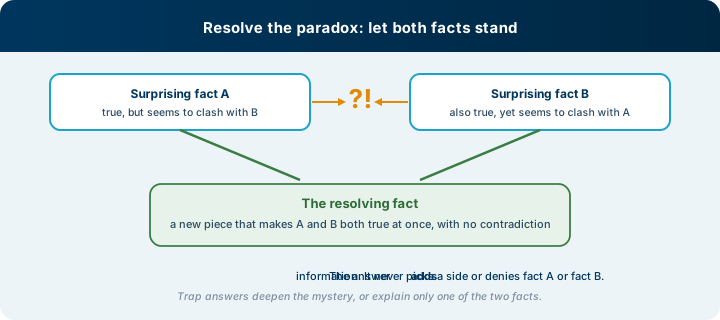
Because the stimulus contains no argument, you are not hunting for a conclusion, a gap, or a flaw. Do not force one. If you catch yourself looking for the author’s opinion, stop. There isn’t one. There are two facts and a feeling of “wait, how can both of those be so?” Your task is to answer that question.
The strongest habit to bring here is the causal mindset from Chapter 5. Ask of each answer: could this fact have produced the situation described? You are looking for a cause that explains why the expected result failed to show up.
The stem pairs an action word with a problem word, almost always followed by “if true”:
Action words: resolve, explain, reconcile, account for. Problem words: paradox, discrepancy, conflict, puzzle, surprising result, anomaly.
In the stimulus itself, the two clashing facts usually sit on either side of a pivot word: but, however, yet, nevertheless, surprisingly, paradoxically, even though. The pivot is your flag. Circle it. The fact before it sets the expectation; the fact after it breaks the expectation.
Look-alikes. Do not confuse this with Strengthen (Chapter 13). Strengthen has an argument with a conclusion and asks you to support a claim; Resolve has no conclusion and asks you to explain a situation. Both use “if true,” so the “if true” tag alone won’t classify the question. Read for the problem word (paradox, discrepancy) and check whether a conclusion is present.
Read the two facts and find the pivot. Locate but / however / yet / surprisingly and mark the fact on each side. In everyday terms, the pivot is the but in “the heater ran all night, but the room was freezing by dawn,” the word that flags the surprise you then have to explain.
State the expected result versus the actual result, out loud and explicit. This is the heart of the method, and skipping it is the number one cause of wrong answers. Say it as two sentences:
For example: “Given that the new safety law passed, you’d expect highway deaths to drop. But deaths went up.” Now the puzzle is precise, and you know exactly what the answer must explain.
Phrase the puzzle as a question. “Why would deaths go up even after the safety law passed?” The right answer is the best answer to that question. A useful confirmation trick: read the candidate answer right after your “Why…?” with the word “Because” in front. If “Because [answer]” reads as a sensible explanation, you likely have it. In everyday terms, it is the test you run on an excuse: “I was late because the elevator got stuck” satisfies the why, while “I was late because the building has elevators” plainly does not.
Sort every answer into one of three buckets. Every choice falls into exactly one:
Address the exact facts and groups stated. The answer has to explain these two facts, about this group, in this time frame. An answer that resolves a nearby puzzle about a different population is a trap. Match the stimulus precisely.
Apply the similarity / difference principle. Read what kind of paradox you have:
An answer that points at the wrong axis (offering a difference when you need a similarity) is built to fool you.
Keep both books on the table: bucket-sorting tells you which answers are even in the running; the similarity/difference check tells you which surviving answer actually fits the shape of the puzzle.
A regional health agency required all of its public hospitals to adopt a new electronic system for ordering prescriptions, replacing handwritten orders. The system was designed to catch dangerous drug combinations before a pharmacist fills an order. In the year after every hospital adopted the system, the total number of harmful medication errors recorded across these hospitals rose substantially compared with the year before.
Which one of the following, if true, most helps to resolve the apparent discrepancy described above?
(A) The electronic ordering system was more expensive to maintain than the agency had originally projected.
(B) Some physicians complained that entering orders into the new system took longer than writing them by hand.
(C) Before the new system, many harmful medication errors went unnoticed and were never recorded, whereas the new system automatically flags and logs every such error it detects.
(D) At private hospitals in the same region, which did not adopt the system, the number of recorded medication errors also rose during the same period.
(E) The new system occasionally failed to flag a dangerous drug combination when a physician overrode its warning.
Step 1 and 2, pivot, expected, actual. The pivot here is logical rather than a single word: a system designed to catch dangerous combinations should reduce errors.
Step 3, the question. Why would recorded errors go up after installing a system built to cut them down?
Step 4, bucket the answers.
(C) is correct. It explains the actual result without disputing either fact. The errors were always happening; before, most went unrecorded, so the count was artificially low. The new system catches and logs every error it finds, so the recorded count rose even if the true number of errors stayed flat or fell. Read it with “Because”: “Recorded errors rose because the old hand system never logged most errors and the new system logs them all.” That is a clean explanation, and both stimulus facts stay true. This is the classic Resolve move of discrediting the measurement: the count went up because counting got better, not because care got worse. It lands squarely in Bucket 2.
(A) is wrong, irrelevant (Bucket 3). Maintenance cost has nothing to do with the number of medication errors. It explains neither the expected drop nor the actual rise. A side issue.
(B) is wrong, irrelevant (Bucket 3), and a tempting near-miss. Slower order entry is a complaint about the system, but it does not explain why recorded harmful errors rose. You would have to invent a chain (slower entry leads to rushing leads to mistakes) that the stimulus never supplies. If you must speculate to connect an answer, it is not the answer.
(C) Handled above.
(D) is wrong, and it actually deepens the puzzle (Bucket 1 in spirit). If error counts rose even at hospitals that never adopted the system, then the system can’t be why the count rose at the public hospitals either. That points to some region-wide cause and makes the original surprise harder to explain, not easier. An answer that makes the discrepancy worse is the Opposite trap.
(E) is wrong, explains only a sliver, and is too small to do the job. An occasional failure when a physician overrides a warning might let a few errors through, but the stimulus says errors rose substantially. A rare override cannot account for a substantial rise, and it does nothing about the gap between expected and actual at the needed scale. It nibbles at the actual result without explaining it.
The credited answer is (C).
Occasionally the stem reads: “Each of the following, if true, helps to resolve the discrepancy EXCEPT.” Now four answers land in Bucket 2 (they each explain the actual result), and your job is to find the one outlier that does not. The outlier is usually a Bucket 3 irrelevant answer or, more cruelly, a Bucket 1 answer that deepens the puzzle. Flip your instinct: instead of hunting the lone resolver, eliminate the four that resolve and keep the one that doesn’t. The bucket-sorting from Step 4 does all the work; you just invert which bucket wins.
For each item, state the expected and actual result, then pick the answer that resolves the discrepancy. Answers and explanations follow in the next section.
1. A city replaced the incandescent bulbs in its streetlights with LED bulbs, which draw far less electricity per bulb to produce the same brightness. Yet in the year after the switch, the city’s total electricity bill for street lighting increased.
Which one, if true, most helps to resolve the discrepancy?
(A) LED bulbs last several years longer than incandescent bulbs before they must be replaced.
(B) The price the city pays per unit of electricity did not change during the year.
(C) Using the savings from the more efficient bulbs, the city installed many additional new streetlights on previously unlit roads.
(D) Some residents preferred the warmer color of the old incandescent bulbs.
(E) A neighboring city that kept its incandescent bulbs saw its lighting bill stay flat.
2. Two adjacent farms planted the same variety of wheat in the same season and used the same amount of fertilizer. The first farm harvested far more wheat per acre than the second.
Which one, if true, most helps to explain the difference in harvest?
(A) Both farms sold their wheat at the same market price.
(B) The first farm’s fields are irrigated, while the second farm relies entirely on rainfall, which was unusually scarce that season.
(C) The two farms are owned by members of the same family.
(D) The second farm used the same brand of fertilizer as the first.
(E) Wheat is among the most widely grown grains in the region.
3. A bookstore began charging customers a small fee for paper shopping bags, expecting the fee to discourage bag use and cut the store’s spending on bags. After a year, the store’s total spending on paper bags was higher than before the fee.
Which one, if true, most helps to resolve the apparent paradox?
(A) Most customers said they did not mind paying the small fee.
(B) The fee was widely advertised in the store’s window.
(C) The fee revenue led the store to switch to a sturdier, far more expensive bag, and most customers kept buying bags anyway.
(D) A competing bookstore across the street did not charge for bags.
(E) The fee was introduced at the start of the store’s busiest sales season.
1. (C).
2. (B). This is a same input, different outcome puzzle (same wheat, same fertilizer, different yields), so the answer must supply a relevant difference.
3. (C).
Put it to work: drill Paradox questions in the practice platform, free during early access, with every answer choice explained.
