Volume I: Foundations · Chapter 5
The job: Spot when an author claims one thing caused another, find the gap that claim hides, and act on it.
Frequency: woven through many sections; the engine behind a large share of Weaken, Strengthen, Flaw, and Assumption questions. Difficulty: medium, but high payoff.
This is a foundation chapter, not a question type. Causal reasoning is a pattern that shows up inside other question types: the Flaw Catalog (Chapter 6), Strengthen (Chapter 13), and Weaken (Chapter 14). The test writers love causation because it is easy to state and almost always built on a hidden leap. Once you can see the leap, you can attack it or defend it on command.
A causal claim says that one thing brings about another: A causes B. A is the cause; B is the effect. The author is not just saying A and B go together. The author is saying A produces B, that B happens because of A.
The LSAT signals causation with a recognizable set of words and phrases. Train your eye to flag them:
There is one more signal, and it is the most important because it is silent. Very often the author never uses a causal word at all. Instead the author observes a correlation (two things tend to occur together) or a sequence (B happened right after A) and then concludes a cause. That jump, from “A and B go together” to “A causes B,” is the single most tested move in causal reasoning. When you see a conclusion of cause resting on a premise of mere correlation or timing, your alarm should go off.
Here is the load-bearing idea of the whole chapter. When an author concludes “A causes B” from the fact that A and B are correlated, the author is quietly assuming four things are not true. Each of those four is a way the argument could be wrong:
Every causal conclusion on the LSAT rides on these four assumptions. That is not a coincidence about the test; it is the logical structure of causation itself. A correlation is symmetric and dumb. It tells you A and B keep company. It tells you nothing about who is driving.
So burn this in: correlation never proves causation. A real cause produces a correlation, yes. But so can a reverse cause, a third factor, or pure chance. The author who reads a correlation as a cause has skipped over three other live explanations.
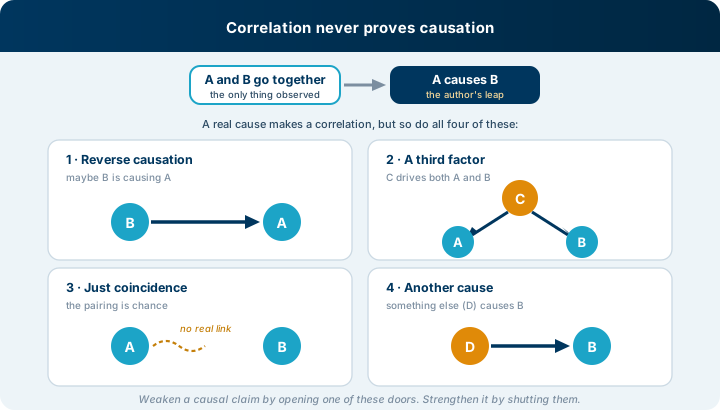
You do not need to memorize the four assumptions in the heat of a question. You need three fast questions you can fire at any causal claim. Call this the causation checklist:
Run these three questions the instant you spot a causal conclusion. You will usually find that one of them is the open door the test writer left for you. The correct answer to a Weaken question walks through that door; the correct answer to a Strengthen question slams it shut.
To weaken a causal claim, you make “A causes B” less likely. You do not have to destroy it. You only have to raise a competing possibility the author ignored. There are five standard moves, and they map directly onto the assumptions above:
Notice that moves 2 and 3 are about whether cause and effect actually track together. A genuine cause and its effect should rise and fall as a pair. Break that pairing, and you break the argument.
To strengthen a causal claim, you do the reverse. You shut down the alternatives the author was assuming away:
Every one of these works by closing a door on the causation checklist. That is why the checklist is your master tool for both Weaken and Strengthen. Same gap, opposite action.
Before you attack or defend, read what kind of conclusion you are dealing with. Three flavors of conclusion behave the same way causal claims do, and the LSAT uses all three:
Treat all three the same way. Each asserts that A is doing the work behind B, so each is vulnerable to the same four assumptions and answerable with the same checklist. When you read the conclusion first and label its flavor, you know immediately that you are in causal territory and which tools to reach for. (You will see this “read the conclusion’s flavor first” habit again in Chapter 13, Strengthen, and Chapter 14, Weaken.)
When an author commits the correlation-to-causation jump, that is a named reasoning error. You will meet it again in Chapter 6, the Flaw Catalog, under several labels:
On a Flaw question, the abstract answer choices will dress these up in formal language. “Takes the fact that one event preceded another to show that the first caused the second” is post hoc. “Fails to consider that the claimed effect might be the cause” is reversed causation. “Overlooks the possibility that a third factor is responsible for the correlation” is the third-cause flaw. Learn to translate the formal wording back into the plain checklist.
A city installed bright streetlights on a set of previously dim residential blocks. Over the following year, reported burglaries on those blocks dropped by nearly a third. A city council member concluded that the new streetlights reduced burglary, and she has proposed installing the same lights citywide to bring crime down everywhere.
Which one of the following, if true, most weakens the council member’s argument?
(A) The blocks that received new streetlights had higher average household incomes than the city as a whole.
(B) In the same year the lights were installed, the city assigned additional patrol officers to those specific blocks as part of a separate pilot program.
(C) Residents of the brightened blocks reported feeling safer walking at night after the lights were installed.
(D) Some burglars commit crimes during daylight hours, when streetlights are off.
(E) The cost of installing streetlights citywide would strain the city’s budget.
Find the structure first. The premise is a correlation in time: lights went up, then burglaries fell. The conclusion is causal: the lights reduced burglary. The flavor is explanation sliding into prediction (she expects the same result citywide). Run the checklist. Could it be reversed? Not plausibly here. Could it be coincidence? Maybe, but there is a juicier door. Could a third factor explain the drop? Yes. Something else may have happened on those blocks at the same time. The strongest weakener will hand us an alternative cause.
(B) is correct. Extra patrol officers were assigned to the exact same blocks in the exact same year. That is a textbook alternative cause: the police presence, not the lights, may have driven burglaries down. This is move 1 on the weakener list, and it directly opens the third-factor door. With another full explanation on the table, the lights-caused-it conclusion becomes much less likely.
Here is why each wrong choice fails:
Only (B) supplies a genuine alternative cause for the observed effect, so only (B) weakens the causal reasoning.
For each item, name the gap and answer the question asked. Try to do all four before checking the answers.
A study found that office workers who keep a plant on their desk report lower stress than workers with no desk plant. The researcher concluded that having a desk plant lowers stress. Name one alternative cause that would weaken this.
Counties that spend more per resident on public libraries also have higher average reading-test scores among children. An education writer concluded that library spending raises reading scores. Is reverse causation plausible here? Explain how you would weaken the argument by reversing it.
A nutritionist notes that people who drink herbal tea every morning tend to live longer than people who do not, and concludes that herbal tea extends lifespan. Which one fact, if true, would most strengthen this causal claim: (a) tea drinkers in the study also exercised more often, or (b) when researchers controlled for diet, exercise, and income, the tea-longevity link still held?
A manager observes that in the months her team used a new project-tracking app, the team shipped more features, and she concludes the app made the team more productive. How would you weaken this by attacking the data, and how would you weaken it by showing the cause without the effect?
Plenty of alternatives work. The cleanest: workers who choose to keep a desk plant may already be lower-stress, calmer, or more in control of their workspace, so a pre-existing trait causes both the plant and the low stress (a third factor). You could also reverse it: low-stress workers have the bandwidth to tend a plant, so calm causes the plant rather than the other way around. Either move attacks the assumption that the plant is doing the causing.
Yes, reverse causation is plausible, but the sharper attack here is actually a third factor: wealthier counties can afford both more library funding and better schools, tutoring, and home resources, so county wealth could drive both spending and scores. For a pure reversal, you would argue that counties whose children already read well vote to fund libraries more (a literate, education-valuing population spends more on libraries), so high reading drives high spending rather than the reverse. Showing that the spending followed the test-score gains rather than preceding them would make the reversal concrete.
(b) is the strengthener. Controlling for diet, exercise, and income rules out the most obvious alternative causes; if the tea-longevity link survives after those are held constant, the causal reading gets much stronger. (a) weakens the claim instead: if tea drinkers also exercised more, exercise is a ready alternative cause for the longer lifespan, so (a) opens the very door (b) closes.
Attack the data: show the correlation is unreliable. For example, those same months were the team’s normal busy season, or the feature count was measured differently after the app was adopted, so the apparent jump may be a measurement artifact rather than a real change. Show the cause without the effect: point to another team at the company that adopted the same app but saw no increase in features shipped. If the app reliably caused higher productivity, it should have produced the effect there too; its failure to do so suggests the app was not the cause.
