Volume II: Logical Reasoning · Chapter 14
The job: Fix It or Break It. Pick the answer that, if true, makes the argument less likely to hold.
Frequency: roughly 4 to 5 per section. Difficulty: medium.
Weaken is the mirror image of Strengthen (Chapter 13). On a Strengthen question you became the argument’s ally and shored up the missing link. On a Weaken question you switch sides. You become the argument’s opponent, and your goal is to land a blow on the reasoning. Same gap, opposite action.
That switch in posture is the whole game. Both chapters run on one engine, the gap between premises and conclusion; the only question is whether you are repairing that gap or attacking it. So if you have Strengthen down, you are most of the way here. The danger is precisely that the two invert the answer, which is why the test plants a strengthener on nearly every Weaken question to catch you going the wrong direction.
A Weaken question hands you a flawed argument and asks you to damage it. The damage need not be fatal. You are not asked to prove the conclusion false or to destroy the argument beyond repair. You are asked to make the conclusion less likely, to give the author a reason to reconsider. Any meaningful damage counts. An answer that takes a confident conclusion and makes it shakier has done the job, even if the conclusion could still limp along.
This matters because students reject correct answers for not doing enough. They want the answer that flattens the argument and pass over the one that merely dents it. The test rarely offers the knockout. It offers the dent, and the dent is correct. The standard is movement in the right direction, not annihilation.
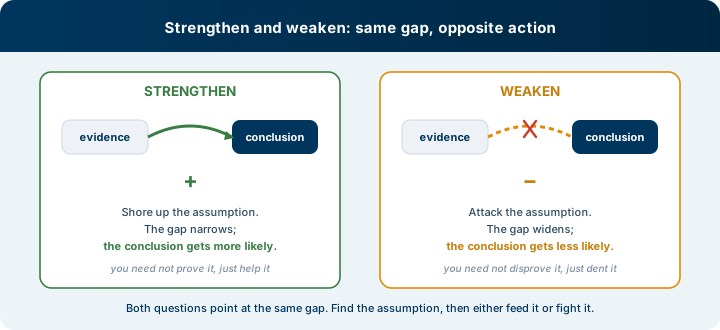
The argument always has a gap, the same premise-to-conclusion gap you met in Chapter 2. The premises may be perfectly true. Your target is not the premises. Your target is the link between the premises and the conclusion, the unstated assumption the author needs for the leap to work. You weaken by showing that link is weaker than the author thought.
One more rule, and it is non-negotiable: treat every answer choice as true. The stem says “which one of the following, if true,” and it means it. Do not waste energy doubting whether an answer is realistic. Granted that it is true, ask only one thing: does it make the argument less likely to hold?
The stem will ask you to undercut the argument. Look for these:
Almost all of them carry the tell “if true.” That phrase marks a Fix It or Break It job, where the answer is allowed to bring in new information, and it separates Weaken from a Read It question.
Look-alikes to keep separate. Weaken sits next to several types that read similarly:
Read the stem first, confirm it is a Weaken, then read the stimulus as an opponent. Find the conclusion with the Therefore Test (Chapter 2). Then find the premises that support it. You now have the link: premises on one side, conclusion on the other, and a gap between them.
This is the signature move of the chapter. Before you read the choices, ask three questions in order:
That third question exposes the assumption. The “how” is always a bridge the author built without stating it, and that bridge is what you attack. Aim your weakener at the “how,” not at the theory in the abstract and not at the data taken alone.
There are two ways to damage the link, and the correct answer almost always takes one of them:
Prephrase which form fits before you read the choices. In everyday terms, to dent “the new playlist is what packs our gym at night,” you can either sever the link (the gym also slashed its prices that month, so the music may be doing nothing) or bring countervailing data (the gym is just as packed on the mornings the old, quiet playlist still plays).
A large share of Weaken questions rest on a causal conclusion (A causes B), so the instant you spot one, switch to the tools from Chapter 5. To weaken a causal claim:
You do not need to memorize this list as something separate. It is the causation checklist from Chapter 5, pointed at the attack.
Read all five. Kill only with a reason. The number-one reason here will be “this strengthens, and I was asked to weaken.” That trap is on nearly every Weaken question, so expect it and name it when you see it. The survivor that genuinely makes the conclusion less likely is your answer.
A regional health agency studied two groups of adults over five years: those who reported eating fish at least twice a week, and those who reported eating fish rarely or never. At the end of the study, the frequent fish eaters had measurably lower rates of heart disease than the rare fish eaters. The agency concluded that eating fish regularly protects against heart disease, and it has launched a campaign urging the public to eat more fish.
Which one of the following, if true, most seriously weakens the agency’s argument?
(A) Some of the frequent fish eaters in the study developed heart disease during the five years, while some of the rare fish eaters did not.
(B) Fish is a relatively expensive source of protein, so the campaign may not change the habits of lower-income adults.
(C) The adults who reported eating fish at least twice a week also exercised more regularly and smoked less than the adults who rarely ate fish.
(D) A separate study found that adults who take fish-oil supplements have lower rates of heart disease than adults who do not.
(E) Heart disease is influenced by many factors, including genetics, that the agency’s study did not attempt to measure.
Run the three questions. What theory does the conclusion advance? That eating fish regularly protects against heart disease, a causal claim. What data support it? A correlation: in this study, frequent fish eaters had less heart disease than rare fish eaters. How do the data support it? The agency read the correlation as causation. It assumed the fish, and not something else about the fish eaters, drove the lower heart disease rates.
That “how” is the open door. This is a causal conclusion drawn from a correlation, so reach for the causal weakeners. The cleanest attack is an alternative cause: find something else about the frequent fish eaters that could explain their healthier hearts.
(C) is correct. The frequent fish eaters also exercised more and smoked less. Exercise and not smoking are well-known influences on heart disease, and here they line up exactly with the group that ate more fish. That hands the agency a complete alternative explanation: maybe the exercise and the lack of smoking, not the fish, produced the lower disease rates. The correlation stays true; the causal inference drawn from it collapses. The conclusion is now much less likely to hold. This is the alternative-cause move, and it undermines the data-to-conclusion connection precisely where the agency assumed the fish was doing the work.
Here is why each wrong choice fails:
Only (C) supplies a concrete alternative cause that tracks with the effect, so only (C) weakens the causal reasoning.
You will occasionally see “Each of the following weakens the argument EXCEPT.” Flip your process. Now four answers weaken, and the credited answer is the odd one out. Eliminate the four that do damage and keep the survivor. The key thing to remember: the credited answer does not have to strengthen. More often on hard EXCEPT questions it simply has no impact, neither helping nor hurting the argument. So three buckets are in play, weaken / no impact / strengthen, and your answer comes from either of the last two. Do not reject the no-impact answer for failing to strengthen; on an EXCEPT question, doing nothing is enough.
For each item, decide which answer weakens the argument, and be ready to say why each other choice fails. Try all three before checking.
1. A company switched its sales team to a new training program last quarter. That quarter, the team’s average sales per representative rose by 15 percent. The sales director concluded that the new training program caused the improvement.
Which one of the following, if true, most weakens the argument?
(A) The new training program was more expensive to run than the program it replaced.
(B) Last quarter, the company also released a redesigned product line that customers found far more appealing than the previous one.
(C) A few representatives who completed the new program saw their individual sales decline.
(D) The company’s main competitor saw its sales fall during the same quarter.
(E) The sales director had personally recommended adopting the new training program.
2. A columnist argues: “Our city should not build the proposed light-rail line. Cities that built similar lines in the past two decades all reported lower-than-projected ridership in the first year. So this line, too, will fall short of its ridership projections.”
Which one of the following, if true, most weakens the columnist’s argument?
(A) The proposed light-rail line would be more expensive per mile than most past projects.
(B) Some residents of the city say they would prefer expanded bus service to light rail.
(C) The past lines that fell short were all built in cities with far lower population density than this city, where dense development reliably fills transit to capacity.
(D) Light-rail lines in other countries have generally met their ridership projections.
(E) The city’s ridership projections were prepared by the same firm that prepared projections for several of the past lines.
3. A researcher found that students who study with background music score lower on memory tests than students who study in silence. She concluded that background music impairs memory.
Which one of the following, if true, most weakens the argument?
(A) The students who chose to study with music were, on average, more anxious test-takers than those who chose silence, and anxiety is known to lower memory-test scores.
(B) The memory test used in the study has been validated by other researchers.
(C) Some students who studied in silence also scored poorly on the memory test.
(D) Many students report that they enjoy studying with music.
(E) Instrumental music is less distracting than music with lyrics.
1. (B) is correct. The argument is causal: the new training caused the 15 percent rise. The three-question prephrase exposes the gap at “how”, the director assumes the training, not something else, drove the gain. (B) supplies an alternative cause: a more appealing redesigned product line launched the same quarter could easily explain higher sales on its own. That is the top causal weakener, and it directly opens the third-factor door.
2. (C) is correct. The argument reasons from past cases to this case: those lines fell short, so this one will too. The hidden assumption is that this city is relevantly similar to the past cases. (C) introduces new data inconsistent with that assumption: the past failures all occurred in low-density cities, while this city is dense, and density reliably fills transit. That breaks the analogy the argument depends on and makes the prediction much less likely to hold.
3. (A) is correct. This is a causal conclusion (music impairs memory) drawn from a correlation (music studiers scored lower). The students chose their own conditions, which opens the door to a confound. (A) supplies an alternative cause: the music studiers were more anxious, and anxiety lowers memory scores. The anxiety, not the music, may be doing the work. Alternative cause that tracks with the effect, exactly the move that undermines the link.
Put it to work: drill Weaken questions in the practice platform, free during early access, with every answer choice explained.
