Volume II: Logical Reasoning · Chapter 20
The job: Describe It. Two speakers make short statements; name the claim they disagree about (or, in the variant, agree about).
Frequency: roughly one or fewer per section. Difficulty: low to medium.
A Point at Issue question gives you a tiny two-person exchange. One speaker says something, a second responds, and the stem asks you to identify the precise claim the two of them disagree about. The credited answer is a statement that one speaker would clearly affirm and the other would clearly deny. A less common variant flips it and asks for the claim they agree about, a statement both would affirm.
This is a Describe It job (see Chapter 7, How to Approach Any Logical Reasoning Question). You are not judging whether either speaker is right, and you bring no outside information. You read both positions, then find the one statement that splits them cleanly. Like every Describe It answer, the credited choice must match what the text actually says.
The hard part is not finding a difference between the speakers. They will differ in tone, emphasis, a dozen small ways. The hard part is finding the difference the test is built on: a single claim where their positions point in opposite directions, one yes and one no. Most often that claim is a judgment or interpretation, not a bare fact. The speakers frequently agree on the facts and split on what the facts mean, what should be done, or what explains them. Train your eye on the evaluative claim, because that is usually where the real dispute lives.
The stem names two speakers (often labeled by name, sometimes as two short paragraphs) and asks about their disagreement:
The agreement variant reads the same way with the polarity reversed:
One look-alike to keep straight. A Method of Reasoning stem is also a Describe It job about an exchange, but it asks how a speaker argues; Point at Issue asks what the two speakers split over. Read to the end of the stem and notice which it points at.
The Agree/Disagree Test is the whole game on this type. For each choice, fill a tiny mental table:
| Speaker 1 | Speaker 2 | |
|---|---|---|
| Affirm, deny, or unknown? | ? | ? |
You need exactly one confident affirm and one confident deny, both anchored in something the speaker actually said. The most common way a tempting wrong answer fails is the unknown cell: one speaker takes a side, but the other never touched the claim, so that box is blank. A blank box is not a disagreement. You cannot disagree with someone who never spoke to the point, so a choice one speaker obviously affirms is still wrong if the other’s view is unknown.
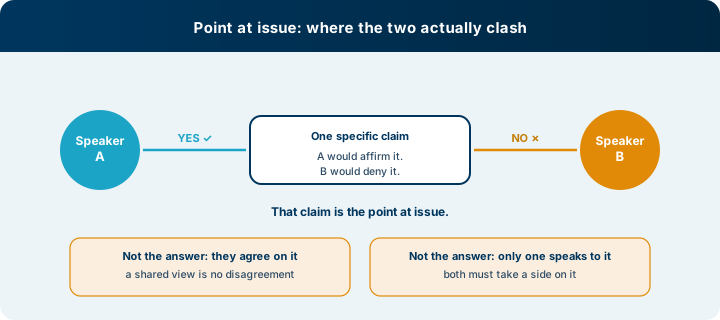
For the agreement variant, flip the target: you want a claim both would affirm. The unknown cell kills a choice here too, because you cannot say two speakers agree if one never addressed the point.
Stimulus:
Reyes: The city should not spend public money restoring the old riverfront theater. The building has sat empty for twenty years, and the cost of bringing it up to modern safety codes would be enormous. That money would do more good funding our underused public libraries.
Okafor: I disagree. The theater is the last surviving example of the cane-and-plaster construction that once defined this district, and structures like it cannot be replaced once they are gone. Preserving our architectural heritage is worth a significant public investment, even when cheaper uses for the money exist.
Stem: Reyes and Okafor are committed to disagreeing over whether
(A) restoring the riverfront theater would be expensive.
(B) the city’s public libraries are currently underused.
(C) the riverfront theater is the last surviving building of its construction type in the district.
(D) preserving the theater is worth a significant amount of public money.
(E) the city should increase its total spending on cultural programs.
Confirm the polarity. “Disagreeing over whether.” I want one clean affirm/deny split.
Pin down each speaker. Reyes: do not spend public money restoring the theater; it is costly, and libraries would be a better use of the funds. Okafor: spend the money; the building is irreplaceable heritage, and preservation is worth a significant public investment even when cheaper uses exist.
Prephrase the split. They agree the restoration is expensive. Reyes even leans on the cost, and Okafor does not deny it, she just says heritage is worth it anyway. So the dispute is not the cost. It is the judgment call: is preserving this theater worth significant public money? Reyes says no, Okafor says yes. That is my prephrase.
Run the Agree/Disagree Test.
The answer is (D). Each wrong answer fails the test: (A) is the factual point they agree on, (B) and (C) are one-sided (the other speaker’s view is unknown), and (E) is outside scope. Only (D) produces a confident yes from one speaker and a confident no from the other.
For each item, identify the claim the two speakers are committed to disagreeing about (unless the stem says otherwise). Run the Agree/Disagree Test on every choice. Cover the answers below first.
1.
Hale: We should adopt the four-day workweek. Studies of companies that tried it found that employees reported much higher job satisfaction.
Ng: Higher satisfaction is not the point. What matters is output, and those same companies showed no measurable gain in productivity.
The two disagree over whether
(A) the four-day workweek raises employee job satisfaction.
(B) job satisfaction is the appropriate standard for deciding whether to adopt the four-day workweek.
(C) the four-day workweek has been tried by any companies.
(D) productivity is difficult to measure.
(E) employees prefer working fewer days.
2.
Costa: The new museum wing must be poorly designed. Attendance there has been far lower than the curators predicted.
Adeyemi: Attendance is low, true. But the wing opened the same month the city closed the only subway line that reaches it, so visitors simply cannot get there easily.
The two disagree over whether
(A) attendance at the new wing has been lower than predicted.
(B) the subway line serving the museum has been closed.
(C) the low attendance is explained by poor design of the wing.
(D) the curators made a prediction about attendance.
(E) the museum should build additional wings in the future.
3. (Agreement variant.)
Park: The novel deserved its prize. The judges rewarded its daring structure, and bold formal experiments are exactly what the prize exists to honor.
Ibrahim: I would have given the prize to a different book. Still, I admit the winner’s structure breaks new ground, and I agree the prize is meant to reward formal risk-taking.
The two are committed to agreeing that
(A) the novel deserved to win the prize.
(B) the prize is intended to reward formal experimentation.
(C) the winning novel is better than the book Ibrahim preferred.
(D) the judges made the correct decision.
(E) daring structure is the most important quality in a novel.
1. Answer: (B). Hale argues from job satisfaction; Ng concedes satisfaction may be higher but says it “is not the point,” and the right standard is productivity. They split on the standard, not the facts. (B): Hale affirms (satisfaction is his deciding consideration), Ng denies. Clean split. (A) is the agreement trap: Hale affirms higher satisfaction and Ng’s “not the point” concedes it, so both affirm. (C) both accept that companies tried it. (E) employee preference is never made a point of contention. (D) is out of scope; neither claims productivity is hard to measure, only that it did not rise.
2. Answer: (C). Costa infers poor design from low attendance. Adeyemi concedes the attendance is low but offers a different cause, the closed subway line. They agree on the fact and split on the explanation. (C): Costa affirms that poor design explains the low attendance, Adeyemi denies it. Clean split. (A) is the agreement trap: both affirm attendance is low. (B) is one-sided; Adeyemi affirms the subway closure, but Costa never addresses it, so his box is blank. (D) both refer to the prediction, so both affirm. (E) is out of scope; neither discusses building more wings.
3. Answer: (B). The agreement variant, so I want a claim both affirm. Park says the prize exists to honor bold formal experiments; Ibrahim agrees “the prize is meant to reward formal risk-taking.” (B): both affirm. (A) is a disagreement, not agreement: Park says the novel deserved to win, Ibrahim would have picked a different book. (C) is one-sided and distorted; Ibrahim prefers another book but never calls the winner worse, and Park never compares them, so a box is blank. (D) Park affirms the decision was correct but Ibrahim would deny it, so it splits them. (E) mischaracterizes Park; he praises daring structure but never calls it the single most important quality.
Put it to work: drill Point at Issue questions in the practice platform, free during early access, with every answer choice explained.
