Volume II: Logical Reasoning · Chapter 12
The job: Fix It or Break It. Find the answer that, added to the premises, makes the conclusion airtight, guaranteed at 100 percent.
Frequency: roughly one to two per section. Difficulty: medium to high.
A Sufficient Assumption question hands you a broken argument and asks you to repair it completely. You are looking for the one answer that, when you treat it as a new premise and add it to the argument, forces the conclusion to be true. Not more likely. True. The conclusion must go from “the author leapt to this” to “this now follows beyond any doubt.” Because the answer is meant to justify the conclusion, this type is also called justify the conclusion.
The word that defines the type is sufficient: enough to do the whole job. The answer you pick has to be enough on its own, combined with the stated premises, to prove the conclusion. This is a higher bar than most question types set. Strengthen (Chapter 13) only asks you to nudge the argument in the right direction. A Sufficient Assumption answer has to slam the door. Every argument of this type has a gap: some new idea appears in the conclusion that the premises never connected to anything. Your job is to build the bridge across that gap, strong enough to carry full weight. You are not propping up a wobbly argument. You are completing a proof.
One more thing makes this type distinctive, and it is good news. Because the answer must produce certainty, these arguments are usually built out of conditional statements (the logic of guarantees) or out of numbers and percentages (the other logic that allows exact proof). That means you can often solve them mechanically, the way you would solve for a missing piece in an equation, rather than by feel. We will lean hard on that.
This chapter lives next to Chapter 11, Necessary Assumption, and the two are easy to confuse. Pin down the difference now, because the LSAT builds wrong answers out of exactly this confusion.
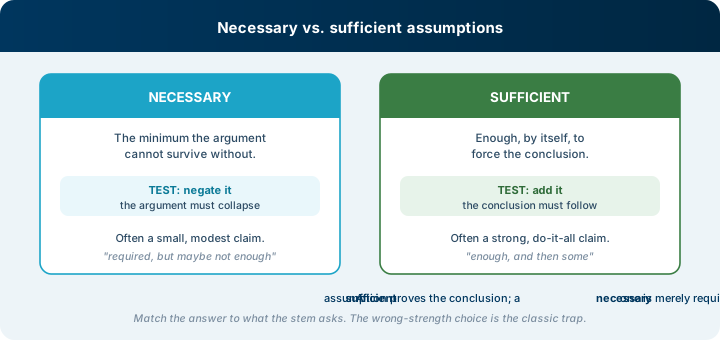
A necessary assumption is something the argument requires. It must be true for the argument to have any chance, but it is not, by itself, enough to prove the conclusion. It fills part of the gap.
A sufficient assumption is something that is enough to prove the conclusion. Add it, and the conclusion is guaranteed. It fills the whole gap, and it is allowed to give you even more than the argument strictly needed.
Think about the money it takes to buy something. Suppose a book costs forty dollars.
So a necessary condition is the floor you cannot drop below. A sufficient condition is a height that, once reached, settles the matter. Notice that one statement can be both. “I have exactly forty dollars” is both necessary and sufficient here: required, and also enough. But the two ideas point in opposite directions when you test them. To test necessary, you ask “does the argument fall apart without this?” To test sufficient, you ask “does the argument become bulletproof with this?”
That difference drives everything:
If you bring necessary-assumption instincts to this chapter, you will reject the right answer for “saying too much.” Do not. Saying too much is allowed when your job is to guarantee.
Watch the stem for the words if assumed and language about the conclusion following or being properly drawn:
The tell is “if assumed.” That phrase asks you to add the answer to the argument and see what becomes provable. It belongs to this type.
The key distinction from Strengthen. This is the single most important recognition skill in the chapter. If the stem says most justifies, or most helps to justify, or most supports, it is a Strengthen question, not a Sufficient Assumption question. The word “most” tells you the bar is below 100 percent, that you are comparing answers by degree. Sufficient Assumption has no “most.” It asks for the answer that makes the conclusion follow, full stop. Compare:
Misreading this costs you the question, because the strategies diverge. On Strengthen you cast a wide net and rank by helpfulness. Here you solve for the exact missing link and demand certainty.
The signature move for this type is mechanical. We call it plug-and-prove, and it rests on one formula:
Premises + Answer = Conclusion.
The correct answer is whatever you must add to the premises to make the conclusion airtight. Solve for it like a missing variable. Here is the procedure.
Step 1: Read the stem and confirm the type. See “if assumed,” and confirm there is no “most.” You are guaranteeing, not nudging.
Step 2: Find the conclusion and the premises. Use the Therefore Test from Chapter 2. Be exact about the terms. The whole method depends on tracking which words appear where.
Step 3: Spot the new term in the conclusion. This is the heart of the technique. Scan the conclusion for an idea that appears only in the conclusion and never in the premises. Call it the new term. The argument never connected it to anything, which is exactly why the argument fails. The correct answer must contain that new term, linked back to the material in the premises. In everyday terms, the new term is the word that shows up out of nowhere: if every premise talks only about your library card but the conclusion suddenly mentions late fees, the plank you need has to tie library card to late fees, since nothing else in the argument brought late fees up.
There is a matching rule for the premises. Look for a premise-only term: an idea that appears in the premises but never makes it into the conclusion. That dangling premise term is usually the other end of the bridge. The correct answer typically links the premise-only term to the conclusion’s new term.
Terms that appear in both the premises and the conclusion are already connected, so they usually do not appear in the answer. They are the parts of the bridge that are already built.
Step 4: Build the bridge and diagram it. Because these arguments are usually conditional, diagram the premises as conditionals (A → B), then chain them on shared terms. You will find a chain that almost reaches the conclusion but is missing one link. The missing link, written as a conditional, is your prephrase. Find it among the answers.
Step 5: Verify by plugging in. This is the confirmation step, and you should not skip it on hard questions. Take your chosen answer, drop it into the argument as if it were a stated premise, and re-read the whole thing. The conclusion must now be undeniable. If you can still imagine the premises and the answer both being true while the conclusion is false, the answer is not sufficient. Throw it out and keep looking.
A note on direction, because it is where careless test-takers die. Conditionals run one way. If the argument needs A → C and your answer gives you C → A, you have the bridge pointed backward, and it proves nothing. Always check that the arrow in your answer points the way the chain needs it to point.
Stimulus: Every grant proposal that the foundation funds has been reviewed by at least two outside referees. The proposal that Dr. Okafor submitted this spring was funded by the foundation. So Dr. Okafor’s proposal was written by a researcher with a current university appointment.
Stem: The conclusion follows logically if which one of the following is assumed?
(A) Any proposal reviewed by at least two outside referees was written by a researcher with a current university appointment.
(B) Most proposals written by researchers with current university appointments are reviewed by at least two outside referees.
(C) Every proposal written by a researcher with a current university appointment is reviewed by at least two outside referees.
(D) Some proposals reviewed by at least two outside referees are not funded by the foundation.
(E) Every researcher with a current university appointment has submitted at least one proposal to the foundation.
Step 1, confirm the type. “The conclusion follows logically if which one of the following is assumed.” That is Sufficient Assumption. No “most.” I need to guarantee the conclusion.
Step 2, find the conclusion and premises. Conclusion: Dr. Okafor’s proposal was written by a researcher with a current university appointment. Premises: (1) every funded proposal was reviewed by at least two outside referees; (2) Okafor’s proposal was funded.
Let me assign terms and diagram. Let F = funded by the foundation, R = reviewed by at least two outside referees, U = written by a researcher with a current university appointment.
F → R.F.U.Step 3, spot the new term. Scan the conclusion. The idea “written by a researcher with a current university appointment” (U) appears in the conclusion and nowhere in the premises. That is my new term. The correct answer must contain U, linked back to the premise material.
Now the premise side. From premise 2 I know Okafor’s proposal is F, and premise 1 chains F → R. So I can prove Okafor’s proposal is R. But the chain stops at R. The term R lives in the premises and never reaches the conclusion. So R is my premise-only term, dangling at the end of the chain.
Step 4, build the bridge. I can ride the chain to R: Okafor is F, and F → R, so Okafor is R. To reach the conclusion (U), I need a link from where my chain ends (R) to the new term (U). I need R → U. Plug it in and the chain completes: F → R → U, so F → U, and since Okafor is F, Okafor is U. That is my prephrase: “anything reviewed by at least two referees was written by a university-appointed researcher,” which is R → U.
Step 5, eliminate and verify.
R → U, exactly my prephrase. Plug it in: Okafor is F; F → R makes Okafor R; R → U makes Okafor U. The conclusion is now undeniable. Keep.U --m--> R, a “most” statement pointed the wrong way. It starts from U, the term I am trying to reach, not the term I am starting from, and “most” never guarantees anything about a particular proposal anyway. It proves nothing about Okafor. Kill. (Most-link trap and reversed direction in one answer.)U → R. It is the exact reverse of the link I need. I need R → U (from reviewed to university-appointed); this gives me U → R (from university-appointed to reviewed). Plug it in and trace it: I can prove Okafor is R, but U → R does not let me run backward from R to U. Doing so would be a Mistaken Reversal (Chapter 3). So this proves nothing about whether Okafor’s proposal is U. Kill. This is the reversed-arrow trap, and it is the most tempting wrong answer here precisely because it uses the right two terms.R but not F. Okafor’s proposal is F, so this says nothing about it, and it never mentions U. No bridge to the new term. Kill.U outward, toward who submitted proposals, and says nothing about which proposals are U. It cannot prove Okafor’s proposal is U. Reversed and out of scope. Kill.The answer is (A).
Notice how the mechanical method did the work. The new term U appeared only in the conclusion, so the answer had to contain U. The premise-only term R dangled at the end of the chain, so the answer had to link R to U. That gave the exact prephrase R → U, and only (A) supplied it. The trap that nearly works, (C), uses both correct terms but points the arrow the wrong way. That is why direction is the thing you check last and hardest: the reversed-arrow answer is built out of the right vocabulary, and only the plug-and-prove re-read exposes that it never reaches the conclusion.
C → A when the chain needs A → C. The right terms, the wrong direction. Tell: the conditional points back toward the premises instead of forward to the conclusion’s new term.--m--> or --some-- connection where you need an all-strength →. Quantifiers below “all” cannot guarantee a result for a particular case. Tell: the answer says “most” or “some” and you needed certainty.For each, identify the conclusion’s new term, prephrase the missing link as a conditional, and pick the answer that makes the conclusion follow. Answers and full explanations are at the end. Cover them first.
1. Every employee who completed the safety course received a certificate. Petra received a certificate. Therefore, Petra is eligible for the night shift.
Which one of the following, if assumed, allows the conclusion to be properly drawn?
(A) Everyone eligible for the night shift completed the safety course.
(B) Anyone who received a certificate is eligible for the night shift.
(C) Most employees who received a certificate are eligible for the night shift.
(D) Petra completed the safety course.
(E) No one who failed the safety course received a certificate.
2. The clinic will be accredited only if it hires a full-time physician. The clinic has hired a full-time physician. Therefore, the clinic will be accredited.
The conclusion follows logically if which one of the following is assumed?
(A) The clinic will be accredited only if it passes a state inspection.
(B) Any clinic that hires a full-time physician will be accredited.
(C) Most clinics that hire a full-time physician are accredited.
(D) No clinic is accredited unless it hires a full-time physician.
(E) The clinic hired its full-time physician in order to gain accreditation.
3. Galleries that exhibit emerging artists qualify for the city arts grant. The Meridian Gallery exhibits only painters who have won a national award. Therefore, the Meridian Gallery qualifies for the city arts grant.
Which one of the following, if assumed, enables the conclusion to be properly inferred?
(A) Every painter who has won a national award is an emerging artist.
(B) Some emerging artists have won a national award.
(C) Every gallery that qualifies for the grant exhibits emerging artists.
(D) Every emerging artist exhibited by the Meridian Gallery has won a national award.
(E) The Meridian Gallery has applied for the city arts grant.
1. (B). New term in the conclusion: “eligible for the night shift,” which appears nowhere in the premises. Diagram: safety course → certificate (premise 1); Petra is certificate (premise 2); conclusion: Petra is eligible. The chain reaches “certificate” and stops; I need to get from certificate to eligible. The missing link is certificate → eligible. That is (B): plug it in and Petra, who has a certificate, is eligible. Undeniable.
eligible → safety course, the reversed direction; it cannot move you forward to “eligible.” Reversed-arrow trap.certificate --m--> eligible); “most” never guarantees the result for Petra specifically. Most-link trap.¬safety course → ¬certificate, a statement about certificates and the course that never mentions eligibility at all. It cannot reach the new term. Out of scope for the gap.2. (B). Read “only if” carefully (Chapter 3): “accredited only if it hires a full-time physician” puts the physician on the necessary side, so premise 1 is accredited → physician. Premise 2 says the clinic hired a physician (physician is true). The conclusion is “accredited.” Watch the direction: the argument knows physician is true and concludes accredited, but premise 1 only runs accredited → physician. Going from physician back to accredited is a Mistaken Reversal (Chapter 3), so the argument as stated does not follow. To make it airtight, I need the arrow pointed the other way: physician → accredited. That is (B), “any clinic that hires a full-time physician will be accredited.” Plug it in: the clinic hired a physician, and physician → accredited, so the clinic is accredited. Undeniable.
accredited → inspection. It tacks on a second necessary condition and points the wrong way; it never helps you reach “accredited.” Out of scope and reversed.physician --m--> accredited); “most” cannot guarantee this particular clinic is accredited. Most-link trap.accredited → physician again (the same necessary condition restated by “unless,” Chapter 3). It repeats premise 1 and adds nothing. Half-bridge: it never supplies the physician → accredited direction you need.3. (A). New term in the conclusion: nothing new actually appears in the conclusion (“qualifies for the city arts grant” is in premise 1). The gap is instead a missing chain link. Diagram: exhibits emerging artists → qualifies (premise 1); Meridian exhibits only national-award painters (premise 2): Meridian exhibits X → X is national-award. Conclusion: Meridian qualifies. To use premise 1, I must show Meridian “exhibits emerging artists.” Premise 2 tells me Meridian’s artists are all national-award winners. So the missing link is “national-award painters are emerging artists,” national-award → emerging. That is (A): then Meridian exhibits emerging artists, which triggers → qualifies. Airtight.
emerging --some-- national-award), far too weak to guarantee that Meridian’s specific painters are emerging artists. Some-link trap.qualifies → exhibits emerging, the reverse of premise 1; it cannot move you toward “qualifies.” Reversed-arrow trap.(Meridian's emerging artists) → national-award. I need to know that Meridian’s award-winners are emerging; (D) tells me Meridian’s emerging artists are award-winners, which is the reverse and never establishes that Meridian exhibits any emerging artists. Reversed-arrow trap.Put it to work: drill Sufficient Assumption questions in the practice platform, free during early access, with every answer choice explained.
