Volume I: Foundations
This book teaches you the two reasoning sections that now make up the entire scored LSAT: Logical Reasoning and Reading Comprehension. It does that by drawing on the consensus methods of three respected LSAT guides. Where those guides agree, you get the solid, time-tested core. Where they differ, this book makes a clear ruling and explains it, so you are never left choosing between competing systems on your own.
You will not find a survey of every possible approach here. You will find one method, taught directly, with original examples built to behave like the real test. The aim is simple: teach the test as it exists today, teach it as one connected skill, and get you to act on each question instead of staring at it.
The LSAT is administered digitally. Every section runs 35 minutes.
Your scored test has three sections:
On top of those three scored sections, you also get:
One thing the modern test does not include: Logic Games, also called Analytical Reasoning. That section was removed in August 2024. If an older book, a tutor, or a practice set tells you to diagram games, that material is out of date. Skip it. This book reflects the current test only.
Look at what those three scored sections add up to. Logical Reasoning is now two of the three scored sections, roughly half of your score. Reading Comprehension is the remaining third.
That matters in two ways.
First, Reading Comprehension is now proportionally more important than it used to be. On the older four-section test, RC was one scored section out of four. Today it is one out of three. Students who treated RC as an afterthought were already making a mistake. On the current test, neglecting it is much more expensive.
Second, and this is the heart of the book, Logical Reasoning and Reading Comprehension are not two separate subjects. They are the same skill applied to different material. Both ask you to find an author’s conclusion, separate fact from opinion, track how evidence is supposed to support a claim, and judge what does and does not follow. A Reading Comprehension passage often contains an argument you must analyze exactly the way you analyze a Logical Reasoning stimulus. Some RC questions are literally Strengthen and Weaken questions wearing a different costume.
So this book teaches the two sections as one integrated skill set. You will learn the reasoning tools first, then apply them in both sections. When a Reading Comprehension chapter reuses a Logical Reasoning technique, it will say so by name.
Your scored test is converted to a scaled score from 120 to 180.
Here is the path your performance takes. First, the test counts your raw score: the number of questions you answered correctly. There is no subtraction for wrong answers. The raw score is then equated across test forms, which means it is adjusted so that a slightly harder version of the test does not unfairly lower your score compared to an easier version. The equated result becomes your scaled 120 to 180 score, which is also reported as a percentile: the share of test takers you scored above.
Two consequences follow directly, and both should change how you take the test.
There is no penalty for a wrong answer. A blank and a wrong answer are worth exactly the same: nothing. A guess can only help you. So you should never leave a question blank. Before time is called, fill in an answer for every single question, even if it is a pure guess. This is not optional advice. It is free points, and skipping it is one of the most common unforced errors on the test.
Points near the middle of the curve are worth more. The relationship between raw score and percentile is not a straight line. Near the middle of the scale, a small gain in correct answers can move your percentile a surprising amount, because that is where most test takers are clustered. A three or four point scaled gain in that range can shift your standing more than the same gain near the top. Since schools care about your percentile, those middle-of-the-curve points are valuable, and they are usually won not by heroics on the hardest questions but by stopping careless mistakes on the ones you should already get.
Before any specific technique, you need the right frame of mind. These principles appear, in one form or another, across every serious approach to the test, and they are the spine of this book.
The test measures reasoning, not knowledge. You are not expected to know economics, biology, or law. You bring only ordinary common sense. Importing outside facts is a trap, not an advantage. Think of a referee, who does not have to be the best athlete on the field and only has to know whether each play follows the rules. Your task is the same: judge whether the reasoning follows, not whether you happen to know the subject.
Judge validity, not truth. Your job is to ask whether the conclusion follows if you grant the premises, not whether the premises are true in the real world. An argument can be valid with false premises and invalid with true ones. The test cares about the link, not the facts.
Aim for accuracy, not completeness. You do not have to finish a section to score well. You will score better by working the questions you can get right and guessing the rest than by rushing through every question and missing things you understood. Do the gettable points first. Guess the rest. Never leave a blank.
Win by elimination. About four of every five answer choices are wrong, and they are engineered to tempt you. The most reliable skill on the entire test is recognizing why a wrong answer is wrong and crossing it out. You are not hunting for the answer that looks best. You are removing the four that fail. Read every choice before you commit.
Prephrase before you read the choices. After you understand the question and the stimulus, predict the answer, or at least the gap or flaw the answer must address, before you look at the five choices. Reading the choices cold makes you easy prey for the tempting wrong answer the test plants right before the correct one.
These are not slogans to admire. They are instructions to follow on every question.
Logical Reasoning has many named question types, but every single question stem hands you one of three jobs. Learning to spot which job you have been given is the master map for the whole section.
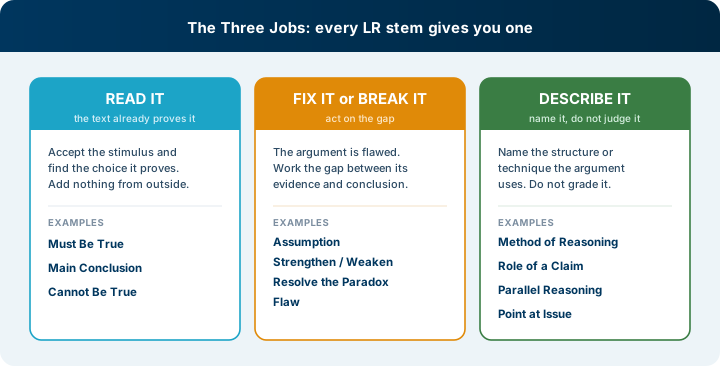
Each type chapter opens by telling you which of these three jobs it belongs to, so you always carry the map. For now, just hold the frame: read the stem, ask which job it gives you, and let that drive how you read everything else.
Work it in order, at least the first time through.
Start with the foundations (Part I). The chapters on conditional logic, causal reasoning, flaws, and the reading method come before the question-type chapters for a reason. Every type chapter assumes those tools. If you jump straight to Necessary Assumption without the foundations, you will be memorizing steps you do not understand. Build the tools first.
Drill one type at a time to mastery. Do not bounce between question types early on. Take a single type, learn its method, work its drills, and stay with it until you can recognize it on sight and apply the method without rereading the chapter. Then move to the next type. Isolated, focused practice is how the patterns become automatic.
Switch to mixed review near test day. Once you have worked the types individually, practice them shuffled together, the way the real test serves them. The real exam will not tell you a question’s type. Mixed sets train the most important early move: reading the stem, classifying the job, and choosing the right method on your own.
Keep a missed-question log. Every question you miss, and every question you got right but felt unsure about, goes in the log. Write down the type, what trap caught you, and what you should have seen. Over a few weeks the log will show you your real weaknesses, which are almost never spread evenly. You will study far more efficiently when you attack your actual error patterns instead of grinding everything equally.
That is the whole plan: learn the reasoning, learn the jobs, drill to mastery, mix, and let your own mistakes tell you where to spend your time. The rest of this book gives you the method for each piece. Start with the foundations, and work straight through.
