Volume III: Reading Comprehension · Chapter 28
You now have a method for every question type on the LSAT. This chapter is about turning that knowledge into a score. Knowing how to attack a Weaken question is one thing. Being able to do it accurately, quickly, and under pressure, at 9:30 in the morning on test day, is another. The gap between those two things is closed by how you study and how you handle the day itself. This chapter shows you how to study so the method becomes instinct, and how to walk into the test ready to use it.
Here is the single most important decision you will make about your studying, and most people get it wrong. Study one question type at a time, all the way to mastery, before you mix types together.
What does mastery mean? It is not “I got most of these right today.” Mastery means you can pick up a question of that type weeks later, work it cleanly, get it right, and explain why every wrong answer is wrong. That last part is the real test. If you cannot say, out loud, exactly why each of the four wrong choices fails, you have not mastered the type. You have just guessed well. The credited answer was probably attractive enough that you found it, but you have no defense against the day the test writer makes the trap more attractive than the answer.
So you work in blocks. You spend your time on, say, Necessary Assumption (see Chapter 11) until the method is automatic: you find the gap without thinking, you run the Negation Check without effort, you recognize a premise-booster trap on sight. Only then do you move to the next type. You do this type by type, building one clean instinct at a time.
The instinct to mix everything together early feels productive. It feels like “real practice.” It is a mistake, and here is why.
Each question type has its own reading posture. On a Weaken question you read like an opponent hunting for the crack in the argument. On a Must Be True question you read like a careful clerk who will not allow one word past what the text proves. On a Resolve question you are not judging an argument at all, you are explaining a surprise. These postures are different, and they are partly in conflict. The skeptical eye that wins Weaken questions will make you reject correct Must Be True answers for being “too obvious.”
When you mix types before any single posture is solid, you ask your brain to switch between half-formed instincts. You reinforce a blurry, generic approach instead of sharp type-specific ones, and you cement bad habits, because you are practicing the habit of approaching every question the same vague way. Master the postures one at a time, when you can give each your full attention, and the type-specific instinct sets like concrete. Then mixing tests it instead of muddying it.
Inside each type, learn the common form first. Most questions of a given type follow a tendency: the conclusion is causal, the trap is the opposite-direction answer, the gap is a term shift. Get fluent with that ordinary form before you study the hard variations.
The hard versions are twists on the common form. A Strengthen question where the right answer rules out reverse causation is a twist on the basic Strengthen move of supporting the link. You cannot recognize the twist until you own the standard pattern it is twisting. So drill the tendency until it is boring, then go hunt the twists on purpose. This order, tendencies to twists, builds a method that holds up on the hardest questions instead of collapsing the moment the test writer steps off the well-worn path.
Near test day, you flip the switch. You stop drilling single types and move to mixed review: full timed sections and full timed practice tests, with every type jumbled together exactly as the real LSAT delivers them.
Mixed review trains a different skill: shifting gears. On the real test you do not get a heading that says “the next five are Flaw questions.” You read each stem, classify the task, load the right posture, and execute, then do it again with a different task one question later. That gear-shift is itself a trainable skill, and it is the most common source of careless errors, picking the right answer for the wrong question because you never fully changed gears. You can only train gear-shifting once the individual gears exist. That is why mixed review comes last, not first.
Most of your studying is drilling: working sets of questions of one type and reviewing them hard. Do it well and a drill is worth ten times a lazy one.
Untimed accuracy first, then add the clock. When you first learn a type, take the clock off entirely. Your only goal is to execute the method correctly, every step, every time, even if a single question takes you six minutes. Speed is a by-product of clean technique, not a substitute for it. Once your accuracy is high and your method is automatic on untimed sets, then you introduce timing, and you build it gradually (more on pacing below). Adding the clock before the method is solid just teaches you to make your mistakes faster. In everyday terms: a touch typist gets fast by getting accurate first, because speed grows out of knowing where the keys are, while pounding the keyboard harder before your fingers know the layout only produces typos faster.
Review every question you got wrong, and every one you got right but were unsure about. The wrong ones are obvious. The sneaky ones are the questions you got right while guessing or while torn between two choices. A right answer you were not sure of is a wrong answer waiting to happen on a slightly harder twin. Treat every “I picked B but C was tempting” as a question you need to break down completely: why B, and exactly why not C. If you skip the ones you “got,” you leave your most fragile points unprotected.
When you review, do not just confirm the right answer. Articulate why each wrong answer is wrong, in the trap language from its chapter. Then look at the credited answer and ask what made the trap tempting. That is the review that builds mastery.
Keep a running missed-question log. This is the single highest-value habit in your whole study plan, and it costs you two minutes per question. For every question you miss (and every one you got right but were unsure of), write down three things:
The log is not busywork. It is diagnosis. After thirty or forty entries, patterns jump out that you could never see one question at a time. You discover you are fine on Weaken but the opposite-answer trap gets you every time. You discover half your misses are on the last five questions of a section, which is a pacing problem, not a logic problem. You discover you blow Method questions because you skim the stem. Each pattern points to a specific fix. Without the log, you study your weaknesses by feel, and feel lies. With it, you study them with evidence.
Here is a realistic arc. Treat it as a skeleton to adapt, not a rule. An eight to twelve week plan works for most people studying part time. If you have more time or a bigger score jump to make, stretch it; if less, compress, but do not skip the structure.
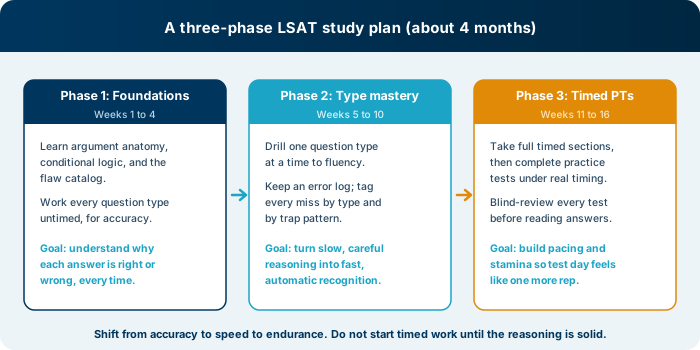
On weekly hours: aim for something you can sustain, somewhere around ten to fifteen hours a week for most people. Consistency beats intensity. Focused hours spread across the week, with real review, will beat one exhausted twelve-hour Saturday where you do questions without reviewing them. Protect the review time above all. Doing questions is how you find your weaknesses; reviewing them is how you fix them.
Adapt the arc to your log. If after week 6 your log says LR Assumption questions are still shaky, do not march on to mixed review on schedule. Hold and re-drill. The schedule serves your weaknesses, not the other way around.
You have about 35 minutes per scored section and roughly 24 to 26 questions in each LR section, with about 27 questions across four passages in RC. That is a real time constraint, but you do not learn to handle it by panicking through full sections from the start.
Build timing gradually. Get accurate untimed, then set a generous time limit and tighten it over weeks. Rushing accuracy you do not yet have just trains sloppiness.
Practice triage. You do not have to do the questions in order, and you do not have to finish. Learn to recognize, quickly, when a question is going to cost you too much time, and move on. Bank that time on questions you can actually get. In RC, rank the passages and do the most workable one first; do not assume the science passage is the hard one (see the RC section-strategy chapter). The skill of skipping well is worth several points, and it only develops if you practice it on purpose under the clock.
Bubble everything. There is no penalty for a wrong answer, so you should never leave a question blank. Practice this until it is reflex: in the last minute of any section, fill in an answer for every remaining question. A blind guess is worth more than a blank every single time. (On the digital test you select rather than bubble, but the rule is identical: leave nothing unanswered.)
The LSAT is delivered digitally, but the administration rules are changing. LSAC has announced that beginning with the August 2026 administration, most test takers will take the multiple-choice portion at a test center, with limited remote exceptions. LSAT Argumentative Writing remains a separate online, remotely proctored task. The exact requirements for identification, permitted items, scheduling, hardware, room setup, and proctoring change from time to time, so check the current LSAC rules well before your test date rather than relying on any book, including this one. What follows are the principles; verify the specifics yourself.
Scout and prepare your setup in advance. If you are testing at a center, know the location, route, parking or transit plan, check-in rules, and permitted items. If you are approved to test remotely or are completing the writing task, run the system check LSAC provides days ahead, not the night before. Confirm your computer, camera, and internet meet the requirements, and arrange your testing space to match the proctoring rules so you are not scrambling on test morning. The goal is to remove every logistical surprise so that on test day your only job is the test.
Sleep, especially two nights before. The night right before a big test is often a poor sleep no matter what you do, because of nerves. That is why the night two nights before matters most. Bank your real rest then, and a rough night right before will not hurt you much.
Warm up by reviewing problems you already did well on. On the morning of the test, do a few questions, but only ones you have already worked and gotten right. The point is to get your reasoning engine running and your confidence up, not to learn anything. Do not attempt new questions on test morning. A fresh hard question you happen to miss will rattle you for no reason right when you need steadiness. Warm up on wins.
Manage your nerves. Some adrenaline is fine and even helpful. Have a simple reset for when it tips into panic: set the hard question down, breathe, move to one you can get, and let a few easy points rebuild your rhythm. Nerves shrink when you are scoring points, so the fastest way to calm down mid-section is to go bank a couple of gettable questions.
Treat every section as scored. The test includes one unscored experimental section mixed in with the scored ones, and you cannot tell which it is. Do not try to guess. Any section you decide is “probably the experimental” and coast through might be the real thing, and you will have thrown away points you cannot get back. Give every section your full effort, every time.
A few things to keep in mind once the test is in front of you and once it is behind you.
Never leave a question blank. It bears repeating because points are quite literally free here. There is no wrong-answer penalty. Your score is built from the number of questions you get right, scaled to the 120 to 180 range. A blank and a wrong answer cost you exactly the same, so a guess can only help. Answer every question.
Do not cancel in a panic. You will almost certainly walk out feeling worse than you expected. Everyone does; the test is designed to be hard, and the questions you struggled with are the ones you remember. That feeling is a terrible guide to your actual score. You generally have a short window after the test in which you can choose to cancel your score, but do not make that decision on test day with adrenaline still in your system. Wait, get some distance, think it through with a clear head, and only then decide. The exact length of the cancellation window and how cancellations are reported can change, so check the current LSAC policy for the specifics.
Retakes are allowed, within limits. You are permitted to take the LSAT more than once, and many strong applicants do. There are caps on how many times you can take it within a given period and in total, and those limits have changed over the years, so confirm the current LSAC retake rules before you plan a second attempt. Just as important: law schools differ in how they treat multiple scores. Some consider only your highest score; others average your scores. This genuinely affects whether and when a retake helps you, so ask the schools you care about how they handle multiple LSAT scores, and let their answer shape your decision.
Everything in this book comes back to one idea. The LSAT does not test what you know. It tests how you reason, and reasoning is a skill, which means it is trainable. You have spent this book learning to find the argument’s skeleton, name the gap, run the right move for each task, and refuse the answer that is merely attractive in favor of the one that is actually correct.
The study plan in this chapter is just that same idea applied to your preparation. Master one thing at a time, all the way down, until you can explain not only the right answer but every wrong one. Keep an honest record of your misses and let it tell you what to fix. Build speed on top of accuracy, never the other way around. Then, near the end, put it all together and let mixed review prove that your instincts hold.
Do that, and test day is not a leap into the unknown. It is one more session of work you already know how to do, just with the stakes turned up. Warm up on your wins, treat every section as the one that counts, never leave a blank, and trust the method you built. You have done the reasoning a thousand times. Now go do it once more.
Put it to work: start with a timed section in the practice platform, free during early access, with every answer choice explained.
