Reference · Appendix A
This is your one-stop cheat sheet. The main chapters use conditional and quantifier logic constantly but keep the mechanics light. Here is the full machinery, including the exotic cases you will hit only a few times per test. Use it to look things up, not to read straight through.
Notation: → is the conditional arrow. ¬ means “not.” --m--> is a “most” arrow (one direction only). --some-- is a some-relationship (reads both ways).
A conditional is a guarantee. S → N reads “if S, then N”: the sufficient condition S guarantees the necessary condition N. S is enough to force N. N is required for S. No time order and no cause is implied. The arrow is a logical sign, not a story.
The contrapositive is the only valid transformation: reverse AND negate.
S → N becomes ¬N → ¬S.
The contrapositive says exactly what the original says. If you ever need a shared term to sit on the other side of an arrow, take the contrapositive to move it.
| Error | Looks like | Why it fails |
|---|---|---|
| Mistaken Reversal | N → S | Reverses without negating. Treats the necessary as if it were sufficient. |
| Mistaken Negation | ¬S → ¬N | Negates without reversing. Treats the sufficient as if it were required. |
A Mistaken Reversal and a Mistaken Negation of the same statement are contrapositives of each other, so both are wrong in the same way. When a stem hands you S → N and an answer asserts N, you can conclude nothing about S.
The indicator tells you which term is sufficient and which is necessary. Word order in the sentence does not matter.
| Introduces the SUFFICIENT condition | Introduces the NECESSARY condition |
|---|---|
| if | then |
| when, whenever | only, only if, only when |
| all, any, every, each | must, required, requires |
| people who, anyone who | needs, essential, depends on |
| in order to | unless, except, until, without |
Note that unless / except / until / without introduce the necessary condition but also require a negation step. See the next section.
| Phrase | Rule | Diagram |
|---|---|---|
A only if B | ”only” marks the necessary | A → B |
A only when B | same as “only if” | A → B |
Only A are B | the “only” term is necessary for the other | B → A |
A if and only if B | biconditional, arrows both ways | A → B and B → A |
Unless B, ¬A | ”unless” term is necessary; negate the other | A → B |
No X are Y | the two cannot coexist | X → ¬Y (and Y → ¬X) |
None of the X are Y | same as “no X are Y” | X → ¬Y |
When you see only or only if, your instinct will be to make the nearby term sufficient, and that instinct is backwards. A only if B does not mean B → A. It means A → B. “Only the funded projects proceed” diagrams as proceed → funded, not the reverse. Everyday check: “Only employees may park in this lot” means a car parked there must belong to an employee (parks here → employee), not that every employee parks there.
Two steps, always the same:
Example: “Unless the city raises revenue, the bridge stays closed.” Necessary = raises revenue. Other term (“bridge stays closed”) negates to “bridge opens.” Result: bridge opens → raises revenue. Everyday check: “I will not leave unless the rain stops” makes “rain stops” the necessary term and negates the other, giving I leave → rain stopped. So if you left, the rain had stopped.
A ↔ B packs two arrows: A → B and B → A, plus both contrapositives. A occurs exactly when B occurs. Triggers: “if and only if,” “when and only when,” “all and only.”
When a term is itself an AND-group or an OR-group, the contrapositive flips AND to OR and OR to AND. This is the single rule that governs all four forms.
| Original | Contrapositive | Splits? |
|---|---|---|
A → (B and C) | (¬B or ¬C) → ¬A | Yes → A→B, A→C |
(A or B) → C | ¬C → (¬A and ¬B) | Yes → A→C, B→C |
A → (B or C) | (¬B and ¬C) → ¬A | No |
(A and B) → C | ¬C → (¬A or ¬B) | No |
A compound splits into two clean conditionals only when the AND sits on the necessary side or the OR sits on the sufficient side.
A → (B and C) splits: if A guarantees both, then A guarantees each. Write A → B and A → C.(A or B) → C splits: if either trigger forces C, then each trigger forces C. Write A → C and B → C.Do not split the other two. A → (B or C) only promises at least one of B or C, so you cannot pull out A → B alone. (A and B) → C needs both A and B together, so neither A → C nor B → C follows. Splitting these is a common self-inflicted error.
Valid links join on a shared term where the term is necessary in one statement and sufficient in the next.
A → B and B → C give A → B → C, so A → C (contrapositive ¬C → ¬A).
If the shared term is on the wrong side, take a contrapositive to align it. Given A → B and C → ¬B, flip the second to B → ¬C, then chain: A → B → ¬C, so A → ¬C.
A → B and A → C do not give B → C.
Two arrows leaving the same sufficient term share no valid path, not even through contrapositives. “All maples are trees” and “all maples are deciduous” do not yield “all trees are deciduous.” Watch for this in Must Be True and Parallel answers.
A conditional describes the group as a whole, never each member. “The committee speaks many languages” does not mean each member speaks many languages. Do not distribute a group property down to individuals.
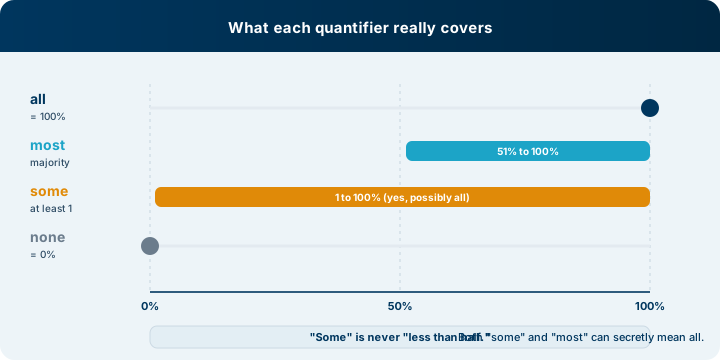
| Quantifier | Meaning | Range |
|---|---|---|
| all | 100% | 100 |
| most | more than half | 51 to 100 |
| some | at least one | 1 to 100 |
| some are not | at least one is not (“not all”) | 0 to 99 |
| most are not | more than half are not | 0 to 49 |
| none | zero | 0 |
Note that most and some both allow all as a possibility. “Most students passed” is true even if every student passed.
| Statement | Reverses to | Diagram |
|---|---|---|
some A are B | some B are A (valid) | A --some-- B |
no A are B | no B are A (valid) | A → ¬B |
most A are B | only some B are A | A --m--> B |
all A are B | no reverse inference by itself; with separate proof that A exists, some B are A | A → B |
Some and none reverse freely. Most and all do not. Reversing a “most” or “all” statement is a Mistaken Reversal. From “most A are B” you may not conclude “most B are A,” only “some B are A.” From “all A are B,” you may not conclude anything backward unless you also know at least one A exists.
One statement implies weaker versions of itself. The implications run one direction only.
all A are B plus proof that at least one A exists ⟹ most A are B ⟹ some A are B
no A are B ⟹ most A are not B ⟹ some A are not B
Upper rungs imply lower rungs once existence is established. Lower never imply upper. “All” gives you “most” and “some” only if the relevant group is known to exist; “some” gives you neither “most” nor “all.”
When two quantified statements share a term, you sometimes get a guaranteed overlap. Most pairs give you nothing. The table shows when an inference exists and what it is.
| Pair (sharing a term) | Inference? | Result |
|---|---|---|
| some + some | never | none |
| most + some | never | none |
| most + most (same shared group) | always | some B are C |
| some + all | sometimes | direction-dependent |
| most + all | sometimes | direction-dependent |
| all + all | always | A → C |
| none + anything | always | yields an inference |
B <--m-- A --m--> C gives B --some-- C: two majorities of the same set A must overlap. Two majorities pointing in line (one into A, one out) do not combine.A --some-- B plus B → C gives A --some-- C. If the “all” arrow points the wrong way, no inference.A --m--> B plus B → C gives A --m--> C. Against the arrow, it collapses to nothing useful.A → B → C gives A → C.A → B plus B → ¬C gives A → ¬C every time.This is the full system for combining quantified statements. We call it quantifier chaining. Think of each statement as a track and each shared term as a station. You travel from one endpoint to the other across the shared middle. Three rules govern every chain.
| Link type | Symbol | Travel direction |
|---|---|---|
| some | --some-- | either way (reversible) |
| none / double-not | → ¬ | either way (reversible) |
| all | → | follow the arrow only |
| most | --m--> | follow the arrow only (one-way) |
You may always ride a some link or a none link in either direction. You may ride an all or most link only in the direction it points. Going against a “most” arrow yields nothing better than the inherent “some” already inside it (a “most” contains a “some” pointing back).
A chain inference is only as strong as its weakest link. Rank strength: some (weakest) < most < all / none (strongest). The result takes the weakest link in the path.
most + all → the chain contains a “most,” so the output is at best most.some + all → the chain contains a “some,” so the output is some.all + all → both links are “all,” so the output is all (a clean →).To get an inference at all, you generally need at least one all or none link, because those are the only links restrictive enough to force an overlap. A path made of only “some” links (some + some) forces nothing. A path of “most + most” is the special exception: two majorities of the same set must collide, which is why most + most (arrows leading away) yields a “some.”
Track negation through the chain, but only the endpoints matter.
→ ¬) always injects relevant negativity into the result, because it negates the far endpoint as you cross it.So in A → B plus B → ¬C, the middle term B carries no negation outward, but the negation on the endpoint C survives: A → ¬C. Had the negation sat only on B in the middle of the chain, it would have washed out.
| First statement | Second statement | Inference? | Resulting statement |
|---|---|---|---|
| some + some | n/a | never | none |
| some + most | (either order) | never (generally) | none |
| most + most | both arrows lead away from shared middle | always | A --some-- C |
| some + all | all-arrow leads away from shared term | sometimes | A --some-- C |
| most + all | all-arrow leads away from shared term | sometimes | A --m--> C |
| all + all | arrows chain head-to-tail | always | A → C |
| none + anything | none-link crossable | always | result carries negativity, e.g. A → ¬C |
A --m--> B and B → C. Most-arrow then all-arrow, both leading away from the shared middle B. Weakest link is “most.” Inference: A --m--> C. (Most A are C.)
A --some-- B and B → ¬C. Some-link then none-link. Weakest link is “some.” Endpoint C is negated by the none-link. Inference: A --some-- ¬C. (Some A are not C.)
B <--m-- A --m--> C. Two most-arrows leading away from shared middle A. Two majorities of A must overlap. Inference: B --some-- C. (Some B are C.)
A --m--> B and C --m--> B. Two most-arrows pointing into the shared term B. The arrows do not lead away from the middle, so no inference. This is the trap version of case 3.
S → N. Contrapositive: reverse and negate, ¬N → ¬S.N → S and Mistaken Negation ¬S → ¬N are both invalid.A→(B and C) and (A or B)→C; do not split A→(B or C) or (A and B)→C.A→B+A→C does not give B→C. Conditionals describe the group, not individuals.