
Bone Cells
Bone looks like a dead, unchanging material, but it is one of the most metabolically active tissues in your body. Right now, roughly 10% of your skeleton is being torn apart and rebuilt. Three types of cells run this continuous renovation project, and knowing what each one does is absolutely critical for the MCAT.
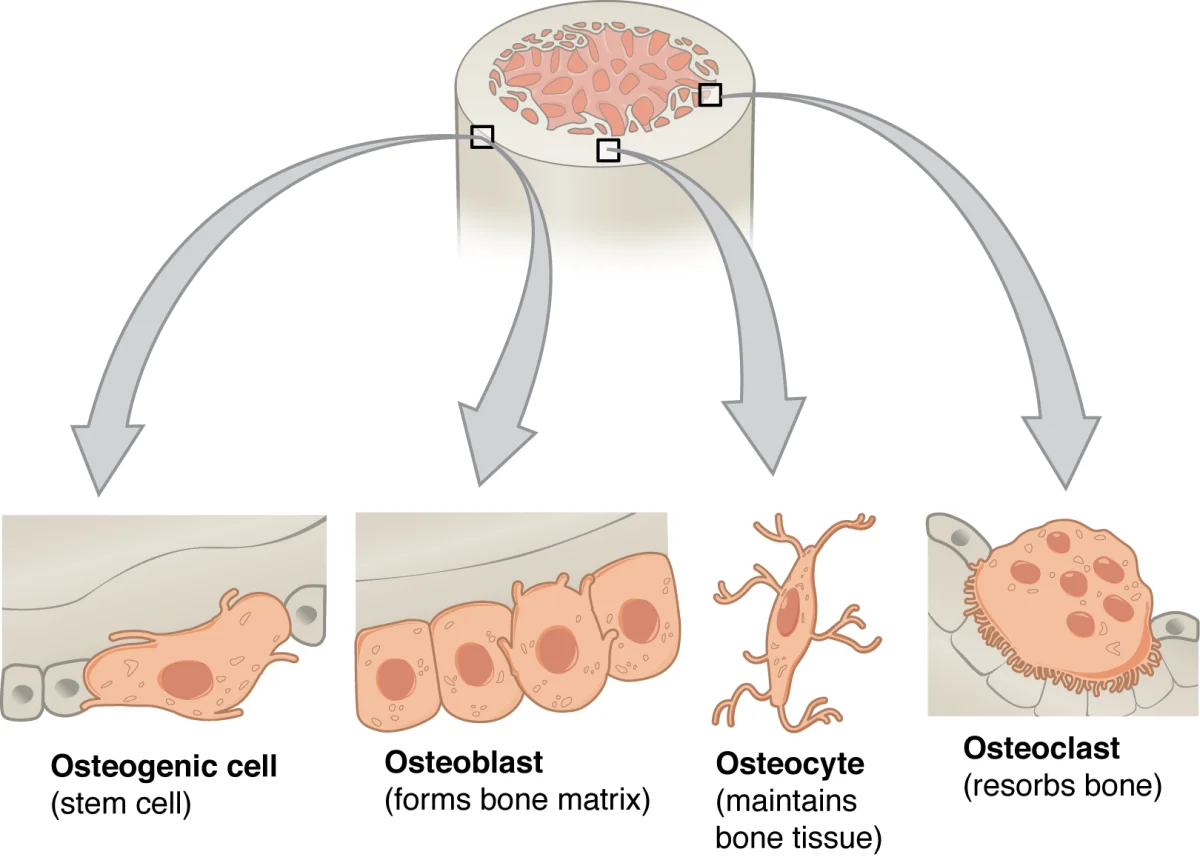
Osteoblasts - The Builders
Osteoblasts are the bone-forming cells. They synthesize and secrete the organic components of the bone matrix - primarily Type I collagen - in an unmineralized form called osteoid. Once the osteoid is laid down, osteoblasts promote its mineralization by depositing calcium and phosphate crystals (hydroxyapatite).
Key facts about osteoblasts:
- Derived from mesenchymal stem cells (the same lineage that produces fibroblasts, chondrocytes, and adipocytes)
- Found on the surfaces of bone (periosteum and endosteum)
- Once an osteoblast becomes completely surrounded by the matrix it secreted, it becomes trapped and differentiates into an osteocyte
- Regulated by parathyroid hormone (PTH), growth hormone, vitamin D, and mechanical stress
Osteoclasts - The Demolition Crew
Osteoclasts are large, multinucleated cells that break down (resorb) bone tissue. They are the demolition crew of the skeletal system.
Key facts about osteoclasts:
- Derived from monocyte/macrophage lineage (hematopoietic stem cells) - they are essentially fused macrophages
- Multinucleated (formed by fusion of multiple monocyte precursors)
- Attach to bone surface and create a sealed resorption pit
- Secrete hydrochloric acid (HCl) to dissolve the mineral component and lysosomal enzymes to digest the collagen
- The dissolved calcium and phosphate are released into the blood
- Stimulated by PTH (indirectly - PTH acts on osteoblasts, which then signal osteoclasts to become active)
- Inhibited by calcitonin (from thyroid C cells)
Osteocytes - The Maintenance Crew
Osteocytes are the most abundant bone cells (~90-95% of all bone cells). They are mature osteoblasts that have become embedded in the mineralized matrix.
Key facts about osteocytes:
- Live inside lacunae (small cavities in the bone matrix)
- Extend long cytoplasmic processes through canaliculi to communicate with neighboring osteocytes and cells on the bone surface
- Act as mechanosensors - they detect mechanical stress (like the impact of running) and signal osteoblasts to strengthen bone in areas under high stress
- Regulate bone remodeling by signaling both osteoblasts and osteoclasts
- Can release calcium from the surrounding matrix in response to hormonal signals
How Osteoblasts Control Osteoclasts
An important concept: osteoblasts regulate osteoclast activity. PTH does not directly activate osteoclasts. Instead, PTH binds to receptors on osteoblasts, which then send chemical signals that stimulate osteoclast precursors to mature and begin resorbing bone. So PTH raises blood calcium indirectly, through osteoblasts.
Hormonal Regulation of Bone Cells
The activity of bone cells is tightly regulated by hormones, and the MCAT expects you to know the major players:
| Hormone | Source | Effect on Bone |
|---|---|---|
| PTH | Parathyroid glands | Stimulates bone resorption (raises blood Ca²⁺) |
| Calcitonin | Thyroid C cells | Inhibits osteoclasts (lowers blood Ca²⁺) |
| Vitamin D (calcitriol) | Kidney (activated form) | Promotes Ca²⁺ absorption from gut; supports mineralization |
| Estrogen | Ovaries | Protects bone; inhibits osteoclast activity |
| Growth hormone | Anterior pituitary | Stimulates osteoblast activity and bone growth |