
Muscle Fiber Types
Not all skeletal muscle fibers are created equal. Your body contains a mix of fiber types optimized for different tasks - some are built for endurance, others for explosive power. The MCAT expects you to know the key differences and be able to predict which fiber type dominates in a given scenario.
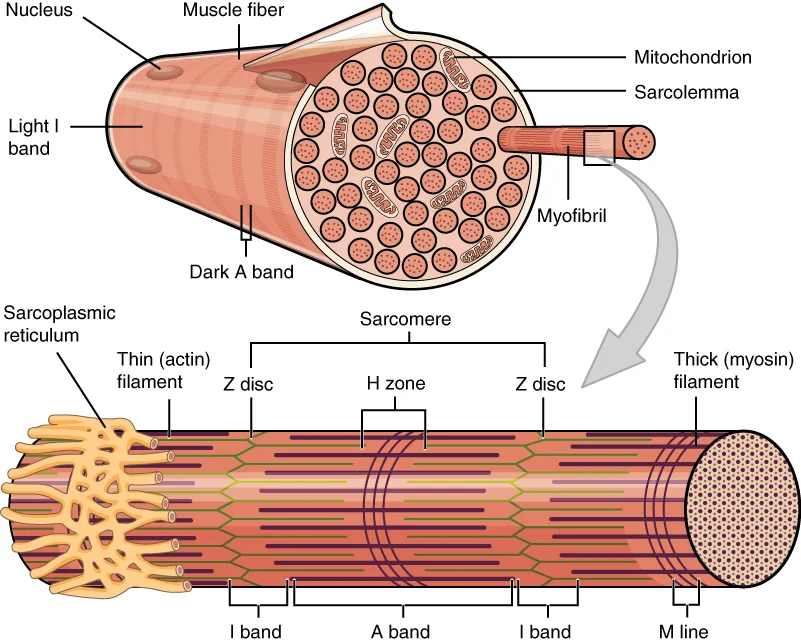
The Three Fiber Types
While the MCAT primarily focuses on Type I vs. Type II, there is actually a spectrum:
| Feature | Type I (Slow Oxidative) | Type IIa (Fast Oxidative-Glycolytic) | Type IIb/IIx (Fast Glycolytic) |
|---|---|---|---|
| Contraction speed | Slow | Fast | Fastest |
| Fatigue resistance | Very high | Moderate | Low (fatigues quickly) |
| Primary metabolism | Aerobic (oxidative phosphorylation) | Both aerobic and anaerobic | Anaerobic (glycolysis) |
| Mitochondria | Many | Many | Few |
| Myoglobin content | High (red fibers) | High | Low (white fibers) |
| Capillary density | High | High | Low |
| Glycogen stores | Moderate | High | High |
| Fiber diameter | Small | Intermediate | Large |
| Force production | Low | High | Very high |
| Motor unit size | Small (few fibers per neuron) | Intermediate | Large (many fibers per neuron) |
| Example activities | Posture, endurance running, cycling | Middle-distance running, swimming | Sprinting, weightlifting, jumping |
Why Are Type I Fibers Red?
The color difference between fiber types comes from myoglobin, an oxygen-binding protein found in muscle tissue (it is structurally similar to one subunit of hemoglobin). Type I fibers contain large amounts of myoglobin because they rely on aerobic metabolism and need a local oxygen reserve. Myoglobin:
- Stores oxygen within the muscle fiber
- Facilitates oxygen diffusion from capillaries to mitochondria
- Has a higher oxygen affinity than hemoglobin (its dissociation curve is shifted left), so it can “grab” oxygen from hemoglobin and hold it until the mitochondria need it
Type II fibers have less myoglobin because they rely primarily on anaerobic glycolysis, which does not require oxygen.
Energy Systems and Fiber Types
The fiber type determines which energy system dominates:
| Energy System | Speed | Duration | Fiber Type | Produces |
|---|---|---|---|---|
| Creatine phosphate | Immediate (fastest) | ~10 seconds | Type IIb/IIx | Regenerates ATP from ADP instantly |
| Anaerobic glycolysis | Fast | ~30-90 seconds | Type IIa/IIb | 2 ATP per glucose, produces lactate |
| Aerobic (oxidative phosphorylation) | Slow | Hours | Type I | ~30-32 ATP per glucose |
For the first ~10 seconds of intense activity, muscles use creatine phosphate to regenerate ATP almost instantly:
Creatine phosphate + ADP → Creatine + ATP (catalyzed by creatine kinase)
This is the fastest ATP source but is exhausted quickly. After that, glycolysis takes over for high-intensity work, and oxidative phosphorylation sustains low-to-moderate intensity activity.
Muscle Fatigue
Muscle fatigue is the decline in force production during sustained or repeated contractions. The causes depend on the fiber type and intensity:
Key causes of muscle fatigue include:
- Depletion of glycogen and creatine phosphate
- Accumulation of metabolic byproducts (inorganic phosphate, ADP)
- Decline in SR calcium release with repeated contractions
Oxygen Debt (Excess Post-Exercise Oxygen Consumption - EPOC)
After intense exercise, you continue breathing heavily even though you have stopped moving. This elevated oxygen consumption (called EPOC or “oxygen debt”) is used to:
- Replenish creatine phosphate stores
- Convert lactate back to glucose in the liver (Cori cycle)
- Replenish myoglobin oxygen stores
- Restore ATP levels
- Support elevated metabolic rate